 As this week is National Friendship Week, I thought I would use this topic to take a deeper look into autism and friendship, specifically some of the challenges many children and families experience. Of course, the first caveat is “if you know one child with autism, you know one child with autism.” Certainly, what I’m sharing does not apply to all, but hopefully I can offer some general considerations that you may find work for you.
Yes, some children with autism experience communication challenges and have trouble with social interactions. They may shy away from the simplest conversation, avoid eye contact, and appear to be “uninterested.” However, that does not mean that they don’t want to have friends. They may simply lack the social skills for developing friendships.
In reviewing a number of studies, results consistently show that compared to typically developing children, children with autism experienced significantly more loneliness than their typical peers, and that their quality of friendships was poorer, in terms of companionship, security, and help.
I know that in Ryan’s case, developing friendships was something that was important to me but not as important to him. He was most content in interacting with adults who were patient enough to take the time to listen to him and ask thoughtful questions. They were not bothered by his repetitions, nor by his desire to speak about his interests only. Looking back on his school years, I am hard-pressed to even identify one peer who was a friend, a sad commentary on his school career.
What can we do as parents and educators to meet this challenge?
- Be patient when the person speaks. It may take him/her longer to express a complete thought. Auditory processing difficulties are present in many children.
- Communicate clearly, in short sentences, with a reasonable pace and volume. If the child is non-verbal, use a picture or a communication board.
- Plan ahead by making play dates, if possible with typical peers.
 Investigate the Best Buddies program – bestbuddies.org. If there is not a chapter at your school, consider working with administration to start one. Ryan participated in ebuddies (ebuddies.org), and thoroughly engaged with his buddy via the computer.
- There are also numerous activities that you can do with your child to help improve his/her social skills: LINK. Ryan and I, during his preschool years, would have staring contests – Who could look at each other the longest without turning away?
During this National Friendship Week, think about the friendships that you and your child may have, and identify ways to strengthen them!
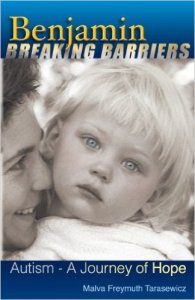 My book reads like a novel, and I share the nuts and bolts of what I came up with to help Benjamin. Since we’ve been on this journey for nearly two decades, there’s a lot to share! Many books focus on the crucial early years, but I continue on from there into the problems, ideas, and solutions that have carried Benjamin through elementary, middle, and high school issues.
 Although it may not always seem to be the case, scientists and researchers are constantly uncovering more information related to autism, offering insights into the origins, possible causes and even at times potential cures. I come across dozens of articles on a weekly basis, some of which seem more important than others. After the positive response I received when I posted Top Research Stories of2014, I thought I would start to share some of the current research articles that I read on a monthly basis. Below are three stories that caught my eye this month.
 The survey shows a nation in the midst of change. Overall, the survey reveals that the more than half of Americans who have personal contact with someone with intellectual disabilities are increasingly accepting and positive. It also exposes that lack of contact has left a legacy of misinformation, dated stereotypes, ignorance and fear in the other nearly half of Americans. When it comes to attitudes towards people with ID, experience is the game-changing ingredient. Despite gains in visibility, the estimated 3 to 9 million people with ID living in the United States remain isolated from the rest of society. Likely as a result of increased exposure and interaction, young adult Americans have more progressive attitudes toward, and expectations for, people with ID. Millennial women, ages 18-34, in general are the most compassionate, inclusive and progressive of any group surveyed.

 In researching cyber bullying and online abuse, I learned that there are actually several types of cyber bullying. They include online harassment, “outing,” (when a victim’s personal information is shared online without their consent), victim blaming, and “trolling,” (faking a social media profile to send hateful messages). I was shocked to read that this is occurring with such regularity.
 While the ADA has led to changes throughout society, perhaps the greatest area of impact is in the area of employment. With passage of the ADA, employers were required to give all qualified individuals equal opportunity in the workforce, regardless of any disability they may have.
 I can’t think about the passage of the ADA without recalling a remarkable woman who was seated in the audience. Dr. Gertrude A. Barber was a member of President Kennedy’s commission on Mental Retardation, involved in crafting and promoting the ADA, and, of course, known for her life’s work on behalf of creating opportunity for individuals with disabilities. In recognition of her efforts, Dr. Barber was invited to the White House to see this landmark legislation passed into law.