Celebrate World Kindness Day!

Instead of recognizing Friday the 13th this week, consider focusing on World Kindness Day instead! This day is a chance to focus on and celebrate the many benefits of practicing kindness. By creating a caring environment in our homes, our schools, and our communities, we give children the opportunity to establish positive relationships, make responsible decisions, and handle challenging situations effectively. kindness

Research shows that kindness does improve behavior and academic success. And did you know that kindness exponentially fosters more kindness? In a similar study, researchers have shown that a single act of generosity can influence dozens more; in other words, kindness is contagious.

If you are interested in working this idea into your lesson plan, or even just for an activity at home, take a look at some of the great resources available from The Random Acts of Kindness Foundation, which include lesson plans, activities, and other projects.

Share your plans to celebrate World Kindness Day within your family or classroom… and keep the kindness spreading!

Posted in Uncategorized | Leave a comment

National Career Development Month!

Each year, the National Career Development Association hosts National Career Development Month in November. During NCD Month, each state is encouraged to promote career related activities and events through the state divisions. The Ohio career Development Association (OCDA) invites you to celebrate with us this year! career-development

In October, the Barber National Institute celebrated the success of adults who have found community employment and have begun their careers.

Since January 2015, the Supported Employment Program at the Barber National Institute has helped 28 individuals get hired for jobs with employers in the community. The adults have been invited back to talk to others who are still training for jobs in the Transitional Work Service Program. Marycarmen Walker, the operations supervisor for Supported Employment, said:

We will welcome back these adults who all have worked very hard to achieve their dream of employment. It is a great opportunity to share their experiences in the community with all of us, and share any advice to their peers who still seek and wait for the day when they can announce “I got a job!”

The Supported Employment Program assists adults with physical and intellectual disabilities with everything from assessing their skills and interests to developing resumes and preparing for job interviews. Once employment has been found, job coaches assist with training and remain at the worksite until all duties are completed to the satisfaction of the employer.

This year, individuals found employment in the housekeeping, food service, and manufacturing fields.

The Supported Employment program at the Barber National Institute began in 1986. Since then, more than 700 adults with disabilities have been placed in jobs in the community.

Statistics released by the Department of Labor in September show that the unemployment rate for adults with disabilities is 12.3 percent, more than double that for people without disabilities.

At BNI, we celebrate all of our adults for working hard to develop their careers!BNI Logo

Posted in Uncategorized | Leave a comment

November is National Epilepsy Awareness Month!

Epilepsy is the 4th most common neurological disease after migraine, stroke, and Alzheimer’s disease, affecting about 2 million people in the United States. Characterized by recurrent and unprovoked seizures, epilepsy remains misunderstood and discriminated against by the general public, and underfunded in research initiatives.

It is estimated that as many as 1 in 3 individuals with autism spectrum disorder also have epilepsy. Experts propose that some of the brain abnormalities that are associated with autism may contribute to seizures. These abnormalities can cause changes in brain activity by disrupting neurons in the brain.epilepsy

Although epilepsy can occur at any age, the condition is more likely to begin among children less than 2 years of age and adults older than 65 years. As do many who live with other chronic disorders, those with epilepsy often face challenges related to managing epilepsy treatment, symptoms, disability, lifestyle limitations, emotional stress, and stigma.

There are numerous support and research groups on epilepsy. One of the most prominent is the CDC’s Managing Epilepsy Well (MEW) Network. MEW Network members, including representatives from U.S. universities, community-based organizations, and CDC are working together to develop and test self-management programs and tools that help people with epilepsy better manage their disorder and improve their quality of life.

Each community chooses to recognize Epilepsy Awareness Month differently. In Erie, we have Paint Erie Purple, #AJO project, and Noble Night, a fundraiser by our local non-profit The Epilepsy Project.

For more information on how you can get involved, visit these sites:

The Epilepsy Project: http://www.theepilepsyproject.org/

MEW Network: http://web1.sph.emory.edu/ManagingEpilepsyWell/

CDC: http://www.cdc.gov/epilepsy/index.html

Epilepsy Foundation of Eastern PA: http://www.efepa.org/get-involved/neam/

Posted in Uncategorized | Leave a comment

Happy Halloween!

As you’re getting ready for Halloween this Saturday, you’re probably thinking about how best to prepare your son or daughter for an event-filled evening. Thankfully, there are a lot of resources out there today. Much different than even 5 years ago! So I decided to share with you some of those resources, as well past Halloween blogs. I still enjoy looking at pictures of Ryan’s first Halloween as Superman, and his preschool rendition of the Tin Man from Wizard of Oz.

Today was our annual Halloween parade. 150 children dressed in elaborate costumes and paraded through our halls, all while we were experiencing a monsoon outdoors! You’ll enjoy seeing some of their pictures, I’m sure!

Halloween Collage

PS – Yes, Ryan’s favorite Halloween activity is the Haunted House. He went to 2 this year!

5 ways to help your special kid love Halloween as much as you do!: http://bit.ly/1PUTZzl

Top 10 Strategies “To Ensure Halloween is Healthy and Stress-Free for your Family” from Autism File Readers: http://bit.ly/1vIVQut

Blog Links:

2014

2013

2012

Posted in Uncategorized | Leave a comment

Guest Blogger: Rhonda Schember

In honor of National Down Syndrome Awareness month, I asked colleague and good friend Rhonda Schember if she would do me the honor of writing a blog. In her words:

“Rhonda and Joe Schember live in Erie and are the proud parents of Jaime, Joe and Jodi.  Rhonda is a semi-retired writer/volunteer and Joe is an executive at PNC Bank.  Jaime, 32, lives in San Francisco, CA and works for Google ATAP… Joe, 30, lives in Albany, NY and works for Mohawk Fine Papers…and Jodi, 30, lives at home and is the President and CEO of Club Jodi!”

I so appreciate Rhonda sharing her story with us, and I hope you enjoy it as well.

~ Maureen


The journey from childhood to adulthood is seldom simple…or straightforward. As each child matures, the “learning curve” changes.

But when a child is born with special needs, that learning curve doesn’t go away. Rather, it’s adapted to include changes through every stage of development. All children can learn – some just learn differently.
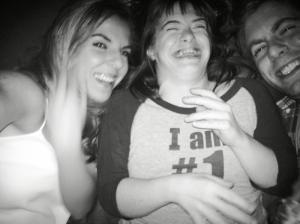
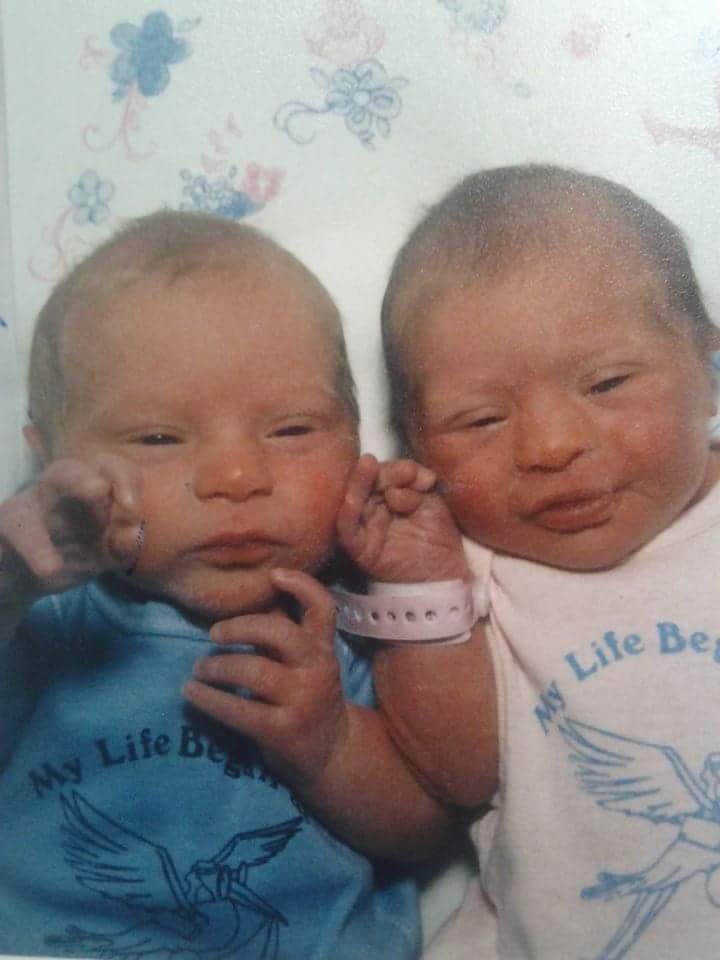
Schember Family (2)Luckily, when our daughter, Jodi, was born with Down syndrome, she arrived as part of a rare package deal. She had a twin brother, Joe. She also had a two-year old sister, Jaime, who immediately considered the twins HER babies.

Together, as a family, we embarked on a journey into unfamiliar territory. We had a lot to learn about Down syndrome – the sooner, the better!

Admittedly, with three children under three, we were in survival mode most of the time. But we experienced an important lesson during those early years. Simply put – we could do this.

Through the combined efforts of therapists and educators, physicians and caseworkers, Jodi made progress. But we never lost sight of the fact that she had a secret weapon at home. She had a twin brother…and an older sister.
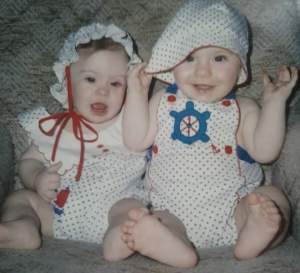
Schember Family (1)As one therapist pointed out, Joe would become Jodi’s best teacher. When Jodi couldn’t roll over or stand, Joe would do it first. If she took too long to copy him, Jaime would push her over or lift her up…and I would hold my breath!

Eventually, Jodi got the idea. There was always someone there for her to watch and imitate. She also had a cheer leader and coach just 2 years older.

Never was that more evident than when the kids were watching Sesame Street one morning. Jodi was still non-verbal at this point and the “word” of the day was not particularly easy. But Joe kept repeating it for her. When she didn’t reply, he jumped up, took her cheeks in his hands and firmly said, “Jodi say IDEA.” And she did…as clear as day…IDEA! No Mama or Dada, her first spoken word was IDEA!

Joe helps Jodi say her first word.

Joe helps Jodi say her first word.

Joe had stumbled into that teachable moment. I sat there in tears and Jaime jumped into Mommy mode – making them repeat it, over and over, until Daddy came home!

Despite the detours and challenges of parenthood, we discovered that those unexpected triumphs can ultimately direct a child’s path to success. They give us hope and determination, but it’s often the siblings who provide the inspiration.

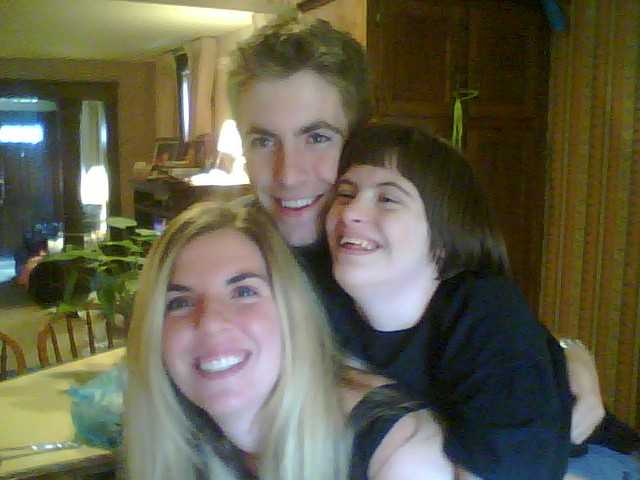
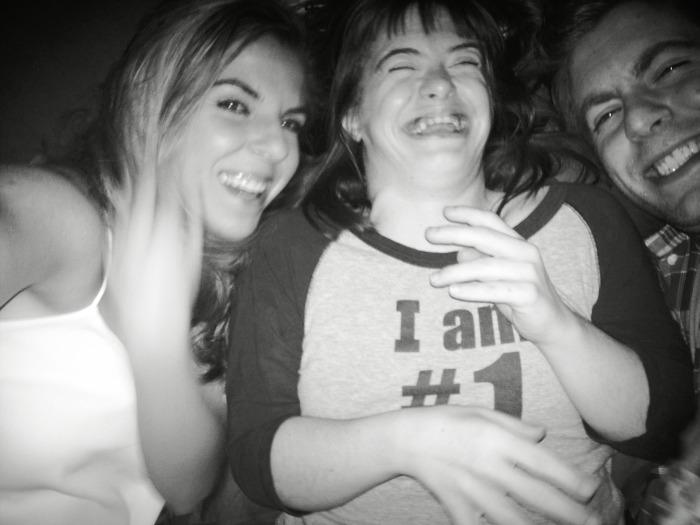
We’re reminded of that every day when Joe and Jaime call from opposite sides of the country to check in on their sister. After 30 years, the love they share is priceless…the bond, unbreakable…and the journey, far less frightening.

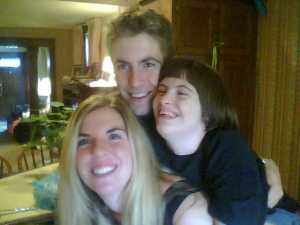
Schember Family (4)Schember Family (3)Schember Family (5)

Posted in Uncategorized | 6 Comments

Monthly Research Updates

researchScientists and researchers are constantly uncovering more information related to autism, offering insights into the origins, possible causes and even at times potential cures. I come across dozens of articles on a weekly basis, some of which seem more important than others. After the positive response I received when I posted Top Research Stories of2014, I thought I would share on a monthly basis stories that caught my eye.
~ Maureen


Apple Lends Hand to Autism Research

Apple is teaming up with autism researchers in an effort to assess whether the iPhone could be used to help identify young children who may be on the spectrum through an app called “Autism & Beyond.” The app includes a parent questionnaire as well as a series of short videos for the child to watch, which are designed to elicit various emotions. Using the iPhone’s camera function, analytical software within the app will assess the children’s facial responses. Researchers hope to collect information from children 1 to 6 years three times each over the course of six months.

Read the full article here.

Many Kids with Mental Health Issues See Only Pediatricians

Using data from a national survey, the researchers found that about 35% of children receiving mental health care in the past year had appointments only with their primary-care physicians, compared with about 26% who saw only psychiatrists and 15% who saw only psychologists or social workers.

Read the full article here.

Wide awake: Why children with autism struggle with sleep

Ruth O’Hara, associate professor of psychiatry and behavioral science at Stanford University in California, is leading a study to understand why so many children with autism have so much trouble sleeping. Sleep disturbance impacts cognition, mood, and behavior — domains that are also affected by autism. By improving sleep, symptoms in these areas may also improve.

Read the full article here.

Tune in next month for an update on autism research!

Posted in Uncategorized | Leave a comment

Physical Therapy Month

October is National Physical Therapy Month! As I considered possible blog topics, one of our physical therapists, Christina Gross, PT, MS, forwarded me an excellent article about the current research regarding physical activity and children with ASD. The article reviews recent evidence that suggests that childhood obesity is increasing among children with developmental disabilities, including ASD. pt month

Some key points include:

  • There are 3 potential factors contributing to obesity in children with disabilities:
    • Low physical activity – Children with disabilities are less likely to engage in and sustain in exercise, when compared to their typical peers. However, limited physical activity levels can also be attributed to their impairments in their communication, sensory, and behavioral domains.
    • Poor nutrition – Children with ASD demonstrated a more limited food repertoire and may have oral, olfactory, and gustatory hyper-sensitivity, leading to aversions of foods of certain textures and smells.
    • Medication use – Some psychoactive drugs, including anti-psychotics, anti-depressants, anti-anxiety drugs, and stimulants, often lead to weight gain.
  • Children and adolescents with ASD may not understand long-term risks associated with obesity. Their parents, often burdened by the challenges of autism, may neglect physical activity and nutrition.

For a more in-depth analysis of their findings, read the full research article here.

Health, wellness, and a fitness regime are essential components of all children’s lifestyles. Physical therapists are integral members of the team when developing these programs for children with disabilities. We are so lucky to have our physical therapy staff:

Chris Gross, P.T., M.S.

Vincent Massella, P.T.A.

Marsha Nevinsky, P.T., B.S.

Thank you all!!

Posted in Uncategorized | Leave a comment

Make it Orange and Make it End!

unity day logoNext Wednesday is Unity Day, a chance for schools and communities around the country to come together to take a stand against bullying. I have shared some startling statistics on bullying in the past (see: cyberbullying and unite against bullying), but unfortunately bullying continues to be an issue, in schools and online. Bullying does not target only certain types of people – on the contrary, bullying can affect both men and women of all difference races, nationalities, shapes or sizes.

Recently, Senator Bob Casey wrote:

According to the Department of Education, nearly one in three students between ages 12 – 18 are affected by bullying and harassment. Studies show that the effects of bullying have long-term consequences, including decreased concentration in the classroom, increased absenteeism and lower student achievement. While the federal government supports states and school districts in promoting school safety, there is no current federal policy that comprehensively and explicitly addresses issues of bullying and harassment.

During floor consideration of the Every Child Achieves Act in July, Senator Al Franken introduced the Student Non-Discrimination Act as an amendment. The amendment sought to protect students from discrimination and harassment on the basis of actual or perceived gender identity and to provide protections for LGBT students similar to those that already exist regarding discrimination based on race, religion, and gender. Unfortunately, the amendment did not receive the 60 votes necessary for passage.

Introduced on January 29, 2015, the Safe Schools Improvement Act would require schools and districts receiving designated federal funds to adopt codes of conduct specifically prohibiting bullying and harassment, including conduct based on a student’s actual or perceived race, color, national origin, sex, disability, sexual orientation, gender identity or religion. The Safe Schools Improvement Act would also ensure that schools and districts implement programs to prevent and respond to incidents of bullying and harassment.

It is encouraging to know that our government is working to address this issue, but it doesn’t have to end there. Unity Day represents something important – a chance for people to stand up and work together as a community to bring an end to the cruelty and harm of bullying.

At ELBS, our high school students will recognize this day by taking part in various activities that illustrate how to identify when a person is being bullied, peace makers and peace breakers, and positive things to say to a friend. We will also be encouraging students and staff to wear orange in honor of Unity Day.

For more information, visit the National Bullying Prevention Month website here, and consider signing up to take part in Unity Day in your community as well!

Posted in Uncategorized | Leave a comment

October is National Down Syndrome Awareness Month!

Oct

As October is National Down Syndrome Awareness month, I thought it would be the perfect time to share some of the many resources available to our communities. Take a look and share – together we expand awareness and understanding!

Each of these groups has a plethora of resources, events, and other information about how to get involved and stay informed. Anything I’ve missed? Please feel free to share below!

Posted in Uncategorized | Leave a comment

World Mental Health Day – This Saturday!

This Saturday, October 10th, we will be observing World Mental Health Day, with the theme of “Dignity in Mental Health.” The World Health Organization is be raising awareness of what can be done to ensure that people with mental health conditions can continue to live with dignity, through human rights oriented policy and law, training of health professionals, respect for informed consent to treatment, inclusion in decision-making processes, and public information campaigns.

world-mental-health-day-300x300The BNI Elizabeth Lee Black School began serving children with mental health challenges and intellectual disabilities in the early 90s. We had identified the need for expanded psychiatric services as well as the addition of a mental health component in some of our classrooms. We applied and were approved for a license to serve 20 school-aged children with dual diagnoses of an intellectual disability as well as a mental health disorder.

This is a challenging population to serve, especially in the areas of coping skills and social skills. These students are often the most behaviorally and emotionally challenged, and have not succeeded in their home school district as a result.

Students enrolled in our Approved Private School participate in our Mental Health Partial Hospitalization program if their Individualized Education Plan indicates this level of need. In addition to their classroom program, the children receive psychiatric services, intensive ABA behavior support, and an extensive physical health and fitness program.

Over the years, the BNI has expanded services in the area of behavioral health for both children and adults. Some of the other services include:

  • Blended Case Management – help to access resources in the community
  • Behavioral Health Rehabilitation Services (BHRS) – change problem behaviors in the home, school & community
  • Family Based & Structural Family Therapies – work to stabilize family environment and improve family communication and structure
  • Childhood Trauma – treat behavioral problems relating to traumatic events, grief and loss
  • Connections Camp – summer program for children/teens with high-functioning autism
  • Social Skills Training – strategies for building social communication skills

BBHI_Logo

To meet the ever-increasing need for mental and behavioral health services, the BNI is planning to open an outpatient clinic, Barber Behavioral Health Institute, in the Spring of 2016. We are excited for this venture, and hope that it will meet the needs for so many more in our community.

Posted in Uncategorized | Leave a comment