Ready, Set, Ride!

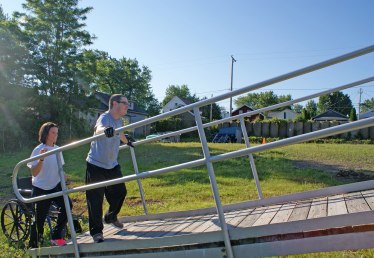
IMG_1414Summer is the season of bike rides! Riding a bike is one of the summertime joys of living in Erie.  We have more than our fair share of great paths and trails around Lake Erie and the northeast region. Riding a bike is a lot of fun and a great exercise for children.  Learning to ride a two-wheeled bicycle without training wheels is also an important milestone for children. To help children develop independent bike riding skills, the Barber National Institute is holding a four-week learn-to-bike program called “Ready, Set, Ride!”

The program is ideal for youngsters and young adults with special needs including autism, Down syndrome, mild cerebral palsy, sensory challenges, or developmental delays.
The “Ready, Set, Ride” program can also assist children having difficulty transitioning to riding without training wheels.

“Ready, Set, Ride!” will be held on Saturday, June 8, 15, 22 and 29 with sessions at 9 a.m. and 10:15 a.m. Continue reading

Posted in Uncategorized | Tagged , , , , , , , , , | Leave a comment

Anxieties

child with anxietyDo you have a child who struggles with anxiety?

Many of us have anxieties.

For some it is flying in an airplane. For others, it is heights (that’s me), public speaking, or doing “new” things.

Many children with autism spectrum disorders experience anxiety.

For Ryan, anxiety is brought on by experiences in group settings where he worries about not doing well, and meeting with lots of people. These situations remind him too much of school where he saw himself as being unsuccessful. He becomes very nervous, he talks very fast, and I can tell that he is becoming agitated.

A recent report from the Centers for Disease Control and Prevention found that 1.8 million children 18 and younger currently have anxiety disorders, and as many as 10% of all children suffer from phobias. Unlike the usual fears of growing up, anxiety disorders don’t simply go away, but must be treated.

Some children are treated by seeing a counselor who uses cognitive behavioral approaches to help them manage their anxiety by teaching coping strategies.

Ryan will utilize deep breathing, counting backwards to himself and/or picturing a scene that he finds very calming.

Researchers at the Mayo Clinic and other organizations are finding that slowly exposing children to the things that are most anxiety provoking can, in a short period of time, eliminate anxiety.

I’d encourage you to read “Exposure Therapy.”

There is even an app, the Anxiety Coach, developed by Dr. Whiteside of the Mayo Clinic, to help you manage your anxiety symptoms.

Ryan and I are going to give it a try!

Posted in Uncategorized | Tagged , , , , | Leave a comment

Coming Soon! Katie Couric Talking Autism on Twitter

katie couricTechnology has drastically changed the conversation of autism, hasn’t it?  Social media outlets such as blogs, Facebook and Twitter provide and instant connection and communication within the vast ASD community.  I must admit, I’m still learning how to keep up with social media explosion.  Even as I write the blog today, I’m watching my twitter feed and am amazed at how quickly the tweets appear.  What a powerful, rapid source of communication!

I also feel encouraged by the avenue that social media provides the ASD community. Twitter is an amazing pathway for all individuals (physicians, parents, community leaders, advocacy groups, legislators and celebrities) to Continue reading

Posted in Uncategorized | Tagged , , , , , , , | Leave a comment

DSM 5: What’s the Big Deal?

dsm5 2013It’s May 2013 and my copy of the DSM 5 is arriving this week. I remember the feeling of apprehension begin to circulate in conversations regarding the proposed revision to Autistic Disorder.  Questions swirled: “How would the change impact children currently diagnosed?” “Would the change of the eligibility criteria result in less children being diagnosed and receiving treatment?”  Parents and professionals questioned the modification of the diagnosis and I too felt concerned.  60% of the Elizabeth Lee Black School students and the majority of children enrolled in behavioral health services have a diagnosis of autism.

So, what’s the big deal?  Life has taught me that a feeling of uneasiness often accompanies change.  However, it is important to me to help parents and professionals (and myself) grasp clarity of the revision.  After reviewing literature and keeping abreast of updates from reliable sources such as the American Psychiatric Association (APA) and Autism Speaks, here’s my understanding…

Children and adults with a current diagnosis of autism will maintain the diagnosis. This is important to keep in mind because the diagnosis determines eligibility for treatment.  If your child is currently diagnosed and receiving services, then this should continue. Continue reading

Posted in Uncategorized | Tagged , , , , , , , , | Leave a comment

Meet two of our Go-To Sources for Speech-Language Pathology

Image

Stephanie Rose-Briggs, SLP

Communication difficulties affect the most vulnerable in our society – children and adults with disabilities.  And, without communication, we are separated from people ultimately missing life’s most vital element: the human connection.

May is designated as Better Hearing and Speech Month. For over 75 years this is the time to raise awareness and understanding of the various forms of communication challenges including hearing, speech, language and voice.

This is why I felt it so important to interview Speech-Language Pathologists from the school at the Barber National Institute.  As I reflect on their statements, I am reminded of the importance of their role with our children.

Stephanie Rose-Briggs, M.A.

Speech-Language Pathologist   

Stephanie attended SUNY in Plattsburgh, New York for her bachelor’s degree and Edinboro University of PA for a master’s degree in Speech-Language Pathology. 

Erik Undzius, M.A.

Speech-Language Pathologist

Erik earned his Master of Arts in Speech-Language Pathology and teaching certifications from Edinboro University.

Stephanie explained that upon completion of graduate studies, Speech-language Pathologists must complete an additional year of training as a Clinical Fellow in a work setting.  Following the completion of the fellowship year, candidates can then apply for their Certificate of Clinical Competence through the American Speech-Language-Hearing Association.  Having this certificate allows them to work in both clinical and school environments.

 Why did you choose your profession?

EU: I chose speech-language pathology as a career due to having been involved in many different aspects of special education my whole life. My parents were both school psychologists and my mother eventually became a high school guidance counselor and I really enjoyed the kids she interacted with on a daily basis and the positive changes my mother made to their lives in general. I felt as though I would like to contribute to a profession that helps, nurtures and promotes growth as well as being an advocate for children and individuals with disabilities.

SRB: I sometimes think the profession chose me!  I knew from about the age of 13 years that this was the career I wanted.  My mother was fluent in Latin and French.  She loved the rhythm, music and creativity of language and I think her love of all things written and spoken rubbed off on our family. And, by the way, I have never changed my mind about the choice of career.  I continue to think it is an exciting and challenging field with new things to learn all the time! Continue reading

Posted in Uncategorized | Leave a comment

Inside the World of a Communication: The Human Connection

Ryan at 2 with Dr. Barber & mom

Ryan at 2 with Dr. Barber & mom

Helen Keller once noted that of all of her impairments, she was perhaps troubled most by her lack of speech and hearing.  She elaborated that while blindness separated her from things, her lack of speech and hearing separated her from people; the human connection of communication.

I know from experience how “tricky” communication with a child can be. Ryan was about a year old when I noticed language delays.  Like any parent, I kept track of the number of words he spoke and his ability to respond to my questions.  He met all the suggested guidelines for language development at that age, but I still had concerns. I spoke to one of our speech pathologists, Kathleen Vogt, and she suggested a biweekly play group. Ryan worked on his expressive and receptive skills with other children, in a play setting under the direction of a speech pathologist. This was the start of our communication journey.

Ryan is now 19 years old. He voices his opinion, as all teenagers do, with gusto! In fact, sometimes while we’re riding in the car and he’s talking up a storm, I’ll suggest that we listen to the silence of the moment. Who knew 18 years later…

This May, as part of Better Hearing and Speech Month, the American Speech-Language-Hearing Association continues its public education efforts around the communication health of children by providing education for parents, raising awareness, as well as identifying and preventing speech and language delays.

Ryan at 19 (green sweatshirt) running in the 2013 Mother’s Day 5k.

Ryan at 19 (green sweatshirt) running in the 2013 Mother’s Day 5k.

All children with language difficulties can learn to connect. Professionals, such as speech pathologists and audiologists, teach children strategies to cope with communication challenges, and if needed, provide them with the appropriate technology.

To me, communication is more than verbal output – it’s about relating to others. I’m grateful for Kathy and all of the professionals who supported Ryan and who work daily with children.

Tune in Thursday to meet some professionals working in the field of speech pathology at our school. How do they help a child connect to others with communication?

Posted in Uncategorized | Tagged , , , | 1 Comment

Why every woman is celebrated on Mother’s Day

Maureen and Ryan2Mother’s Day celebrates moms, but I believe that it’s a day we can celebrate the women in our lives.

She may be your aunt, sister, friend, mentor, guardian or co-worker.

She may be a fabulous woman that you admire or respect.

She may be a wonderful woman who inspires you, teaches you, or has nursed your wounds (physical and emotional). Continue reading

Posted in Uncategorized | Leave a comment

Technology & Early Childhood Education: Why does it matter?

SONY DSCGoogle Executive Chairman Eric Schmidt recently wrote that “for every person online, there are two who are not” and that his goal is to have the whole world online by 2020. It’s an ambitious goal in the right direction. Technology allows us to explore the world, create, communicate, and discover. We acquire the technical skill sets that allow us to be the engineers, physicians, nurses and electricians of tomorrow. We expand our opportunities and unlock unlimited potential. Continue reading

Posted in Uncategorized | 2 Comments

If You Could do One Thing to Make a Difference in the Life of a Child, Make it this One

TRR_9135

The one thing that makes a difference in the life of a child born into poverty is the opportunity to succeed. How do you provide a child with this opportunity? Through quality early childhood programs.

Too many families lack the financial resources to afford preschool.  These children reach kindergarten knowing 600 fewer words than children the same age from families with higher incomes.  By second grade, the gap widens to approximately 4,000 words.

Did you know that math skills measured at kindergarten are the strongest predictor of later school achievement?  The cognitive skills used in mastering math are the same skills necessary for the child to do well in school.  This is why quality early childhood programs should not be an option but a mandate.  Every child, regardless of the family situation, deserves a chance to be successful.

PNC is doing one thing: Through the Grow Up Great Initiative they are creating opportunities for children to achieve their fullest potential. To date, they have reached 1.75 million children and 108,000 teachers.

I look forward to hearing about PNC Grow Up Great new program developments, federal and state advocacy activities, the Sesame workshop collaboration and how they are enhancing their digital outreach.  The digital outreach is very intriguing to me, especially in this era of the “new digital divide.”

I’ll be traveling on Thursday. However, I look forward to sharing what I learn and my thoughts on the “new digital divide” and its impact on our children and adults with disabilities next week. Stay tuned!

Read Erie Times Article – Marlene Mosco explains why PNC invests in early childhood learning

Posted in Uncategorized | Tagged , , , , , | Leave a comment

Thankful for the Autism Journey

ImageI feel a sense of gratitude as I reflect on how far we’ve come since the early 90s on this journey called autism.  To all who work to keep autism on the forefront, thank you.  Parents, teachers, physicians, researchers and advocates all played, and continue to play, an integral role in these advancements. 

  • To the families and caregivers of children living with autism, I appreciate your dedication in facing your challenges daily. 
  • To professionals working with our children, I acknowledge your commitment to helping our each of our children be their very best.
  • To our legislators and advocacy organizations, I commend your efforts leading the charge to secure additional funding to allow expansion of services as the number of children and adults with autism dramatically increases.

As I said in Tuesday’s post, the journey continues.  My path has been filled with twists and turns, a few bumps, some hills, and smooth sailing every so often.  I feel thankful for all I’ve learned professionally and through Ryan.  As April draws to a close, it would feel fabulous to keep autism awareness on the forefront all year long as we travel the road to solving the puzzle of autism. 

Posted in Uncategorized | Tagged , , , | 2 Comments