

L-R: Emily Pinto Taylor and Josh Taylor in Peru
Guest Blogger: Emily Pinto Taylor
It feels utterly fitting that I write something for this blog, which I’ve read for years and the topic of which is near and dear to my heart. Autism Spectrum Disorders have for me (as they do for so many others) a special meaning – I grew up around kids with disabilities at the Barber National Institute (then the Dr. Gertrude A. Barber Center), where we would visit after school a few times a week, getting grilled cheese sandwiches and fries from our friends in the café and eating hard candies out of my Aunt Gertrude’s candy dish. Between that and my cousin, Ryan, who has Autism, I am lucky enough to have been blessed to know people with disabilities and to have them change the way I see the world in a powerful way.
I’m in medical school now (about to graduate!) and I was lucky enough to spend a  month in July working in a rural hospital and clinic in the middle of the Amazon rainforest in northwestern Peru. While I was there, I had an interaction with a young mother of a child with a disability, which reminded me (as I have seen over and over again) how incredibly strong the love of a mother is for her child.
One day, half-way through the month, I sat with this woman, whose 8 month old son has Down’s Syndrome, and talked about her life. About her hopes for her child, about her experiences after having him, about the baby’s dad, who left her when he saw him, stating, “that is not my son.” About her life now, how she lives with her parents and can’t work because she spends the day taking care of her small baby and isn’t supported. And about her future, as she’s only 18, but with a positive family history for Down’s, her likelihood of having another of her future children have the disease is much higher than the general population.

Santa Clotilde, Peru
We talked about what that is like for her, whether she understands the significance of that fact and what she imagines life will be like for her son in the future. We talked about whether she understands the risk that she runs, having future kids, but along the underside of the conversation ran the social convention there, which dictates that most people have 4-8 kids; very few people have I met with fewer. I wanted to speak hope to her, to speak hope over her life and his future with such a genuine passion that at a few points during the conversation, I lost my words. It was like those moments in surgery when you find out the tumor is cancerous or you deliver alive the tiny preemie and watch them move, where you have this mask that covers your face and hat that covers your forehead and all you’re left with are these transparent plastic glasses over your eyes, and your eyes have to communicate everything — all of your fear about this tumor, all of the promise for this squirming baby, all of your hope and love and kindness… all of it. And you raise your eyebrows a little, crinkle your eyes at the corners when you smile, and you hope they can tell, and it’s enough.
Nothing I did that day was enough, but I hope that it came across regardless. I hope that from my bumbling attempts to tell her about my wonderful friends with Down’s syndrome, who are living awesome, successful, happy lives, that she was given a small glimpse of the hope that her son’s life will have. How happy he will be.
She kept saying, “I love my baby, though.” What made me saddest is that she had to keep saying it, as if I’d invalidate it. As if I’d ever want to take that away.
If only we all had that. Had a mom like these mothers, who sleep in the hospital cribs with their kids with piomiositis or pneumonia for the 3 or 10 days they’re hospitalized, sometimes with their two other small kids beside them, the whole family curled up together in a ball in a 3’x6’ space, 4’ off the ground with 2’ of metal bars around the top. The endurance of these mothers is something I will never understand, and it makes me pause before ever assuming anything about them—sometimes they can’t stay to give their child with a raging cellulitis or asthma attack IV antibiotics or treatment. They can’t stay not because they don’t want to save their child, but because when you ask, they live 7 hours away and their other kids are staying in the house alone right now until they get back. And they have to get back.

Santa Clotilde, Peru
Going back to the States, my impression of mothers there will forever change the way I look at them in the hospital here. I know there is evil in the world, and there are mothers who do not treat their children with kindness and love, who are not the 100% reliable people that we often glorify mothers to be. But I know that I will forever assume the opposite, that a mother (and, for that matter, a parent) wants to do what’s best for their child, and might not know how or have the resources or understand my advice, that they might not be able to stay for IV antibiotics because of their 5 other children living 4 hours away and currently home alone waiting for them, but that they want to. I will always assume that they want to do what is best for their child. And I will tell them that, and often, because I think one of the most validating things for a parent is hearing what a terrific job they are doing. How much more so this is true for a parent of a child with special needs! And how much stronger they are than I (or any of us) ever imagine.
If you’d like to learn more about some of the incredible opportunities for children with Down’s Syndrome in the US, check out some of the links on the previous post!
BIO: Emily Pinto Taylor is a full-time chocolate chip cookie baker and half-marathon runner and part-time medical student (and soon-to-be doctor!) at Loyola University Chicago, Stritch School of Medicine. She is a graduate of Collegiate Academy, Emory University and plans a career working in Med-Peds palliative care. She is one of Ryan’s most enthusiastic supporters and is always on the hunt for a way to use up those last few summer peaches.
 Online gaming is not only a great resource for social skills, but also a leisure skill our children can enjoy with their typical peers. Many children are enthralled with Minecraft, the game that consists of building a world block by block (Lego style). However, I worry about issues such as bullying, aggressiveness and inappropriate language. So I was excited to learn about Autcraft, a by invitation only server created by a dad of a son with autism.
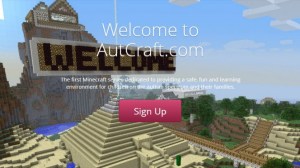 PC version of Minecraft for $26. Then you request an invitation from the Autcraft server. The wait time is approximately one week. Once you start you will be given a welcome kit consisting of an ender chest, 3 diamonds, a set of tools, and some food. They do not spawn special items or extras in for players and encourage them to adventure out to find items. If your child is scared of monsters, they currently have 3 different worlds: Peaceful, Hard and Resources World. The Peaceful and Resource worlds are best for those not comfortable with “monsters.” Hard world will test a player’s ability to keep themselves and their homes safe from mobs that can create explosions, shoot arrows, sword fight, poison and punch. All worlds are set to “normal/survival” and players can die from falling, drowning, starvation, or by lava in all; however, none of the worlds or mini-games allows pvp (player v player) fighting.
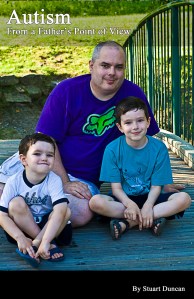 A unique component of Autcraft is their administrators. The founder and owner, Stuart Duncan, username AutismFather, has a son with autism. He is also the creator of
 Did you know that
 Today we mourn the loss of a celebrated artist, comedian, and actor. I first got to know Robin Williams through Mork & Mindy, a TV show that had you laughing nonstop for 30 minutes. I enjoyed the show so much that he became one of my favorite actors and I never missed any of his movies.
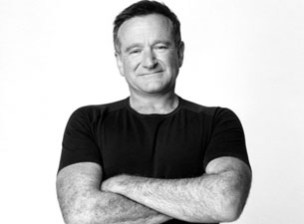 We as a society need to step up and educate ourselves on this serious issue. It is only then that we can support, encourage and advocate on behalf of children and adults with depression and other mental health conditions.
 Did you know that you can make a difference in the lives of children with ASD and other developmental disabilities? It’s as easy as writing or sending an email to your local or state representative, senator and asking for their support for funding or legislation that will ensure a better life for the person with the disability…and it only takes 5 minutes.
 medical, transportation, education and other expenses. The bill has been drafted to ensure the savings accounts would supplement, not replace, benefits provided through private insurance, Medicaid, salaried employment, and other sources. To address cost concerns, the scope of the bill was significantly narrowed from the legislation that was introduced in 2013. Among the changes are a cap on contributions at $14,000 a year, requiring that individuals open accounts in their home state or with a state which contracts with their home state, limiting individuals to only one ABLE account, and limiting the availability of ABLE accounts to people who acquire the disability before age 26.
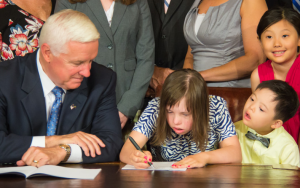
 Another exciting example of the impact of advocacy efforts is the passage of the



 regional and national diversity and inclusion nonprofit organizations.


