Robin Williams – A Legendary Actor


Robin Williams-7Today we mourn the loss of a celebrated artist, comedian, and actor.  I first got to know Robin Williams through Mork & Mindy, a TV show that had you laughing nonstop for 30 minutes.  I enjoyed the show so much that he became one of my favorite actors and I never missed any of his movies.

Unfortunately, Robin Williams struggled with depression, a diagnosable mental disorder, which is prevalent in the U.S. and worldwide.  Some of the signs and symptoms include:

  • Feelings of hopelessness and helplessness
  • Loss of interest in daily activities
  • Anger and irritability
  • Loss of energy
  • Sleep pattern changes

A serious symptom of depression is suicide.  It’s the third leading cause of death among children and young adults ages 10 – 24.  Men take their lives nearly four times the rate of women, accounting for 79% of suicides in the U.S.  Over 90% of people who die by suicide have clinical depression or another diagnosable disorder.  If you think a friend or family member is considering suicide, express your concern and seek professional help immediately.  Also, get support from family and friends, even if your friend asks you not to.  It’s too serious to keep secret and you can’t keep your friend safe all on your own.

Sadly, there is still a stigma attached to depression and mental illness.  Many associate it, however wrongly, as a sign of weakness and don’t seek help.  Eighty percent of people that have symptoms of clinical depression are not receiving any specific treatment for their depression.  In fact, for every 33 children in school, one child will have clinical depression.

Robin WilliamsWe as a society need to step up and educate ourselves on this serious issue.  It is only then that we can support, encourage and advocate on behalf of children and adults with depression and other mental health conditions.

If you or someone you know needs help please visit or call:

1-800-273-TALK (8255) | deaf hotline: 1-800-799-4889
Mental Health America
National Alliance on Mental Illness
MIND

I agree wholeheartedly with Matt Damon, when he said Robin Williams “… was put on Earth to make people happy.”

Posted in Uncategorized | Tagged , , , , , , , , | 1 Comment

Are You Ready To Make A Difference?

Catchafire_CoverDid you know that you can make a difference in the lives of children with ASD and other developmental disabilities?  It’s as easy as writing or sending an email to your local or state representative, senator and asking for their support for funding or legislation that will ensure a better life for the person with the disability…and it only takes 5 minutes.

A good example of how you can make a difference is seen in ABLE (Achieving a Better Life Experience) Act, which was recently approved by the House Ways and Means Committee and has moved on to the Senate.  The ABLE Act would amend Section 529 of the Internal Revenue Service Code to allow tax-free savings accounts for individuals with disabilities that would not count toward the $2,000 individual asset limits that apply to the Supplemental Security Income (SSI) and Medicaid programs. Such accounts are now permitted for college savings.

The accounts could be used to cover housing,images medical, transportation, education and other expenses. The bill has been drafted to ensure the savings accounts would supplement, not replace, benefits provided through private insurance, Medicaid, salaried employment, and other sources.  To address cost concerns, the scope of the bill was significantly narrowed from the legislation that was introduced in 2013.  Among the changes are a cap on contributions at $14,000 a year, requiring that individuals open accounts in their home state or with a state which contracts with their home state, limiting individuals to only one ABLE account, and limiting the availability of ABLE accounts to people who acquire the disability before age 26.

Surprisingly, ABLE was first introduced in Congress in 2006.  Although it has taken this long to finally reach the Senate it was the persistence and perseverance of advocacy groups, parents and educators who continued to rally representatives to this cause.

photo2Another exciting example of the impact of advocacy efforts is the passage of the Autism CARES Act by the Senate.  The bill sponsored by Senators Robert Menendez (D-NJ) and Mike Enzi (R-WY) and Representatives Chris Smith (R-NJ) and Mike Doyle (D-PA) reauthorizes the Combating Autism Reauthorization Act of 2011 for an additional five years.  Since its original enactment in 2006, the law has advanced the science and practice in the autism field by increasing the number, scope, pace, and coordination of research, surveillance, public awareness, and professional training efforts.   The new measure will continue these efforts and includes a number of welcome changes: a name change that uses more respectful language, a designated ASD position in the Department of Health and Human Services to oversee the law’s implementation, increased representation of self-advocates and family members on the Interagency Autism Coordinating Committee (IACC), and requiring a report on the needs of transitioning youth.

So, how do you get the attention of your legislator?  I have included some resources to get you started.

As there are further developments with legislation I will continue to give you updates.

Posted in Uncategorized | Tagged , , , , , , , , , , , , , , | Leave a comment

6 Tips to Make a Smooth Transition from Summer To School

Ryan on his first day of kindergarten at Grandview Elementary.

Ryan on his first day of kindergarten at Grandview Elementary.

The lazy, hazy days of summer are soon coming to an end for our children.  Playing outdoors until dark, daylong trips to the beach, amusement rides at Waldameer Park will soon be memories.  These casual days with few demands will no longer happen once school begins.

For us at ELBS, our students’ first day of school is August 25th.  To help with the transition from summer to school, I’d encourage parents to begin exposing their sons and daughters to some of the elements of the school routine right now.

Some suggestions include:

  • Slowly begin to return to your traditional bedtime and morning routines even if it’s simply going to bed and waking up 30 minutes earlier.
  • Consider the type of demands that will be placed on your child the first week of school.  Would it be helpful if your child spent 30 minutes each day sitting at a table and working on a project?
  • If you child is going into a new environment, write a social story as a way to introduce a new building, classroom or teacher.
  • Schedule a meeting with your child’s teachers and support staff.  Give them and your child the opportunity to get acquainted.  It is helpful to provide a handout describing what teaching methods and behavioral strategies work the best for your child.
  • As a parent it is also important to prepare yourself.  The beginning of the school year can be an anxious and stressful time but it is essential for you to remain positive and calm, so that your child does not pick up on your anxiety.
  • Last but not least plan a fun activity in September.  Give your child something to look forward especially if they are anxious about the new school year.

If you have any tips for a successful transition please share them.  I always appreciate discovering new ways to make the start of school fun and exciting.  Enjoy the rest of your summer and the start of a new school year.

Posted in Uncategorized | Tagged , , , , , , , , , | 3 Comments

The Importance of Rules for a Child on the Spectrum

Rules - FamilyRules, rules, rules.  We follow them without thinking and occasionally break them, but for you and me, they’re simply guideposts by which we live. For a child on the spectrum, rules establish the framework which governs his/her life.  As I read Dr. Joe Barber’s blog, Rules Are Important, I thought about the role that rules have played in Ryan’s life.

For Ryan, everything is black or white and there is no in between.  As a two year old, the rule was ‘clean up your toys after playing.’  As a prompt I might sing the “Clean up Song,” but soon he automatically completed the task when he finished playing.

As a preschool student I introduced the Ten Commandments in simple-to-understand terms.  He had a commandment notebook with pictures illustrating each commandment.  The fourth commandment, Honor Thy Father and Mother, meant to him follow your mom’s rules.  The significance of following the commandments, of course, is heaven.  We also kept the rules posted on the refrigerator as an ongoing reminder.  Often he would point to the rule, read it and tell me how he followed the rules.

As he grew older, new rules were added and subtracted.  He would hear the news about someone breaking the law and was quick to ask what the consequence was.  He had difficulty understanding that he should not correct his peers when they were breaking the rules nor report to the teacher that rules had been broken.

Ryan working

Ryan working at BNI

Rules provide structure for Ryan regardless of his age.  To this day he will ask which commandment the rule follows.  He will tell me if one of his peers at Transitional Work Services did not follow the rules and the consequence.  He is well aware that if you don’t follow the rules at work, you will be fired.  He definitely does not want that to happen as he truly enjoys his responsibilities and the money he earns.  Too few people have such a strong work ethic.

Summer school ends for us tomorrow and the children will be enjoying their free time until the end of August.  I’d encourage parents to embark on the next few weeks remembering the structure that rules provide will foster a smoother transition for your child back to school.  I wish you a safe, happy and healthy summer.  In Erie we are hoping for a return of the sun and warm temperatures.

Posted in Uncategorized | Tagged , , , , , | 2 Comments

Are Diversity and Inclusivity Being Embraced In the Corporate World?

Nordstrom 1

Inclusive communities, inclusive schools, inclusive work force.

Yes, all buzz words in the field of disabilities.  I think that many businesses and organizations “talk the talk” but how many truly “walk the walk”?

After asking that question I was excited to see that Nordstrom’s was a company that did “walk the walk”! In their 2014 Anniversary catalog Nordstrom’s models were not only handsome and beautiful men, women and children but diverse:  a child with Down Syndrome, a combat veteran who lost his leg while fighting in Afghanistan, a young woman wheelchair bound with MS and a model who was born without an arm. Nordstrom 4

I went to their web page and learned that they value the richness that diversity brings not only in its work force, but also in their vendors. In fact, they have been reflecting diversity in their models since 1997.  Nordstrom also supports the communities that support them by contributing to Nordstrom 3regional and national diversity and inclusion nonprofit organizations.

Yes, I go to the Anniversary sale every year and after reading about Nordstrom’s diversity programs, I am going back and doing “just a little bit” more shopping.

Perhaps we will begin to see more companies take on this charge as part of their mission.  It is about time! 

Posted in Uncategorized | Tagged , , , , , , , , , , , , | 2 Comments

Oh, What Fun We Had!

L-R  Jude Shingle, Ann Ellison, Judy Stewart, Maureen Barber-Carey

L-R: Jude Shingle, Ann Ellison, Judy Stewart and Me (Maureen Barber-Carey) in Washington, D.C.

Yesterday, my colleagues and I had the privilege to give a presentation at the 2014 VSA Intersections: Arts and Special Education Conference. The title of our talk was Digital Art at the Intersection of Arts and Special Education. It focused on the use of technology in special education specifically with the implementation of social stories™.

Early on we made a commitment to technology and wanted to provide insight on how our school uses it to help students learn, grow and gain confidence. The audience was very receptive. They enjoyed watching a film the students made, learned various methods to secure funding for technology and gained an understanding of the fundamentals of a social story. They also enthusiastically participated in making a social story with our artist in residence Jude Shingle.

Only in its second year, the VSA conference is truly amazing and a great resource. It provides a wealth of knowledge and is a wonderful networking opportunity. I met many individuals dedicated to the arts and special education including the VSA representatives from Korea and Hong Kong. I look forward to continuing our collaboration with VSA and watching as this conference continues to grow.

Posted in Uncategorized | Tagged , , , , , , , | 6 Comments

VSA – Here We Come!

Tomorrow is an exciting day!  We are traveling to Washington, D.C. to present Digital Art at the Intersection of Arts and Special Education.  Jude Shingle, Ann Ellison, Judy Stewart and I were honored to be selected to give this presentation.

L-R: Jude Shingle, Ann Ellison, Judy Stewart and Me (Maureen Barber-Carey)

L-R: Jude Shingle, Ann Ellison, Judy Stewart and Me (Maureen Barber-Carey) practicing for our presentation in D.C.

The 2014 VSA Intersections: Arts and the Special Education conference brings together educators, administrators, researchers, teaching artists and more interested in improving the arts learning experience for students with disabilities.  The VSA is a Jean Kennedy Smith Arts and Disability Program of the John F. Kennedy Center for the Performing Arts.

On Thursday’s blog, I will let you know how it went, provide a copy of our presentation and some feedback that we received from audience members.


Posted in Uncategorized | Tagged , , , , , , , , , , , , , , | Leave a comment

Are You Ready To Beat The Beast?

Ryan beating the Beast on the Maureen Riazzi Adapted Course last year.

Ryan beating the Beast on the Maureen Riazzi Adapted Course last year.

Are you ready to beat the Beast on September 6th? On yesterday’s blog I shared true stories of athletes reaching out to children on the autism spectrum to encourage them to become active in football, hockey, surfing and soccer. These athletes recognize the power of their position and reached out to their own communities to establish relationships with children who look up to them. We are proud that so many individuals from our community and beyond have come together to support children and adults with disabilities by becoming involved with the Barber National Institute’s Beast on the Bay. We too have volunteer athletes who have offered their expertise in providing training for persons participating on the Maureen Riazzi adaptive course. In addition, we have hundreds of volunteers who are helping make this year’s Beast on the Bay a huge success.

The Beast on the Bay is a 10-mile extreme obstacle course on the shores of Presque Isle State Park. Participants will scale walls, trudge through mud and race through wooded trails. With the success of last year’s inaugural race we already have 880 participants from sixteen states including Florida, California, South Carolina and Tennessee. Our oldest competitor is 72 and the youngest is 16. I’m also excited that 48% of the racers are women.

Maureen & Ryan with Beast

Myself, the Beast and Ryan at last year’s Beast on the Bay

A unique component of Beast on the Bay is a 1.2 mile obstacle course offered for persons with disabilities 16 years and above. Beginning at Beach 1 the course will accommodate ambulatory participants as well as those in a wheelchair or power chair. Six obstacles will be spaced throughout the course and incorporate a variety of challenges. All participants are welcome to have a “course buddy” accompany them free of charge. Watch our video from last year’s Barber Beast on the Bay Adapted Course.

I’m so proud the Barber National Institute began the Beast on the Bay to bring awareness and focus on the capabilities and courage of persons with disabilities.

Posted in Uncategorized | Tagged , , , , , , , , | Leave a comment

All Inclusive Sports – Fact or Fiction?

topsoccer1

TOPSoccer participant

Who were you cheering for in the FIFA World Cup? Throughout the world, all attention was drawn to the final game. As I watch these elite athletes who have trained their entire lives to have the opportunity to be in this event, I thought about young people with special needs who often enjoy sports, but have limited opportunities to be included. I decided to research what programs are out there. I was pleasantly surprised by the number of programs that I found.

As a St. Mary’s graduate and follower of Notre Dame football since I was three years of age, I was really pleased to hear about how Notre Dame athletes reached out to a 10-year-old boy with autism prior to the start of their summer camp. They visited his home, had dinner and, of course, played football. In

Notre Dame Football Players

Notre Dame Football Players

addition, they told the coach about the young man and on the first day of camp, the coach introduced himself. The other players greeted him with high-fives, smiles and encouragement. Before this experience, he attended the camp for three summers, but barely talked with the other kids and only minimally interacted with the players and other campers. This year he was proud, excited, happy and interacted with enthusiasm.

Other sports such as surfing, soccer and hockey have also reached out to children with

Surfers Healing

Surfers Healing

autism. Pro surfer Israel Paskowitz used his unique talents to develop Surfers Healing, a free one-day surf camp in which professional surfers teach children with autism. Three thousand children on an annual basis participate in 22 camps across the country. Although we don’t have a camp in Erie, it would be great to travel to one of their sites to have Ryan participate.

Another program to consider is US Youth Soccer TOPSoccer. A community based training and team placement program for young athletes with disabilities and organized by youth soccer association volunteers. The program is designed to bring the opportunity of learning and playing soccer to any boy or girl who has a mental or physical disability.

In 2012, Kevin Gilroy, a Boston University men’s ice hockey player, founded Athletes 4

Athletes-4-Autism

Athletes-4-Autism

Autism to help children with autism after his involvement with teaching a local hockey clinic for children with special needs. He worked with The Autism Research Foundation (TARF) to establish an inclusion program that would benefit children with autism by hosting athletic clinics taught by college athletes. “My future vision for Athletes 4 Autism is to have a place where kids can just come and be themselves, with and without disabilities,” Gilroy said. “They learn that just because a kid has autism doesn’t mean that he can’t play hockey or he can’t play sports. Everybody can play.”

I’m planning to share my blog with the directors of the local college athletic programs, as well as the Erie Seawolves and Bayhawks. Perhaps they would be willing to explore similar programs using these models. I’d encourage you to investigate the opportunities in your community and share these success stories, which promote an inclusive sports environment.

Posted in Uncategorized | Tagged , , , , , , , , , , , , , , , , , | Leave a comment

Ready, Set, Go! New Study About Running and Helping Children with Autism

Maureen and Ryan running

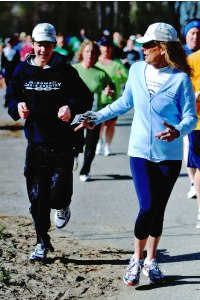
Ryan and I running together during a Mother’s Day run.

In past blogs, I discussed the importance of intense physical activity for children with autism and special needs. That’s why I was excited to read about a study with the Achilles International and Cigna Foundation to evaluate how running can help children with autism. Although it is in its early stages, it is hoped that the research will yield insights into how physical activity can improve certain symptoms of ASD.

Achilles International, founded in 1983, is a group that allows people with all types of disabilities to participate in mainstream athletic events. Initially serving adults with physical disabilities, today Achilles Kids offers running, walking and rolling programs for children with autism and cognitive disabilities.

The Achilles Kids: Races  and Workouts program provides training activities that integrate free-play, games, and nutritious snacks to make the experience fun.  In New York, children with disabilities are given the opportunity to compete alongside able-bodied children in the Road Runners Club’s Pee Wee races.

I was also fascinated to read about OLYMPUS DIGITAL CAMERAAchilles Kids: Run to Learn program, which was developed in 1995 by Achilles International. The program consists of a series of physical and educational activities that integrate educational challenges and games with running, walking, rolling, or other forms of movement to encourage and motivate children to participate in regular physical activity.

It is based on a real 26.2 mile marathon, but done virtually. In a year-long gym activity, children do a number of laps each week. The laps are counted and converted into miles, and then charted as a 26.2 mile route on a map of their town. While the children are tackling the long-term accomplishment of completing the marathon, they are also realizing short-term achievements based on meeting weekly goals. In addition, it also incorporated math, English, science and nutrition.

achilles 2Achilles Kids: Run to Learn is currently in over 150 schools in the U.S. with approximately 3,500 kids participating. I am requesting more information about the program. Perhaps we could establish a Run To Learn at the BNI.

To request more information about the Learn to Run program or find a Achilles International program near you, visit Achilles International‘s website or call 212-354-0300 x305.

Achilles Internationals programs are a great tool for breaking down barriers and raising awareness.


Posted in Uncategorized | Tagged , , , , , , , , , , , , | Leave a comment