“My Job Chart”

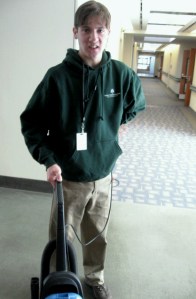
All of us hope our children will have a strong work ethic. When Ryan was a toddler I would sing the “Clean Up” song to remind him that play time was over and he needed to put his toys away. Regardless of his age, he always had a list of “jobs” that were his responsibility to complete. Today, he continues to assume responsibility for various jobs within the house: watering the plants, sweeping, emptying the dishwasher, making his bed and taking out the trash. His days are full with two jobs — working in maintenance at Bello’s Grocery Store and BNI. He tells me he wants to work hard so that he can earn money for movies, skiing, golf, LECOM and other fun activities. His work ethic is admirable and he receives praise from his supervisor for his dedication and hard work.

Ryan - computer reinforcer

Ryan using the computer as a reinforcer.

One of the tools I had used to encourage his compliance with chore responsibilities was a job chart, which is why I was intrigued when I recently came across MyJobChart.com. This online tool provides an interactive “chore” system that teaches children the concepts that promote independence. The parent identifies the jobs to be completed, assigns points for each job, and, with their child, establishes rewards. The child then logs on with his/her own password and selects the job to be completed. Once completed, the child receives points that can be converted into dollars that are saved, spent or donated to charity.   The parents are also notified when the child has completed the task and has selected a reward.

With over 687,000 members, My Job Chart has shown itself to be the modern equivalent of an old fashioned sticker chart. We know that our children enjoy using technology, and this site not only engages them, but teaches them responsibility, accountability, money management and problem solving — essential skills for individuals of all ages. This site is free for families and can be used with Apple and Android apps.

Try it and let me know if it works for your family.

Posted in Uncategorized | Tagged , , , , , , , | 2 Comments

Fireworks and Safety – Can the Two Go Together?

fireworksLast year, my July 4th blog offered you tips for an autism-friendly Independence Day. This year I’m discussing safety.  As with all holidays, there are many activities, but with the 4th of July we think immediately of fireworks.

However, many community firework displays are being eliminated or cut back due to economic conditions, and families are purchasing fireworks for their own backyard celebrations.

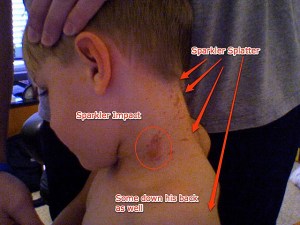
Each year thousands of children and teenagers continue to be injured while fireworks injuryusing fireworks. Some guidelines to follow:

  • Keep back a safe distance away when fireworks are being used.
  • Keep water or a garden hose available and ready to use.
  • Do not buy fireworks for your children and NEVER let them light the fireworks.
  • Even sparklers require direct adult supervision as sparklers can get up to 2,000 degrees Fahrenheit, equivalent of a blow torch.
  • Teach your children to have a healthy respect for fireworks.

Safety is always my number one priority. Make sure it is yours as well so that you and your family can have a safe and fun 4th of July.  I wish you a very Happy 4th of July.

Posted in Uncategorized | Tagged , , , , , , , , , , | Leave a comment

To Fly or Not To Fly – That Is The Question

child-in-flightAs we begin the month of July I’m sure that many of you are planning your annual summer vacations.   As I think back to our vacations, I recall how I initially approached flying with Ryan with trepidation.  Would he remain calm passing through security?  How would he deal with the crowds in the airport?  How would he react to sitting on an airplane for a few hours?  I knew that up until he got on the plane he would perseverate on flying, his way of dealing with the unknown.  We did social stories and traveled to our local airport and watched the planes coming in and out.  We also talked about how much he would enjoy his first airplane trip… and he did.  Fortunately for both of us, his first flight was a success and I could look to future trips without a sense of foreboding.

However, for many families, airline travel is not a positive experience. That’s the reason child and airplaneWings for Autism was created in 2011 by the Charles River Center in Massachusetts and Massachusetts Port Authority.  Wings for Autism provides families with the opportunity to practice entering the airport, obtaining boarding passes, going through security and boarding a plane.  Also, the program gives airport personnel an opportunity to observe and interact with children with disabilities and their families.  Today, Wings for Autism has expanded to a number of cities including Seattle, Anchorage and Tulsa.  Another program that I found is AIR – Helping Families Soar.

What can you do to bring such a program to your community? I am

  • Contacting the Airport Authority to make them aware of these programs and determine steps to initiate the program locally
  • Contacting the airlines that fly out of Erie, PA
  • Contacting Wings for Autism and AIR – Helping Families Soar

I will give you an update on my progress. Wouldn’t it be great if every community with an airline had such a program for children with special needs?  Let’s make that our goal!

Posted in Uncategorized | Tagged , , , , , , , , , , | Leave a comment

The Impact of One

Ryan's First Marathon 2004 (cropped)

Jeanne and I at one of Ryan’s first runs.

Tomorrow marks the last day of one of our long term employees, Jeanne Baker.

Thirty four years ago she began her Barber National Institute (BNI) career as a behavior specialist in our Adult Services. However, Jeanne has worn many hats in her tenure.  Many of her assignments were related to the initiation of new programs. She lead the development of our Intermediate care facility (ICF/MR) in Erie, a new residential program with lots of medical related requirements which were all new to all of us.

When the Secretary of Welfare (DPW) asked Dr. Gertrude Barber to provide ICF/MR services to Philadelphia, Dr. Barber called upon Jeanne to lead this charge. Jeanne was on the road to Philadelphia so much that she commented that she had to stop and think when she woke up, “What city am I in?”

The early 1990’s saw the development of Behavioral Health Services with Jeanne at the helm. This was the beginning of the tsunami of children with autism. We reviewed the research, acknowledged that Applied Behavioral Analysis (ABA) was the preferred treatment and began sending staff for training. The BNI became well known for its expertise in working with children on the spectrum.

IMG_3714

Jeanne bringing smiles and laughter to the students at ELBS.

Next was the development of the Pittsburgh Residential Services, again a request from DPW because of our expertise in working with families whose sons and daughters had been institutionalized. After a brief stint as the Director of Compliance (a position that Jeanne did not favor as she preferred working with the children and adults), she joined the Children and Youth Services as administrative director, where she has served the last 10 years.

As each of us looks back over our careers, and the persons who have worked so closely with our children, I am sure that most of you had a Jeanne Baker in your life. The name will be different but a similar person whose life was dedicated to seeing that all children and adults with disabilities had every opportunity to grow and develop to their fullest. Thank you Jeanne for sharing your life work with us and making dreams come true for our children and their families.

Posted in Uncategorized | Tagged , , , , , , , , , , , , , | 2 Comments

Autism Research Embraces Technology

Autism & GenomeAutism Speaks recently announced that they are collaborating with Google to transform genomic research on ASD. This is a very complicated, scientific concept so I have been researching it further to ensure that I understand what this means.  What I’ve learned is:

  • For the first time ever researchers have analyzed the entire DNA sequence (whole genome) of individuals with ASD and were able to link autism symptoms to specific genetic changes in half of the families studied.
  • Autism Speaks will use the Google Cloud platform to manage, analyze and share this information.
  • The goal is to sequence the whole genome of 10,000 individuals with ASD living throughout the world.  Upon completion this collaboration could lead to the identification of various subtypes of autism.
  • “Whole genome sequencing has shown its potential to fundamentally transform the future of medical care for people with autism,” said Autism Speaks Chief Science Officer Rob Ring.

So now that I understand the impact of this research I decided to investigate how you and I can participate. The site that I found most helpful was Interactive Autism Network.

I’d encourage you to consider registering with this network. Wherever you live you can make a difference by participating … and it only takes 10 minutes.

Posted in Uncategorized | Tagged , , , , , , , , , , , | Leave a comment

A Tribute to Dianne Winiecki

Dianne Winiecki

Dianne Winiecki

This weekend saw the passing of our dear friend and colleague Dianne Winiecki. We are sad to lose her but know that she has gone to her Lord and will no longer suffer the challenges that she has experienced the last two years.

I first met Dianne during the summer of my freshman year when I began to work as a classroom aide at the Barber Center. My past experiences included volunteering for Center activities, so this was going to be my “first” real job.  I was nervous, as I had no idea what to expect in my role as classroom aide.  Mrs. Pascarella assured me that she would assign me to the best teacher that they had, Dianne Winiecki.  It was truly a learning summer and I found that I thoroughly enjoyed working with the children.

Throughout my college years, summertime found me back to the Center continuing my role as a classroom aide. These experiences led me to pursue a Master’s Degree in Special Education.  I returned to the Center after working as a special education teacher in the Erie School District.  Now in my new role as a supervisor, I would assign Dianne to mentor new teachers and assistants.  Every teacher wanted to work with Dianne as she was so fabulous with the children.  She retired in 2012 because, as she told me, “I can’t keep up with the kids so it is not fair to the teacher or the children.”

My personal friendship with Dianne began 18 years ago when Ryan was two and a student in the Happy Hearts childcare program. I was concerned, as he was experiencing developmental delays in language.  I turned to Dr. Barber for advice and she called upon Dianne for a special favor to work with Ryan.  Although she only worked with Ryan for nine months, they established an unbreakable bond.  Easter, Christmas, Halloween and birthdays were occasions to visit, go on trips to the Peninsula, see movies and take car rides.  This continued until her illness prevented their get-togethers, but we continued to mail a monthly card to update her on our activities and let her know that she was loved and missed.

Dianne was the very definition of “making dreams come true” for all of our children. Thank you for your 48 years of service to the Barber National Institute.You will truly be missed.

Posted in Uncategorized | Tagged , , , , , , , , | 6 Comments

In Memory of Lorna Wing – A Pioneer in Autism Research

Lorna Wing

Lorna Wing

“Her life was a gift for people with autism across the world. She has left a huge legacy behind” ~ Patricia Howlin

Lorna Wing, one of the pioneers of autism research, passed away June 6th.  She worked at the Institute of Psychiatry in the MRC Social Psychiatry Unit in the 60s, 70s, and 80s and conducted landmark studies of autism that changed many conceptions of the disorder.  She also introduced the concept of autism as a spectrum disorder that affected children and adults of all ages and abilities.

With other parents she founded the National Autistic Society in the UK in the early 60s, which established the first specialist schools and later adult services for people with autism.  As a mother of a daughter with severe autism, her work throughout her life reflected her understanding of the challenges parents’ experience of raising a child with autism.

In 1981 she introduced Hans Asperger’s work to the English-speaking world.  Few at this time knew that an Austrian pediatrician, Hans Asperger, had published a paper in the early 1940s about his observations of four children who had difficulty integrating socially, had normal intelligence but lacked non-verbal communication skills.  We owe our thanks to Lorna Wing for discovering this work.

Although at the time I was not familiar with Lorna Wing’s work in the UK in the US we were relooking in the early 80s at some of our children who were diagnosed with intellectual disabilities with “autistic tendencies.”  We began to acknowledge that children with autism required instructional strategies different from children with intellectual disabilities.  Faculty traveled to the University of North Carolina to learn about T.E.A.C.H. model.  Others travelled to California and learned from Ivar Lovaas, a clinical psychologist and founder of ABA (applied behavior analysis).  Both models are still used at ELBS today.

I am saddened by her passing but know because of the work of Lorna Wing, children and adults with ASD have every opportunity to be successful members of their communities.   

Posted in Uncategorized | Tagged , , , , , , , , , , , , , , , , | Leave a comment

Remembering My Father’s Lessons

MBC's Father & Dr. Gertrude Barber as children (cropped)

Photo Credits: (Front Row L-R) Maureen’s Father with his sister, Dr. Gertrude Barber

As we approach Father’s Day I think back to my father who passed away 40 years ago. No matter how many years go by each of us has very special memories of our dad.  For me I think how my father served as a role model throughout my life.  He always encouraged me to reach for the sky.  Challenges were opportunities for us to grow.

As I reflect on my life as a parent, teacher and administrator I have used his lessons to guide me on my journey. It has led me to dreams not only for Ryan but for the hundreds of families that I have had the privilege of getting to know and serve.  By following my father’s advice I have helped make dreams come true for Ryan and the children and families at Barber National Institute.

As I think about my father I recall a quote that I truly believe.  “The most important … work you and I will ever do will be within the walls of our own homes.” ~ Harold B. Lee

What Makes a Dad
God took the strength of a mountain,
The majesty of a tree,
The warmth of a summer sun,
The calm of a quiet sea,
The generous soul of nature,
The comforting arm of night,
The wisdom of the ages,
The power of the eagle’s flight,
The joy of a morning in spring,
The faith of a mustard seed,
The patience of eternity,
The depth of a family need,
Then God combined these qualities,
When there was nothing more to add,
He knew His masterpiece was complete,
And so, He called it … Dad
~Author Unknown

Posted in Uncategorized | Tagged , , , , , , , , , , , , , , , , | 2 Comments
httpwww.autismjobboard.com - Shannon Nash with her son Jason, who helped inspire her to launch Autism Job Board, a new website for job seekers with autism spectrum disorder.

Shannon Nash with her son Jason, who helped inspire her to launch Autism Job Board, a new website for job seekers with autism spectrum disorder. Photo credit: http://www.huffingtonpost.com/2014/06/02/autism-job-board_n_5418880.html?utm_hp_ref=autism

In a study published yesterday in the JAMA Pediatrics journal, we learned that autism is one of the costliest disabilities: $2.4 million across the lifespan if the person also has intellectual disabilities. Not surprising is that 79% of that cost is due to services such as medical care, home health care, special education and after school care.  What is surprising is that 9% is due to wages that caregivers give up to care for a family member with autism.  Overwhelming? Yes, but it serves as a call to action for all of us to bring down the cost of autism for families and society.

  • Knowing that early identification leads to better outcomes in our children we need to educate our legislators about the importance of funding early intervention programs.
  • Parents often decrease their working hours because of the difficulty in securing quality childcare.  Encourage businesses to offer family friendly workplace policies, which might enable more parents to stay working.
  • Advocate for businesses to hire individuals with autism and intellectual disabilities like Shannon Nash did by launching the Autism Job Board website.  It’s a win-win situation for both the employer and individual.
  • Expand residential living options for adults with ASD.  Too often I hear from parents that their son or daughter is living in their basement unable to afford an apartment but wanting to live independently.  Their ongoing question is, “what can we do?”

I believe that we need a comprehensive, strategic plan to address these critical issues. I certainly don’t have all the answers to this problem that is facing society.  I would like to hear from you on what do you think we could do.

Posted on by all about autism | Leave a comment

004The sun is shining on our students who are graduating this evening from the Elizabeth Lee Black School. I’ve know some of the children since they began as infants in our Early Intervention Program. I met others when they turned 3 and started preschool.

But tonight is special. We have 45 students graduating into kindergarten in their neighborhood school, photoelementary school or BNI Adult Services. I look back and reflect upon their extraordinary accomplishments. Children who did not talk when they started school are now having conversations; children who did not walk are now running across the playground. Their confidence and self-esteem blossomed as they acquired new skills, friends and lots of supporters among our faculty.

We deeply believe that we have a responsibility to each of our students to provide them and their family with every opportunity to grow and develop to their fullest potential. John VThat is what I will see tonight – 45 children and their families who’s “dreams have come true.”

If you have graduation pictures that you would like to share I would love to see them.

Posted on by all about autism | Leave a comment