World Thinking Day

wtd_patch_2015

This year’s badge for Girl Scout participation in World Thinking Day

Did you know that Sunday is World Thinking Day? Girl Scouts throughout the world created this day to participate in activities and projects that center around an annual theme. This year’s theme of “creating peace through partnerships” is inspired by the United Nations’ Goal to develop global partnerships for development.

This goal is about all countries, rich and poor, working with one another to create a global partnership that will benefit us all. In order for poorer countries to succeed, more prosperous countries must provide more effective aid, sustainable debt relief, and fair trade rules.

World Thinking Day not only gives the Girls a chance to celebrate international friendships, it is also a reminder that Girl Scouts of the USA is part of a global community—one of nearly 150 countries—with Girl Guides and Girl Scouts.

world-think

Girl Scouts of America represent global awareness through a multitude of fun and creative activities

We can take a page from the Girl Scouts’ book, both as an individual and as a community, to take time to think about how we all come together as global partners and support each other. In our BNI community, I’m thinking about how we can reach out to persons with disabilities in under-developed countries to help improve their lives.

We don’t necessarily need to reinvent the wheel in order to support this goal. There are several wonderful international programs that already exist. Two such ones that come to mind are Best Buddies and Special Olympics.

Best_BuddiesBest Buddies is a global volunteer movement that helps foster one-to-one friendships and integrated employment opportunities for people with intellectual and developmental disabilities. Volunteers annually contribute their time and services, a total that values $168 million USD!

LA2015_Primary_Lockups_4_color-01_webreadyThe Special Olympics, founded by Eunice Kennedy Shriver in 1968, provides year-round sports training and athletic competition in a variety of Olympic-type sports for children and adults with intellectual disabilities. Over 4.4 million athletes from 170 different countries have enjoyed participating in one of 32 sports competitions since its inception.

Our students are participants in the Best Buddies program and greatly enjoy it. Ryan’s been a Best Buddy for the last two years and has networked with typical peers from across the country as a result. It’s a very enriching and rewarding program, and best of all… it’s free!

What other ways or programs can you think of to achieve the World Thinking Day Goal?
Posted in Uncategorized | Tagged , , , , , , | Leave a comment

Presidents and Americans with Disabilities

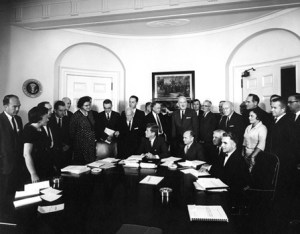
In honor of President’s Day, I decided to reflect on some of the Presidents who played a significant role in improving the lives of children and adults with disabilities. Up until the 60s, most families were ashamed to admit that they had a child with a disability. President John F. Kennedy’s sister Rosemary, who had intellectual disabilities, served as an impetus for the President’s push to establish the President’s Panel on Mental Retardation in 1961.

The Presidents Panel on Mental Retardation, 1961

The President’s Panel on Mental Retardation, 1961

Comprised of 27 members, the panel reviewed the country’s current intellectual disabilities programs, eventually presenting the President with over 100 recommendations for the first comprehensive federal approach. Dr. Gertrude Barber, our founder, was a member of this panel.

A year later, President Kennedy signed the Maternal and Child Health and Mental Retardation Planning Amendment, which incorporated many of the panel’s recommendations and provided planning grants to enable states to update their intellectual disabilities programs. A second piece of legislation provided funding for construction of facilities related to treatment and care of people with intellectual disabilities. At the time of its signing, President Kennedy stated: “Mental retardation ranks with mental health as a major health, social, and economic problem in this country. It strikes our most precious asset, our children.”

300px-Gerald-ford

President Gerald Ford

The next major piece of legislation concerning people with intellectual disabilities was President Ford’s 1975 signing of the Education for All Handicapped Children Act, since renamed to the Individuals with Disabilities Education Act (IDEA). This special education legislation established a federal mandate of “free, appropriate public education” for children with disabilities. After the law passed, over one million children who had not been receiving any or very limited educational services were brought into public school systems.

Then on July 26, 1990, President George H.W. Bush signed The Americans with Disabilities Act, the world’s first comprehensive declaration of equality for people with disabilities. “Today’s legislation brings us closer to that day when no Americans will ever again be deprived of their basic guarantees of life, liberty, and the pursuit of happiness,” President Bush said.

President Bush signs the historic ADA.

President Bush signs the historic ADA

Most recently, Obama made history by signing the ABLE Act, which provides lifetime saving capabilities for people with disabilities.

It’s wonderful that the United States continues to be a leader in supporting the rights of children and adults with disabilities. In only 50 years we’ve gone from sending people with intellectual disabilities “away” to celebrating their unique and valuable contribution to our society. As Americans, we can all be proud of the monumental progress our country has made.

Posted in Uncategorized | Tagged , , , , , , , , , , | 2 Comments

Valentine’s Day!

There are several popular legends surrounding the story of Saint Valentine. One is that he was a Roman priest who was arrested, imprisoned, and eventually martyred after being caught marrying Christian couples. At the time, helping Christians was considered a crime.Val Day

Another says that Valentine, who was a priest, defied the order of the emperor Claudius and secretly married couples so that the husbands wouldn’t have to go to war.

Still another legend is that Valentine was imprisoned because of his refusal to sacrifice to pagan gods. While in prison, his prayers are said to have healed the jailer’s daughter, who was blind. On the day of his execution he left her a note signed, “Your Valentine.”

Today, whatever its origins, Valentine’s Day is known around the world as an opportunity to celebrate those we care about. At BNI, we celebrate with an annual Valentine’s Day dance for our high school students. The teenagers have a rare chance to get dressed up, and enjoy special punch and snacks. Villa Maria High School Honor Society students are invited to attend, and the students have a blast dancing the afternoon away! IMG_3046

Students also spend the week before selling Candy Grams to be delivered to “Your Valentine” the day before Valentine’s Day. The sender chooses whether he/she wants popcorn or candy and selects a Valentine card, which is assembled by the students and delivered to the recipient. Proceeds from the sale are then used by the students for their trips in the community.

At my house, I know we’ll be looking forward to the chocolate-covered strawberries!

Posted in Uncategorized | Tagged , , , , , , , , , , , | 1 Comment

Teaching Kindness

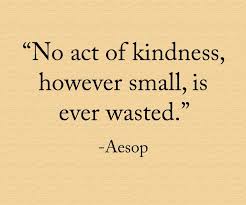
Aesop QuoteThis week is Random Acts of Kindness Week. As I thought about the topic, I began to consider how kindness is taught. The rampant problem of bullying in our schools underlies a deeper issue – are we teaching our children to be kind?
According to a recent study, about 80% of interviewed youth said their parents were more concerned with their achievement or happiness than whether they cared for others. The interviewees were also three times more likely to agree that “My parents are prouder if I get good grades in my classes than if I’m a caring community member in class and school.”

I think we can all agree that that’s not good. So the question becomes, “What do we need to do differently?”

It’s never too early for children to hear from parents that caring for others is a top priority. A big part of that is holding children to high moral standards, such as honoring their commitments. I recall how as a youngster I signed up to play tennis, only to find that it wasn’t the right sport for me. However, my parents insisted that I continue for the season, as I had made a commitment to the team to play.

Learning to be caring is like learning anything else: it takes practice. Lots of it. This begins with the parents. Children need to hear their parents address each other as well as others in a respectful manner. This can be as simple as being polite to the waiter taking your order. Make sure your child understands that there is never an acceptable time to be rude to another person.

It’s easy to foster a caring attitude toward family and friends, but it can be more challenging to teach a child how to extend that to an unfamiliar person. Even though technology makes it appear that we are more connected than ever, the reality can be that there is a disconnect behind the computer screen. While the internet is a great platform to learn more about our globe and its challenges, it’s important to take this to the next level. I have always encouraged Ryan to learn more about and be open to different cultures and communities other than his own, but also to ask, “What can I do to help these people in need?”

Parents are a child’s first teacher. We have an important role to play as a mentor and role model. Even when you’re not aware, your child is observing you and seeing how you manage problematic or stressful situations. The way you respond is the way they will respond. Ask yourself: “Is this how I want my child to behave?” When I’m in a stressful situation, I find it helpful to take deep breaths. I have been teaching Ryan the same technique whenever he becomes anxious and overwhelmed.

This week is a wonderful reminder to all of us to be kinder to people and the world around us. Our world needs some extra kindness!

For fun activities to do with your child, visit the 100 Acts of Kindness Project Page: http://bitsofpositivity.com/tag/100-acts-of-kindness-project/

Posted in Uncategorized | Tagged , , , , , , , , , | Leave a comment

In the Public Eye

I began reading Fully Alive: Discovering What Matters Most, by Timothy Shriver this week. Although I was generally familiar with the story of Rosemary Kennedy, I was not aware of how much she inspired her family to devote their careers to helping the most vulnerable. Dr. Gertrude Barber served on President John Kennedy’s 1961 “President’s Panel on Mental Retardation,” which heralded the beginning of federal involvement and fiscal aid to states. Their report, a landmark in public policy history, provided 112 comprehensive recommendations that covered prevention, treatment, social services, research, and education. This report also marked the first time in the history of the United States that a President would be called on to include children with intellectual disabilities in the nation’s schools, and to create a new system of support for adults with intellectual disabilities.

One of the most disturbing takeaways from the book so far is the depth of shame families experienced when they had a child with a disability. It’s hard to imagine trying to “hide” Ryan from the public. How could I ever be ashamed of Ryan?

Grace and actress Lauren Potter.

Grace and actress Lauren Potter.

Hence why I was very pleased to see a third-grader with Down Syndrome front and center as part of a television commercial for McDonald’s during the Super Bowl. And in recent years, Glee, a popular Fox TV show, has cast a new member who also has Down Syndrome.

We’ve certainly come a long way from the days of Rosemary Kennedy! I’ll share more information about Fully Alive as I read further, but even without finishing it, I believe this is a book everyone needs to read.

Posted in Uncategorized | Tagged , , , , , , , , , , | Leave a comment

Big Leap in Numbers: What Does It Mean?

In May of 2013, the American Psychiatric Association announced changes in DSM-IV. “Intellectual developmental disorder” replaced the term “mental retardation,” and the diagnosis for intellectual disability placed less emphasis on a person’s IQ score and greater consideration on clinical assessment. The terms “Asperger’s Syndrome” and “Pervasive Developmental Disorder” were eliminated and folded under the Autism Spectrum Disorder umbrella. There was concern that the new DSM-V might limit the number of children being diagnosed with autism.

Contrary to this prediction, the numbers of children being diagnosed has soared.

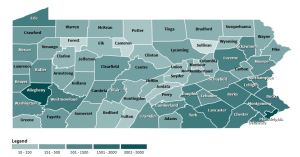
PA Census

A by-county map of autism diagnoses receiving services in PA.

The 2014 Pennsylvania Autism Census findings show that the number of individuals has risen to over 55,000 children and adults receiving services, up from 20,000 in 2009. This is a 181% overall increase in the number of individuals with autism receiving services, and a 334% increase for adults 21 or older, making them the fastest growing group. It’s important to keep in mind that those persons not receiving services or those who were misdiagnosed/never diagnosed are not counted here. Thus, they believe that this is a significant underestimate.

The CDC recently announced that it is planning to assess the impact of the new diagnostic criteria and determine how communities are responding to increasing incidents of autism. Ten sites from across the country will evaluate the medical and education records for eight-year-old children residing in the area to determine how many children have a diagnosis of ASD. A new component is that six of these sites will also assess records of four-year-old children. In addition, all the sites will track at least one other condition such as “intellectual disability.”

The review will ask:

  • Would this child qualify for an Autism diagnosis prior to DSM-IV revisions?
  • How are communities using this data?

It will be interesting to see what the CDC’s new approach to assessment tells us about ASD diagnoses. Unfortunately, such data compilation takes time; they don’t expect to release findings until 2018. However, the CDC’s 2012 review findings should be released in 2016. We were all surprised by CDC’s 2010 findings that 1 in 68 children are on the spectrum… what will this upcoming report tell us? If our own state’s giant leap is any indication, we could be in for a big wake-up call.

Posted in Uncategorized | Tagged , , , , , , | 1 Comment

National Thank You Month

thanks“Thank You.” These are two words that I taught Ryan as soon as he was speaking. To me, being polite is an important virtue for parents to teach their children. As Ryan progressed through school, one of the positive comments his teachers always gave me was, “He is so polite. I wish all the students were like him.”

Did you know that January is National Thank You Month? This is the perfect opportunity to find the time to celebrate all that you are grateful for. I am grateful for so much. Good health; supportive family and friends; creative, hardworking co-workers; working for an organization whose goal is to make dreams come true for children and adults with disabilities … to name just a few!

It’s easy to forget to pause and express your gratitude to the people in your life who are there for you day-in and day-out. There are also those who you may seldom see but who have played an important role in your life at some point. This is the perfect month to reach out both! Below is a handful of ways to say thank you:

  • Write a handwritten note or letter to someone you are thankful for
  • Take a friend out to coffee or lunch and tell them you appreciate their support
  • Surprise a loved one with flowers and tell them you value all they do
  • Start a gratitude journal, writing at least one thing a day that you are grateful for. Ryan and I daily stop and tell each other something we are grateful for.
  • Thank your coworkers for their hard work, acknowledging that often it takes a team to get the job done

And don’t forget to thank people for the simple things: bagging your groceries, cashing you out at the gas station… The list goes on!

Posted in Uncategorized | Tagged , , | Leave a comment

Virtual Reality: A New Frontier?

Virtual reality training and autism? I was a bit incredulous when I first saw this headline. Certainly we are deluged with articles on “What Apps Work Best” and how technology benefits children on the spectrum. As a non-techy, I wasn’t even sure what virtual reality means. After some digging, I learned many important facts and became impressed with its potential.

A virtual reality simulation of a social setting.

A virtual reality simulation of a social setting.

First, a brief definition: Virtual reality is a computer-simulated environment that can mimic physical presence in the real world. It can even re-create sensory experiences like virtual taste, sight, smell, sound, and touch.

For individuals on the spectrum, this ability to replicate everyday situations is important because it allows practice of challenging situations in a non-threatening environment. A great example of this is rehearsal of social interaction, which is often a deficit for children with ASD. By engaging in non-scripted, virtual dialogues, individuals can improve their conversational skills as well as their ability to decipher facial expressions without becoming overwhelmed due to the presence of another person. For adults, the opportunity to engage in job interviews through virtual reality simulations can provide the confidence and skills they need to secure a job in the real world.

VR_2Researchers have found that in as little as five weeks, participants’ scores have significantly improved in the domains of emotional recognition and the ability to understand and respond to what others are thinking. Interestingly, researchers have also found that after virtual reality training, young adults with autism show increased activation in brain regions associated with social understanding as well as the formation of new connections between brain regions. (Read the full research article here.)

Last year, Steve Weiser (GM of the Erie Chamber Orchestra), gave us the opportunity to try out an Oculus virtual reality headset. It was quite the experience; however, these headsets are currently not available for consumers. It will be interesting to see the evolution of virtual reality over the next couple of years, or perhaps even sooner!

VR_3

Posted in Uncategorized | Tagged , , , | 2 Comments

Celebrating Literacy!

Reading-is-to-the-mind....gifJanuary is a big month for literacy awareness. All month long, we celebrate National Book Blitz Month. If you’re like me, your reaction to this was similar to: Great! What’s that?

After some digging, I learned that NBB was created by a PR executive to encourage authors to promote their own books and work more closely with the media to create more buzz about their work.

However, many have chosen to make it about catching up on your “to read” lists, getting better acquainted with your favorite author by reading (or re-reading) their works, or even finding a new favorite author.

Perhaps Book Blitz Month inspired National Read-a-thon Day. On Saturday from noon until 4 pm, readers across the country will join together in four hours of reading, all with the hopes of raising awareness for literacy in our country.

pete

Pete the Cat

And finally, tomorrow is National Reading Day, an annual event celebrated in schools all around the United States. The event is designed to celebrate and encourage reading by Pre-K through third grade students, to develop the literacy foundation they need. At ELBS, we will be gathering together to read “Pete the Cat’s Big Lunch” as a group. He is one of our favorite characters!

Many children and adults with special needs are challenged in reading. Bookshare is a great resource for them. It’s free for any registered student thanks to a grant from the Office of Special Education programs. For adults there is an annual fee of $50, but this provides unlimited access to books and other free reading tools.

I asked a few of our teachers for their favorite books. They included:

Pete the Cat and His Four Groovy Buttons, Eric Litwin.

Pete the Cat is wearing his favorite shirt—the one with the four totally groovy buttons. But when one falls off, does Pete cry? Goodness, no! He just keeps on singing his song—after all, what could be groovier than three groovy buttons? Count down with Pete in this rocking new story from the creators of the bestselling Pete the Cat books.

The Shape Song Swingalong, SteveSongs

What can you make with a line, a circle or square? This inspiring book, based on an original song by children’s singer SteveSongs, shows how simple shapes can be transformed into anything you can imagine from boats to skyscrapers to a circus. The catchy song and animation will soon have you dancing along, making shapes! Includes a dual-purpose audio and video CD to listen to the sing-along on a CD player or listen and watch the video animation on a Mac or PC.

Up, Up, Up!, Susan Reed

This airborne adventure takes readers ballooning over lands near and far, all the way to the stars. The charming sing-along song on the accompanying CD keeps spirits high, while the rhyming and playful text introduces all sorts of settings and vocabulary-building words.

The Journey Home from Grandpa’s, Jemima Lumley

Hop in the yellow car and look for all the other forms of transportation on the way home from Grandpas. A beautiful, double-page spread at the end features all of the colors and modes of transportation from the story. Includes a dual-purpose audio and video CD to listen to the sing-along on a CD player or listen and watch the video animation on a Mac or PC.

What books have you found that your child enjoys?

Posted in Uncategorized | Tagged , , , , , , , | Leave a comment

Being a Fighter for Civil Rights

MLKIn doing some research on Dr. Martin Luther King, Jr., I discovered a quote that I haven’t read before but is great advice for all of us.

“Whatever career you may choose for yourself – doctor, lawyer, teacher – let me propose an avocation to be pursued along with it. Become a dedicated fighter for civil rights. Make it a central part of your life. It will make you a better doctor, a better lawyer, a better teacher. It will enrich your spirit as nothing else possibly can. It will give you that rare sense of nobility that can only spring from love and selflessly helping your fellow man. Make a career of humanity. Commit yourself to the noble struggle for human rights. You will make a greater person of yourself, a greater nation of your country and a finer world to live in. – Dr. Martin Luther King, Jr.

(April 18, 1959, Youth March for Integrated Schools Speech)

Being a “dedicated fighter for civil rights” sounds intimidating because our initial impression is, “Well, I can’t do that. It is a full-time job.” Yes, for Dr. King it was. But this quote reminds us that it doesn’t need to be a full-time job. Each of us can, in a multitude of small ways, dedicate our time, efforts and passion towards human rights.

Some of these ways include:

  • Welcoming diversity into your neighborhood, church group or synagogue.
  • Volunteering – whether it’s at a soup kitchen, shelter, or community center.
  • Talking to your children and encourage them to accept people who may look or sound different than their family. We are all more alike than different.
  • Staying informed about current and proposed legislation that may not impact you directly, but would have a great potential impact on society.
  • Speaking up – be vocal about the support and services you believe are needed. You may think you’re only helping those you care about, but you are also helping others who feel similarly and are afraid to speak up.

It is easy to think “I’m only one person, I’m not making a difference,” but it is important to remember that no one person is responsible for change alone – it is the result of many people working together. After all, it was also Dr. Martin Luther King, Jr. who said:

“If I cannot do great things, I can do small things in a great way.”

Posted in Uncategorized | Tagged , , , , , , , | 2 Comments