
Read Part 1 here
As you might expect, the changes in these numbers and in the number of classrooms required the expansion of our staff. With the addition of new classrooms, we now have 89 classroom staff and 30 therapists, including speech, OT, PT, and behavior. Three quarters of all our staff have at the minimum an associate’s degree – one quarter of these have a master’s degree! This speaks to the consistent trend we have seen is the need to recruit staff who are better educated than generations prior.
We also have several new – or newly renovated – programs for this school year. Our renovations include a “spruced up” cafeteria as well as newly renovated high school restrooms. These restrooms were constructed in 1987 – over 30 years ago! It is safe to say it was time for an update.
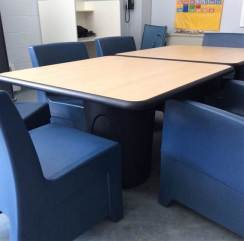
Norix table & chairs
The behavior department is introducing behavioral healthcare furniture, Norix, as an increased safety measure. The furniture is built with a soft, rounded plastic and is then filled with sand so it is weighted down and unable to be moved. This is particularly important in classrooms where behavioral issues are a concern.
During our August inservice, percussion artist Jim Donovan held a training session for teachers and therapists for “Drumming Therapy.” Research shows that using musical strategies and rhythms increases attention to tasks, reduces stress, and improves socialization and non-verbal expressions. After our first experience with Jim a year ago, we saw such positive results with our students that we decided to implement the training school-wide.

Now, we already plan to have Jim return to train the paraeducators – this is one of the most requested training sessions we’ve ever had!
We are also continuing our three-year implementation of PBIS – Positive Interventions & Supports. This year begins Year 2, in which we will implement the student matrix. We continue to follow the three main matrix topics of: Be Kind, Be Safe, Be Independent; however, students will achieve these goals differently than staff. We will continue to reinforce the staff matrix simultaneously.
School year 18-19 looks to be even more successful than 17-18!

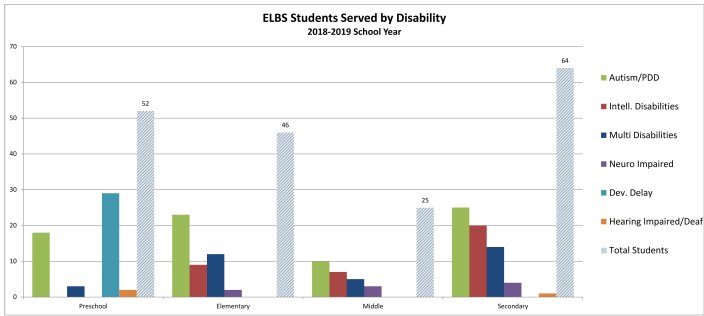 As current conventional research would indicate, the most prominent change we have seen is the rise in students with an autism diagnosis. The age range of our students also continues to expand; we have a much larger population of middle and secondary students compared to a decade ago. We also currently have 17 early intervention students; 17 inclusive preschoolers; 33 specialized preschoolers; and 18 Happy Hearts students.
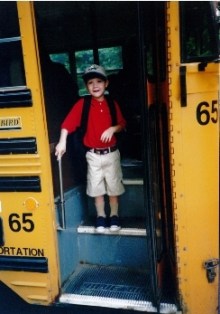 I recently heard a Back-to-School ad play on the TV and immediately thought, “Can it be time for this already?” I can still recall how I felt as July turned into August and we began the back-to-school countdown. Ryan was always very anxious (and I was, too) so I learned over the years how I could help the both of us control our worry. Perhaps some of my ideas might help you and your child.
 on unity, inclusion, and the Special Olympics turning 50, I could not help but think about my aunt, Gertrude Barber.
 We know that there is no single cause of autism; in fact, the common consensus among researchers now is that there are several possible influences and genetic factors that come in to play, some of which may even interact. Certainly, we all agree with the adage: “If you know one person with autism, then you know one person with autism.” This saying illustrates the extreme variation within autism the autism spectrum, not only of outward expressions but also in the bio markers that can be observed.
 Moe, (1929-2004) was a Canadian professional golfer who had won the Canadian amateur championship (1955) the Canadian PGA Championship (1974) as well as many other golf tournaments throughout his golfing career. He attempted USA tournaments but found that his shyness and the fact that he was bullied by some pros led him to choose to only play in Canada. He had a reputation as the “best ball striker” in golf. Even Tiger Woods described him as one of two golfers who owned their own swing…the other being Sam Snead. Moe was unconventional in both his dress and his play. He played extremely fast and would not even slow down to line up his puts. Moe’s one and only topic of conversation was golf. He had limited understanding of the social context and seldom looked people in the eye. But, his ability to hit shot after shot perfectly straight was undeniable. Knowing what we know today, we would think that Moe had Asperger Syndrome. Ryan finished the book yesterday!
 Ryan and Moe have golf in common. It is something Ryan enjoys doing and more importantly provides him with an outlet for the repetitive behaviors that brings him comfort and lessens his anxieties. I can’t help but feel Moe would share those sentiments! I recognized that Ryan’s athletic skills, his interest in a one-man sport and his desire for structure and repetition might be best suited for golf and I am thankful that he has found such enjoyment from it.


 Flurry of studies hint at folic acid’s protective role in autism


