Remembering My Father’s Lessons

MBC's Father & Dr. Gertrude Barber as children (cropped)

Photo Credits: (Front Row L-R) Maureen’s Father with his sister, Dr. Gertrude Barber

As we approach Father’s Day I think back to my father who passed away 40 years ago. No matter how many years go by each of us has very special memories of our dad.  For me I think how my father served as a role model throughout my life.  He always encouraged me to reach for the sky.  Challenges were opportunities for us to grow.

As I reflect on my life as a parent, teacher and administrator I have used his lessons to guide me on my journey. It has led me to dreams not only for Ryan but for the hundreds of families that I have had the privilege of getting to know and serve.  By following my father’s advice I have helped make dreams come true for Ryan and the children and families at Barber National Institute.

As I think about my father I recall a quote that I truly believe.  “The most important … work you and I will ever do will be within the walls of our own homes.” ~ Harold B. Lee

What Makes a Dad
God took the strength of a mountain,
The majesty of a tree,
The warmth of a summer sun,
The calm of a quiet sea,
The generous soul of nature,
The comforting arm of night,
The wisdom of the ages,
The power of the eagle’s flight,
The joy of a morning in spring,
The faith of a mustard seed,
The patience of eternity,
The depth of a family need,
Then God combined these qualities,
When there was nothing more to add,
He knew His masterpiece was complete,
And so, He called it … Dad
~Author Unknown

Posted in Uncategorized | Tagged , , , , , , , , , , , , , , , , | 2 Comments
httpwww.autismjobboard.com - Shannon Nash with her son Jason, who helped inspire her to launch Autism Job Board, a new website for job seekers with autism spectrum disorder.

Shannon Nash with her son Jason, who helped inspire her to launch Autism Job Board, a new website for job seekers with autism spectrum disorder. Photo credit: http://www.huffingtonpost.com/2014/06/02/autism-job-board_n_5418880.html?utm_hp_ref=autism

In a study published yesterday in the JAMA Pediatrics journal, we learned that autism is one of the costliest disabilities: $2.4 million across the lifespan if the person also has intellectual disabilities. Not surprising is that 79% of that cost is due to services such as medical care, home health care, special education and after school care.  What is surprising is that 9% is due to wages that caregivers give up to care for a family member with autism.  Overwhelming? Yes, but it serves as a call to action for all of us to bring down the cost of autism for families and society.

  • Knowing that early identification leads to better outcomes in our children we need to educate our legislators about the importance of funding early intervention programs.
  • Parents often decrease their working hours because of the difficulty in securing quality childcare.  Encourage businesses to offer family friendly workplace policies, which might enable more parents to stay working.
  • Advocate for businesses to hire individuals with autism and intellectual disabilities like Shannon Nash did by launching the Autism Job Board website.  It’s a win-win situation for both the employer and individual.
  • Expand residential living options for adults with ASD.  Too often I hear from parents that their son or daughter is living in their basement unable to afford an apartment but wanting to live independently.  Their ongoing question is, “what can we do?”

I believe that we need a comprehensive, strategic plan to address these critical issues. I certainly don’t have all the answers to this problem that is facing society.  I would like to hear from you on what do you think we could do.

Posted on by all about autism | Leave a comment

004The sun is shining on our students who are graduating this evening from the Elizabeth Lee Black School. I’ve know some of the children since they began as infants in our Early Intervention Program. I met others when they turned 3 and started preschool.

But tonight is special. We have 45 students graduating into kindergarten in their neighborhood school, photoelementary school or BNI Adult Services. I look back and reflect upon their extraordinary accomplishments. Children who did not talk when they started school are now having conversations; children who did not walk are now running across the playground. Their confidence and self-esteem blossomed as they acquired new skills, friends and lots of supporters among our faculty.

We deeply believe that we have a responsibility to each of our students to provide them and their family with every opportunity to grow and develop to their fullest potential. John VThat is what I will see tonight – 45 children and their families who’s “dreams have come true.”

If you have graduation pictures that you would like to share I would love to see them.

Posted on by all about autism | Leave a comment

WanderingOur children are excited as they approach their final countdown to summer vacation. We as parents have probably been planning our children’s vacation schedule since the beginning of April.  I know I always did.  Summer is a time when we are vacationing at the beach, visiting amusement parks, out and about and having fun.  Even though summer is a fun and exciting few months, it is also a worrisome time because our children may have opportunities to wander.

As June is National Safety Month I hope to update everyone and increase awareness about this critical safety issue. Since I wrote my previous blogs (Children with ASD and Wandering, Safety Measures for a Wandering Child,  Planning and Prevention Tips for Children with ASD and The Search for Avonte) on wandering there have been a number of new supports that have become available to decrease the dangers of wandering.

Why do children wander?

  • Goal directed wandering: wandering child in tunnelwandering with a purpose of getting something he/she wants
  • Bolting / Fleeing wandering: running away out of fear, anxiety, excitement or stress
  • Wandering due to boredom, confusion or simply becoming lost

What can you do as a parent to be prepared?

  • National Autism Society has a Big Red Safety Toolkit that provides you with caregiver checklists, sample family wandering emergency plan, information sheet for first responders.
  • They also have a toolkit for First Responders, which includes a checklist, resources andwandering PLI-wanderer tips
  • Tracking Devices: There are a couple of varieties.  GPS depends upon satellites to provide positioning and navigation information.  Project Lifesaver, CareTrak and LoJack SafetyNet are typically facilitated by local law enforcement and use radio frequency.
  • GeoFencing: a feature in a software program that uses the global positioning system (GPS) or radio frequency identification (RFID) to define geographical boundaries. A geofence is a virtual barrier.
  • Tracking devices alone should not be relied upon as the sole source of your loved one’s security. Close adult supervision, home security measures and other safety precautions should always be taken and routinely reassessed for updated when necessary.
  • Teach your child to swim.  Many YMCAs have swimming lessons for children with special needs.  It is recommended that the final lesson should be with clothes and shoes on.wandering girl_by_lake

As we gear up for all of the fun activities I wish you a safe and happy summer.  Ryan and I will be swimming, playing tennis, golfing and kayaking.  I’m tired already.

Posted on by all about autism | Leave a comment
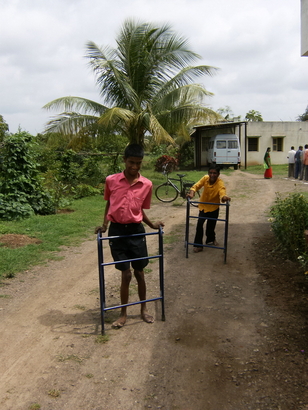
Dr. George provided walkers to two boys

Dr. George provided walkers to two boys who sat on the floor all day long. Like typical boys, they even learned to run using the walkers. One boys legs have developed enough and is now able to walk unassisted. (Photo Credit: http://www.nspreschurch.org/india.html)

It was 1990 and David Householder of the North Sewickley Presbyterian Church recommended to Dr. V.C. George that he come to Erie for on-the-job training at the Dr. Gertrude A. Barber Center. At that time he was a manager of a program for adults with disabilities in India.  Dr. George spent four months with us learning about everything we did for children and adults with disabilities in our school, with our adult services and in our residential programs.  He returned to India to begin his mission.

He came back to Erie in the late 90s and early 2000s many, many times, always committed to learning the state-of-the-art programs. One summer, our physical therapist, Tom Hudson, returned to India with him to spend six weeks assisting Dr. George with establishing his programs for children and adults with disabilities.  In 2008, Dr. George dedicated his school for children with disabilities. A few years later he began a small center for adults with disabilities.  Dr. George currently serves as Clinical Psychologist/ Administrator of Vadaketh Development Center, Miraj, Maharashtra, India and is President of the Indian Association of Clinical Psychologists.

Vadaketh Center

Vadaketh Center in Miraj, Maharastra, India


In addition to providing these direct services, Dr. George has been able to help at least two other village schools begin to serve children with disabilities. Also, he is a voice for these children at the national level in India and is influencing the priorities and services India offers persons with disabilities.

SONY DSC

Photo Credit: L – R; Maureen Barber-Carey, Dr. V.C. George, Irene George, Bridget Barber, John Barber


Today, 24 years later, he has returned to the Barber National Institute to offer us an update on the Vadaketh Development Center and to learn from us what is current that is practiced in the field of disabilities. Dr. George frequently comments that he has established a Gertrude Barber Center in India.  I look forward to his visit and will share his comments in future blogs.

Posted on by all about autism | Leave a comment

Break the Stigma!

mental-health-monthAs we focus on May as Mental Health Awareness Month, we know that there is a great deal of misunderstanding about mental illness. Unfortunately, negative attitudes and beliefs toward people who have a mental health condition are common.  Although 1 in 4 people have some form of a mental health disorder, a recent study found that in Europe and the United States up to 75% of those affected don’t receive the treatment they need.

Too often people are reluctant to seek help because of the stigma attached to mental illness1 in 4 mental illness and are afraid to let anyone know they have an issue. Those most affected by the stigma are young people, those from minority ethnic groups, members of the military and healthcare professionals.

What can you do? Take the pledge to break the stigma.  People across the country are finding innovative ways to start the mental health dialogues in their communities.  In Charlotte, event organizers arranged a flash mob, photography, documentary video, and a pledge to break the stigma.  For more information visit the National Institute of Mental Health website.

After you check out the videos below I think you’ll be willing to take the pledge.

For more resources:
National Alliance on Mental Illness
Creating Community Solutions
The Civic Commons

I encourage you to join them on FB and Twitter and help break the stigma.

Posted in Uncategorized | Tagged , , , , , , , , | Leave a comment

Bridging The Digital Divide

preKI was fortunate to attend Tuesday’s “Bridging the Digital Divide: A Forum on Using Technology in Early Childhood Education” sponsored by the RAND Corporation and PNC Grow Up Great. This was an excellent opportunity to hear from education experts and network on this important policy issue.  Knowing that eighty percent of four year olds receive regular care from someone other than their parents and three quarters of these children attend a preschool program, a quality early childhood education (ECE) is essential.  We know that increased higher education graduation rates, good jobs, higher earnings and greater self-sufficiency come from quality ECE.  Unfortunately, too many disadvantaged children are behind their peers in technology, access and use.  The question remains can technology and ECE reduce this digital divide, as well as, provide opportunities to build cognitive, social and motor skills.

TRR_0588eA two prong approach is needed that supports access to devices not only in schools but also in households in low income areas. Too many preschools do not have computers, adequate bandwidth and appropriate software.  As I listened to the presentations, I was heartened that BNI had made a significant commitment to ensure that the infrastructure that we needed was in place.  Today our school is wireless; we have two desktop computers per room and 70+ iPads.  Yet computers and iPads remain only one tool in a teacher’s tool kit.

I was excited to hear aboutTRR_7872 Message From Me, a new system of communication between pre-k children and their parents to improve school and home consistency. Funded through a grant from The Grable Foundation and PNC Grow Up Great, preschool children are able to take digital pictures, record audio messages and send them to their families via email and cell phone technology.  The outcomes are many:  increased self-esteem and independence, enhanced communication and social skills.  What parent would not enjoy receiving a message from their child at school?  Currently in the pilot phase, I learned that an app should become available in September.

Thanks to PNC Grow Up Great for sponsoring this research and leading the charge to bring quality ECE to all children.

Posted in Uncategorized | Tagged , , , , , , , , , , , , | Leave a comment

May is Better Speech and Hearing Month – Celebrate The SLP in Your Life Today!

Since May is Better Speech and Hearing Speech Therapistsmonth I thought it would be fun to pose some questions to our Speech Language Pathologists (SLP) and share their responses with you.

Our talented SLP team includes Alicia Anthony, Amy Moczulski, Danielle Herbe, Danielle Kirsch, Emily Landkrohn and Pam Goetz.

What is the most rewarding about being a SLP?

  • Seeing a child make gains because of the services you are providing
  • Seeing the excitement on a student’s face when they are successful in communicating something that they weren’t able to before
    Anthony, Alicia
    Alicia Anthony
  • The moment when I see the light in the child’s eyes because they just realized they can communicate
  • Interacting with the families of my students and hearing parents talk about the gains and successes that their child has achieved.

What are some of the challenges?

  • Juggling time with therapy sessions, paperwork, meetings, makeup sessions and billing.
  • Discovering what the best access method is for each individual to allow him or her to
    Herbe, Danielle
    Danielle Herbe

    be the most successful in accessing and using various augmentative and alternative communication devices.

  • Staying current with everything new and promising in the field without losing sight of solid, tried and true therapy techniques and materials.
  • There is never enough time in the work day to devote to my students and their many needs.

What would you say to encourage others to work in this field?

  • Communication is one of the most powerful tools that we have to use in life to convey
    Kirsch, Danielle
    Danielle Kirsch

    our thoughts, opinions and beliefs and to relate to the world and people around us.  Having a career that helps people of all ages improve their communication makes a positive difference in the world and the lives of others.

  • One of the best aspects of being a SLP is how rewarding it can be in making a positive difference in the lives of both children and adults.  There are many different settings and needs so it’s exciting to have many options.
  • This is a profession in which you can truly feel that you have made a difference in many children’s lives.

    Landkrohn, Emily

    Emily Landkrohn

  • There are many reasons.  SLPs have many options in choosing a population and a setting.  Regardless of which career path you choose the end result is the same.  You are providing therapy to individuals to improve their communication skills and to reach their fullest potential.
Moczulski, Amy

Amy Moczulski

We are so fortunate to have these SLPs working with our BNI family. It takes a special person who thrives on the challenges to work with a diverse population and who enjoys working closely with families. Thank you for your dedication and hard work.

Posted in Uncategorized | Tagged , , , , , , , , , , , , | 2 Comments

A Year of Music

2013-11-25 11.20.05 edited

Erie Chamber Orchestra

As I think back over the 2013-14 school year it has been a year of “music.” Monthly visits with Steve Weiser and the Erie Chamber Orchestra featured 11 hands-on events, concerts and activities. The children enjoyed the brass quintet and percussion concerts, an instrumental petting zoo and were introduced to the violin, cello, bass and oboe to name only a few. Weekly visits by Young People’s Chorus of Erie with Dr. Gabrielle Dietrich, Alyson Amendola, Jeremy Flock, Alaina Manchester directed our high school students as a satellite chorus.  In addition, our students participated in a Musical Revue through the Erie Playhouse in April and today we are performing “Here Comes The Sun” at the annual Garden Party (video & photo).

Young People's Chorus of Erie

Young People’s Chorus of Erie

We have seen numerous benefits to the infusion of music in our curriculum.

  • The multisensory quality of music allowed students to hear music, be visually stimulated by the movement, imitate the beats and play some instruments
  • Music promoted communication among our students, their peers and instructors
  • Music was an effective way to stimulate and maintain focus and attention
  • Music had a calming effect with many of our children with anxiety disorders
  • Students who had difficulty in some academic areas were successful in music
  • Rhythm helped students slow down their rate of speech and became more intelligible

    Musical Revue with Erie Playhouse

    Musical Revue with Erie Playhouse

The positive changes we have seen in the students’ behavior, communication and emotional well-being are remarkable. Just view this video of “Here Comes The Sun” and you’ll see firsthand the excitement and happiness on their faces.

Posted in Uncategorized | Tagged , , , , , , , , , | 2 Comments

Friendship Abounds at Connections Camp

“My child was not successful at SONY DSCthe local summer day camps. What can you offer me?”  Fourteen years ago a small group of parents of children with high functioning autism/Asperger’s approached me and asked me to help them find a solution to the challenges and obstacles their children were experiencing in the traditional day camp.  They were looking for a summer recreation program where their children could be together, have fun and develop friendships. Their children were in inclusive educational placements and progressing well academically but didn’t have friends.  Their parents worried that another summer would pass with the children alone at home playing video games or reading books about their special interests.  They wanted SONY DSCmore.

That is how Connections Camp began in 2000 as a day camp for children ages 5-14 diagnosed with high-functioning autism, Asperger syndrome or pervasive development disorder.  Today it is a model program that helps children and teens develop interpersonal skills, manage their emotions and make good decisions. Through the use of social coaching, campers are encouraged to work through difficult social situations and react positively to these challenges.

Today we are announcing a collaboration among the Erie SeaWolves, BNI and the Erie SONY DSCSiebenbuerger.  The SeaWolves will offer a baseball clinic at Jerry Uht Park on Tuesday, July 22nd for participants in the Connections Camps.  Erie SeaWolves players and coaches will help teach baseball fundamentals such as fielding, throwing, pitching and base running.  They will also cover topics such as nutrition, proper stretching and exercise.  The goal is for youngsters to take what they learn at the clinic and put it to use on school and neighborhood fields with their friends, classmates or in a league. In addition, to the instruction provided at the Clinic, each child will receive a t-shirt, certificate and a ticket to an Erie SeaWolves game, where they will be recognized on the field before the start of play.

At the close of Connections Camp, the children exchange email addresses, make future SONY DSCsocial dates and look forward to getting together the following summer. As one child told me, “I don’t have any friends at school but at Connections Camp I have lots.”  Definitely a win-win for all of the children involved.

Connections Camp will be held Wednesday, June 25th through Tuesday, July 29th, 2014 from 9:00 a.m. to 3:00 p.m. daily. Connections Camp will be held in Erie at Gannon University and in Warren County at Youngsville Elementary School. Registration forms are available.  Space is limited so sign up today.

If you live outside of the Erie area please visit Autism Speaks for their summer camp directory.

Posted in Uncategorized | Tagged , , , , , , , , , , , | Leave a comment