National Therapeutic Recreation Week!

Reading that this week is National Therapeutic Recreation Week, I realized that I wasn’t quite sure what “Therapeutic Recreation” was. So naturally, I decided to do a bit of research. I learned a number of fascinating things! therapeutic-rec-300x126

For example, did you know:

  • Recreation therapy can be a related service according to IDEA legislation
  • It is an umbrella term for four distinct services:
    • Assessment of Leisure Functioning
    • Leisure Education
    • Therapeutic Recreation Services
    • Recreation in Schools & Communities
  • Recreation therapists can work with students on friendship development, applying knowledge learned in school to the community setting, and developing/expanding leisure repertoire
  • Qualified recreation therapist providers are certified, registered, and/or licensed to provide therapeutic services

Recreation therapists engage in a variety of different “interventions,” as they called, during their therapy sessions. Some examples are:

  • Teaching bicycle riding, weight lifting, swimming
  • Offer social skills instruction during recreation activities
  • Develop a “friends book” with pictures and telephone numbers of friends
  • Reinforce self-care skills after physical activities

Keep in mind that related services are only included in an IEP if they are deemed necessary in order for the student to benefit from special education. These services must detail their uniqueness and necessity for the student’s success. Parents are the key drivers in securing this service in their child’s IEP. To learn more, visit: http://bit.ly/1O90Pxz.

Posted in Uncategorized | Tagged , , , , , , | 4 Comments

Exciting Opportunities!

What a whirlwind start to our week! It may be summer vacation for our students, but we are working hard on several exciting opportunities for the organization this month. As the 25th anniversary of the Americans with Disabilities Act approaches, we have been giving a lot of thought to the wonderful changes this has brought about, as well as the areas where we could continue to grow and push forward. Look for an op-ed in the Erie Times News to appear soon!

disstoryNationwide, we are starting the celebrations early with the arrival of #DisabilityStories on Twitter this Wednesday. We will participate in the conversation by sharing #DisabilityStories in the form of photos, facts, links, videos, and conversation on social media. Read more about this fun mission here: http://bit.ly/1eytOir.
Did you know that TEDx Conferences are coming to Erie? For those of you unfamiliar, TED, which stands for Technology, Entertainment, Design, is a set of global conferences that includes talks by professionals, entrepreneurs, educators, business owners, and thought-leaders on topics ranging from science, culture, academics, and more. These presentations, known as TEDTalks, are available to watch for free on their site, ted.com. TEDx conferences are independent TED-like events, which can be organized by anyone who obtains a free license from TED, agreeing to follow certain principles. I am happy to report that we are in the process of submitting an application to the upcoming TedxErie.

Stay tuned!

excitement

Posted in Uncategorized | Leave a comment

BNI in Colorado!

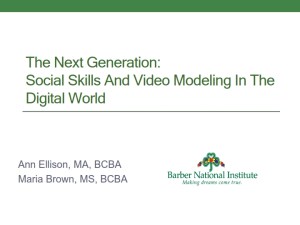
Ann Ellison, MA BCBA, and Maria Brown, MS BCBA, presented “The Next Generation: Social Skills and Video Modeling in the Digital World” for the National Autism Society of America in Denver, CO, this week. Denver draft 2_002 They were honored to be selected from the hundreds of proposals that were submitted!

Key objectives of the presentation were:

  • List essential features of effective social stories and video modeling
  • Identify three digital tools which can be used to create a project
  • Create a basic story board for a project

Social stories and video modeling can be used to teach, as well as reinforce, any skill area. At ELBS, we use these methodologies to develop social/ communication skills, functional/academic skills, and employment skills, just to name a few.

As defined by Carol Gray (1991), Social Stories™:

  • Teach new behavior or strengthen existing behaviors
  • Define expected behaviors (social rules)
  • Explain the behavior of others (perspective)
  • Present information in a concrete, literal way
  • Support sequencing, organization, and planning
  • Provide structure to unknown situations

Denver draft 2_041As part of the presentation, Ann and Maria will discuss how to develop a social story, take effective videos, and develop tutorials. Their motto is: “Be inspired… Create, share, and teach!”

If you would like to view their entire presentation, click here: Denver.

Posted in Uncategorized | Leave a comment

Meltdowns or Tantrums: How to Tell the Difference

Meltdown? Tantrum? This decision can be tricky, but it’s really important to differentiate between the two because your approach to handling the behavior will greatly differ. After many years of experiencing both and trying to discern what is happening, I wanted to share with you some tips about how to tell the difference and what to do for each. big_cartoon_carvin_scream

For those unfamiliar, a meltdown is considered “an involuntary reaction to over-stimulation, whether cognitive or sensory,” while tantrums are “voluntary reactions in order to manipulate someone.”

To help determine if your child is in fact having a meltdown, look for a few of these key signs:

  • Is your child watching you to see your reaction?
  • Are they aware of their surroundings?
  • Are they concerned with their own safety?
  • When the episode ends, do they calm down quickly?

A child having a meltdown will typically not be aware or concerned with their surroundings, safety, or even your reaction to them. It’s just the opposite with a tantrum: the child is often trying to manipulate either you, his surroundings, or both in order to get what he wants. With meltdowns, even after the episode is over, it may take a while for him or her to calm down. Whereas, following a tantrum, the child will quickly move on to something else.

Once you have determined whether your child is having a meltdown or a tantrum, your response will likely be very different for each. For meltdowns, here a few ideas:

  • Remove your child from an area where they could harm himself or others
  • What comforts your child typically? Try to use that during the meltdown
  • Be calm and reassuring
  • Have a plan in place if the meltdown occurs in a public area
  • Noisy, crowded spaces are often the setting for meltdowns due to sensory overload. Keep your trips short and reward your child for good behavior throughout the visit

Because temper tantrums are really power struggles between you and your child, be sure you have a behavior plan that addresses what you should do if this behavior occurs. Consistency is the key. Some other tips that might help are:

  • Understand why the behavior is occurring
  • Role-play/practice appropriate responses to difficult situations
  • Use language that focuses on what you want your child to do, not what you want them NOT to do
  • Calm first, teach second

As a parent, I find truth in this quote from Fred Rogers: “I think of discipline as the continual everyday process of helping a child learn self-discipline.” After all, it’s never too early to start building appropriate positive behaviors in your child!

Posted in Uncategorized | Leave a comment

Happy 4th of July!

4th

Posted in Uncategorized | Leave a comment

Guest Blog: Reading Comprehension Instruction for Students with Autism without Accompanying Intellectual Disability

Today’s blog is brought to you by friend and colleague Dr. Sarah Howorth.

Dr. Howorth is an Assistant Professor of Special Education at Mercyhurst University, and a 2015 graduate of the Joint Doctoral Program in Special Education and Digital Leadership at the State University of New York at Buffalo. Her doctoral research focused on the use of technology for instructional purposes in special education, reading comprehension, and students with Autism Spectrum Disorder, and was funded by a grant from the Office of Special Education Programs (OSEP) of the Federal Department of Education.

Recently, Dr. Howorth was awarded the Herb Prehm Student Presentation Award by the Division of Autism and Developmental Disorders (DADD) at the 2015 National Council For Exceptional Children Conference in San Diego. Dr. Howorth has presented nationally on reading instruction for students with disabilities, digital technology integration for instruction, behavior management, and virtual rehearsal for teachers using TeachLivE.

A former special education teacher, with certification in both New York and Pennsylvania, she has taught in Michigan, Pennsylvania, and the Shanghai American School in China. In 2001, Dr. Howorth served as a behavior specialist at the Gertrude A. Barber Center. She is a new faculty member at Mercyhurst University here in Erie, Pennsylvania and has recently returned to live here with her family.

~ Maureen


Reading Comprehension Instruction for Students with Autism without Accompanying Intellectual Disability

As indicated in Dr. Barber-Carey’s last blog post, reading comprehension instruction can be a struggle for teachers of students with Autism. Although many of these individuals learn to read quite well, they often struggle with making inferences and understanding the main idea of both narrative and expository text. This can have negatives implications on their academic success in both middle school and high school. howorth 1

Block et al. (2009) indicate that focus on academic reading for understanding is emphasized after grade three, rather than learning to read. In order to comprehend what they are reading, learners need to process the information embedded within the text, integrate it with their own prior knowledge, and monitor their own understanding of what is being read in order to make inferences about what is not explicitly stated in the text (National Institute of Child Health and Human Development, 2000). Cognitive processing styles of students with ASD must also be taken into consideration when designing instructional interventions.

Skilled readers must use information from their own background, the text clues, and the context in which they are reading (e.g. leisure, academic, instructions) in order to make meaning. Students with ASD have many areas of cognition impacted by their neurological differences, including metacognition, abstract thought, and interpretation of language (Boutot & Myles, 2011) Only three studies have investigated literal and inferential reading comprehension and students with high functioning autism spectrum disorder (Kamps et al., 1989; Kamps et al., 1994; O’Conner, & Klein, 2004).

Howorth 2However, in the Thinking before, While, and After reading (TWA) strategy used by Mason (2004; 2013), accessing prior knowledge is taught first, then the student is guided to think and verbalize what they want to learn from what they are reading. Students with ASD require support such as this to make connections between abstract ideas (Wahlberg & Magliano, 2004). The final step of the TWA strategy (Mason, 2004; Mason, 2013) involves summarizing what has been learned, and retelling of the information in the students’ own words.

Again, making global connections such as this is a skill that requires explicit instruction, especially for students with ASD (O’Conner & Klein, 2004).   I have conducted two studies that investigated the functional relationship between learning how to use the TWA strategy and the reading comprehension of middle school students with high functioning autism spectrum disorder. One of them is currently under review for publication in an international special education journal.

The results of both studies indicate that students with autism need to be explicitly taught self-regulated reading strategies such as TWA, and also benefit from the task analysis style list of steps involved with this strategy. When paired with highlighting of text to provide a visual guide for summary retells, reading comprehension greatly increased for all of my participants. The strategy can be taught using either paper-based or digital (i.e. PDF) texts.

Howorth 3 Howorth 4

*Images copywright Sarah Howorth, 2015


References

Block, C. C., Parris, S. R., Reed, K. L., Whiteley, C. S., & Cleveland, M. D. (2009). Instructional approaches that significantly increase reading comprehension. Journal of Educational Psychology, 101(2), 262-281. doi:10.1037/a0014319

Boutot, E. A., & Myles, B. S. (2011). Autism Spectrum Disorders: Foundations, Characteristics, and Effective Strategies. Pearson: NY.

Howorth, S. (2014). Effects of TWA strategy on expository reading comprehension of students with high functioning autism spectrum disorder. Manuscript submitted f   or publication.

Kamps, D. M., Dugan, E. P., & Leonard, B. R. (1994). Enhanced small group instruction using choral responding and student interaction for children with autism and developmental disabilities. American Journal On Mental Retardation, 9960-73.

Kamps, D., Locke, P., Delquadri, J., & Vance Hall R. (1989). Increasing academic skills of students with autism using fifth grade peers as tutors. Education & Treatment of Children, 12(1), 38-51.

Mason, L. R. (2004). Explicit self-regulated strategy development versus reciprocal questioning: Effects on expository reading comprehension among struggling readers. Journal of Educational Psychology, 96(2), 283-296. doi:10.1037/0022-0663.96.2.283

Mason, L. H. (2013). Teaching students who struggle with learning to think before, while, and after reading: Effects of self-regulated strategy development instruction. Reading & Writing Quarterly: Overcoming Learning Difficulties, 29(2), 124–144. doi:http://dx.doi.org.gate.lib.buffalo.edu/10.1080/10573569.2013.758561

Mason, L. H., Hogan, H. P., Walter, A. A., Meadan-Kaplansky, H., Hedin, L., & Taft, R. (2013). Self-regulating informational text reading comprehension: Perceptions of low-achieving students. Exceptionality, 21(2), 69–86. doi: 10.1080/09362835.2012.747180

National Institute of Child Health and Human Development. (2000). Report of the National Reading Panel. Teaching children to read: An evidence-based assessment of the scientific research literature on reading and its implications for reading instruction (NIH Publication No. 00-4769). Washington, DC: U.S. Government Printing Office. Retrieved from https://www.nichd.nih.gov/publications/pubs/nrp/Documents/report.pdf

O’Connor, I., & Klein, P. (2004). Exploration of strategies for facilitating the reading comprehension of high-functioning students with autism spectrum disorders. Journal of Autism and Developmental Disorders, 34(2), 115–127. doi:10.1023/B:JADD.0000022603.44077.6b

Wahlberg, T., & Magliano, J. P. (2004). The ability of high function individuals with autism to comprehend written discourse. Discourse Processes, 38(1), 119–144. Retrieved from http://www.erlbaum.com/Journals/journals/DP/dp.htm

Posted in Uncategorized | Leave a comment

A Different Way to Read

I was fascinated to learn about a reading program that improves brain connectivity in students with autism. Ryan was an early reader. He had a very large sight vocabulary by age 4. However, as he moved into primary grades, I was very concerned about his comprehension skills. He was a great reader, but did he truly understand what he was reading?

children-readingUnfortunately, he did not. Difficulties with comprehension were a problem for Ryan throughout his school career. That’s why I was excited to read about a program that capitalizes on the strengths of students with autism. Not only does it improve comprehension, but it establishes new connections between the areas of the brain that are involved in understanding language.

In a study of 13 children with autism who were between the ages of 8-13, students participated in 200 hours of instruction using the Visualizing and Verbalizing Program. An age-matched group of children who also had autism but did not participate in the VVP acted as the control group. Reading comprehension tests and a fMRI, tracking brain activity and connectivity, were administered as both a pre-test and a post-test, to measure results. Investigators found increased brain activation and connectivity between two of the brain’s core language areas as well as improved reading comprehension for the children in VVP. By contrast, the children in the control group showed no significant changes in either area.1211017-Visualizing-Verbalizing-Kit-N

I was excited about this program because it speaks to one of my favorite quotes: “If a child cannot learn in the way we teach, we must teach in a way the child can learn.” I plan to look into VVP to see about incorporating it into our school program. Who knows, maybe Ryan would still benefit from it. It’s never too late to learn!

Posted in Uncategorized | 3 Comments

What I Want You To Know About Me…

After I read this blog, I thought back to Ryan’s school years. Every August, I would meet with his new teachers and review a list we created called, “The Top Ten Things to Know About Ryan Carey.” I always walked away from these meetings hopeful that Ryan would have a successful year. I certainly encourage other parents to consider this option, because it definitely worked for us!

Here are some excerpts from the 2008 school year list:

  • Look beyond my diagnosis and see me for whom I am. It’s just “Ryan Carey”, not “Autistic Ryan Carey.”
  • When I ask the same question repeatedly, it’s because I get anxious and I am worried about what is going to happen in the future
  • I get nervous when I am in social situations, even with people I know well. I’ll say “Hello,” shake hands, but then I will want to go elsewhere
  • Intense exercise, such as running for 60 minutes, is the best way for me to relax and calm down. Provide as many opportunities as possible for me to move about freely (in a safe space!)
  • When I am crossing streets or in the parking lots, I can sometimes be in a hurry to get where we are going. This causes me to move too quickly, which can be dangerous
  • Expect the most of me, just as you would from any other child. You’ll be surprised by what I can do!

I added a note from myself at the end:

“Have fun with him, he will truly teach you more than you will know and being with him is unlike being with any other child. He is truly unique and yes, challenging at the same time. You will need to think outside of the box, and know that what we are doing with him might not always sound like what we should be doing, but we have to do things very differently with Ryan, including how we interact with him. Set your expectations high, because trust me when I tell you that he can do, he can.”

Ryan on his first day of kindergarten

Ryan on his first day of kindergarten

Posted in Uncategorized | Leave a comment

Celebrating Dads

Father’s Day is always bittersweet for me. Certainly, I have many good memories of my father. Unfortunately, he passed away when I was in college so the time I had to spend with him was short.

My father, Joseph C. Barber

My father, Atty. Joseph C. Barber

When that Sunday in June rolls around, I contemplate the impact my father had on my life. He had high expectations for my siblings and myself; an “A” wasn’t good enough, it needed to be an “A+!” His motto was: “if you set your goals high, you will reach them.”

His talents as a writer were enormous, and I consider my abilities in that area a direct result of his influence. He believed that each and every person had an intrinsic value and all should be treated equally. He encouraged diversity in our friendships to help broaden our perspectives. He, along with my mother, believed that volunteerism was not only a requirement, but a necessary first step in understanding your commitment to your community.

The Barber Family

So when I came across the following story of two fathers, I could hear my father’s voice ringing in my ear. In 2014, NCAA Coaches Pat Skerry and Tom Herrion embarked on a mission to raise awareness of autism. Fueled by the love for their sons, both diagnosed with autism, the two coaches made a simple request to fellow coaches to don the Autism Speaks logo pin during a February 2014 NCAA basketball game. After an overwhelming response, the Coaches Powering Forward for Autism program was created. This program provides basketball coaches, their teams, schools and community supporters with an even greater opportunity to help increase awareness, fundraise and advocate for the needs of families and individuals affected by autism.

Of course, Dads don’t need to create national programs in order to be special. I know a great many fathers of our students who go above and beyond for their child on a daily basis. Yes, they are special too!

To all fathers out there: Thank You!!

Posted in Uncategorized | 2 Comments

Happy Father’s Day!

Fathers_001

Posted in Uncategorized | Leave a comment