Teaching Social Skills

Did you know that kindergarten-aged children who share, cooperate, and are helpful are more likely to have a college degree and a job 20 years later, compared to those who lack these social skills in early life? In the past, there was a significant push to begin academics prior to kindergarten. It was not unusual to see preschool children sitting at tables completing worksheets. Fortunately, we no longer believe this is the case. We now know that the acquisition of social and emotional skills helps the child to do well in school, pay attention, establish relationships, and learn empathy.

As many children with ASD have deficits in their social-emotional arena, it becomes even more important to begin to teach these skills at a very early age. Today, there are a number of social skills curriculums available at all age groups and skill levels. However, a group that has been ignored, to date, is young adults with autism.

That’s why I was especially interested in reading about the “Program for the Education and Enrichment of Relational Skills” (PEERS). A recent study, published in the Journal of Autism and Developmental Disorders, took a closer look at the success of this program. The results were overwhelmingly positive.

22 young adults, 18-24 years of age, with autism and without intellectual disabilities, were participants in a group study over a period of 16 weeks. Those who completed the classes offered by PEERS had significantly greater improvements in social skills and in their frequency of social engagement, compared to the control group who was on the wait list. In addition, those who took the class had a significant decrease in autism symptoms that were related to social responsiveness.

Even more encouraging, four months after the training participants returned for another evaluation. These results showed that they continued to demonstrate significant gains in social skills and engagement.

I have always said that learning is a lifelong endeavor; I’m pleased that there are now opportunities for continuing social skill development for adults with autism!

For further information on PEERS, visit their site: http://www.semel.ucla.edu/peers/teens

Posted in Uncategorized | Leave a comment

Friendship & Autism

buddiesAs this week is National Friendship Week, I thought I would use this topic to take a deeper look into autism and friendship, specifically some of the challenges many children and families experience. Of course, the first caveat is “if you know one child with autism, you know one child with autism.” Certainly, what I’m sharing does not apply to all, but hopefully I can offer some general considerations that you may find work for you.
Yes, some children with autism experience communication challenges and have trouble with social interactions. They may shy away from the simplest conversation, avoid eye contact, and appear to be “uninterested.” However, that does not mean that they don’t want to have friends. They may simply lack the social skills for developing friendships.

In reviewing a number of studies, results consistently show that compared to typically developing children, children with autism experienced significantly more loneliness than their typical peers, and that their quality of friendships was poorer, in terms of companionship, security, and help.

I know that in Ryan’s case, developing friendships was something that was important to me but not as important to him. He was most content in interacting with adults who were patient enough to take the time to listen to him and ask thoughtful questions. They were not bothered by his repetitions, nor by his desire to speak about his interests only. Looking back on his school years, I am hard-pressed to even identify one peer who was a friend, a sad commentary on his school career.

What can we do as parents and educators to meet this challenge?

  • Be patient when the person speaks. It may take him/her longer to express a complete thought. Auditory processing difficulties are present in many children.
  • Communicate clearly, in short sentences, with a reasonable pace and volume. If the child is non-verbal, use a picture or a communication board.
  • Plan ahead by making play dates, if possible with typical peers.
  • ebuddiesInvestigate the Best Buddies program – bestbuddies.org. If there is not a chapter at your school, consider working with administration to start one. Ryan participated in ebuddies (ebuddies.org), and thoroughly engaged with his buddy via the computer.
  • There are also numerous activities that you can do with your child to help improve his/her social skills: LINK. Ryan and I, during his preschool years, would have staring contests – Who could look at each other the longest without turning away?

During this National Friendship Week, think about the friendships that you and your child may have, and identify ways to strengthen them!

Posted in Uncategorized | 3 Comments

Guest Blog: Interview with Malva Tarasewicz

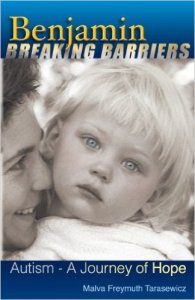
Malva Freymuth Tarasewicz is an accomplished author and mother to Benjamin, a young adult with autism. Her book, Benjamin Breaking Barriers: Autism – A Journey of Hope, is compelling and full of great ideas. She has since started a blog of her own: www.BenjaminBreakingBarriers.com. I had the opportunity to interview her about her experiences with Benjamin. I hope you enjoy getting to know her; I know I did!

 ~ Maureen


Q: Malva, what prompted you to write this book?

A: I’ve been Benjamin’s primary therapist throughout his life and, being a professional musician and educator, I’ve come up with many creative ways to bring forth Benjamin’s personality and strengths – while also working on his problem areas. Autism therapy is expensive, and parents can do so much to help their children at home. You don’t have to be an expert to be effective, and there’s always a need for fresh insight and inspiration.

BBBMy book reads like a novel, and I share the nuts and bolts of what I came up with to help Benjamin. Since we’ve been on this journey for nearly two decades, there’s a lot to share! Many books focus on the crucial early years, but I continue on from there into the problems, ideas, and solutions that have carried Benjamin through elementary, middle, and high school issues.

Since life is a work in progress, I’ve extended the book into a collaborative blog that includes essays by Benjamin. For example, he has expressed his current views on romantic relationships, and has written about music and how it helps him when things are difficult. The music essay, by the way, was picked up by Autism Speaks and was also featured in the Art of Autism awareness campaign this past spring.

Q: For you, the arts are key to enlivening the therapeutic process. Can you give an example?

A: Being a musician, I naturally gravitate to musical sounds and rhythms – music accesses something primal within us. Oliver Sacks, eminent brain researcher and psychologist observes, “Music occupies more areas of the brain than language does—humans are a musical species.” Anyone can clap a rhythm and sing; even a tone-deaf person can use a sing-songy voice that is clearly different from their ordinary speaking voice. And music will often get a response from someone with autism when a spoken directive will not. For example, when first encouraging Benjamin to give eye-contact at age two, I’d put him in a hammock and, while swinging him back and forth, I would sing. Then I’d stop in the middle of the song and Benjamin would inevitably glance up at me, wondering why the music had disappeared. To reward his eye-contact, I’d resume singing, and this gradually became a sort of game, a back-and-forth interaction. Getting that eye-contact was a big deal because Benjamin was so lost in the fog of autism – thus, music became a primary gateway to engagement. My book gives many examples of how to use music in day-to-day therapeutic engagement.

Q: Benjamin has exceptional public speaking skills, and you’ve mentioned his long-time involvement in theater. Can you recount the beginnings of this path?

A: First, let me say that theater, by its very nature, lends itself to being therapeutic: you get to practice lines and body language over and over again, and you learn to be part of a team as well, so you are working on social skills. But long before a child with autism might participate in drama, you can create little mini-plays that dovetail with your therapeutic goals. I did this a lot with Benjamin when he was little. For instance, I would take one of those four-line verses like, “Jack and Jill went up the hill…” I’d work it in all manner of ways. Using dolls/figurines, we’d practice play skills and reinforce comprehension. We’d act out the verse using props and costumes, working on speech issues and physical gestures. We’d draw pictures – thus addressing fine motor and visual/spacial skills. We’d sing the verse too, clapping, marching, or dancing along. Mother Goose rhymes are precious seed-material—you can do so much with them!


If you are interested in purchasing Malva’s book, you can find a copy on Amazon here.

Benjamin has given a TED talk titled Breaking Barriers of Autism: The Power of Kindness and Friendship. Watch it here: https://www.youtube.com/watch?v=r05BUkOfOk8

Posted in Uncategorized | Leave a comment

Autism Research Updates

researchAlthough it may not always seem to be the case, scientists and researchers are constantly uncovering more information related to autism, offering insights into the origins, possible causes and even at times potential cures. I come across dozens of articles on a weekly basis, some of which seem more important than others. After the positive response I received when I posted Top Research Stories of2014, I thought I would start to share some of the current research articles that I read on a monthly basis. Below are three stories that caught my eye this month.


Study Picks Up Autism Broadcast in Tiny Antennae on Cells

A new study suggests that some symptoms relating to autism may be connected to a mutation in a section of Chromosome 16, which is linked to autism. Cilia, which are essentially miniscule hairs on the surface of all cells, are altered as a result of this chromosome mutation. The study also raises the possibility that drugs that target the cilia may ease symptoms of autism.

Read the full article here.

Study Finds Autism, ADHD Run High in Children of Chemically-Intolerant Mothers

A new study from the University of Texas Health Science Center at San Antonio found that mothers with chemical intolerances are two to three times more likely than other women to have a child with ASD or ADHD. Chemical intolerances include sensitivity to engine exhaust, gasoline, smoke, fragrances, cleaners, nail polish remover, and air fresheners, to name a few.

Read the full article here.

Contrary to Previous Studies, Children Born By Ceasarean Section Are Not At Higher Risk for Autism

Two Swedish siblings have provided the best evidence to date that there is no causal link between birth by C-section and autism, contrary to older studies that suggest that C-sections raise a child’s risk by up to 20%.

Read the full article here.


Tune in next month for an update on autism research!

Posted in Uncategorized | Leave a comment

How Our Country Feels about Intellectual Disabilities…

In July, Maria Shriver’s foundation released The Shriver Report Snapshot: Insight into Intellectual Disabilities in the 21st Century. This report shared the results of an online poll, conducted within the United States, after surveying a total of 2,021 adults ages 18+, of whom 1,103 were identified as knowing someone with an intellectual disability. The poll was conducted by Harris Poll, on behalf of The Special Olympic Games in Partnership with Shriver Media.

Infographic_IntellectualDisabilities_IG12The survey shows a nation in the midst of change. Overall, the survey reveals that the more than half of Americans who have personal contact with someone with intellectual disabilities are increasingly accepting and positive. It also exposes that lack of contact has left a legacy of misinformation, dated stereotypes, ignorance and fear in the other nearly half of Americans. When it comes to attitudes towards people with ID, experience is the game-changing ingredient. Despite gains in visibility, the estimated 3 to 9 million people with ID living in the United States remain isolated from the rest of society. Likely as a result of increased exposure and interaction, young adult Americans have more progressive attitudes toward, and expectations for, people with ID. Millennial women, ages 18-34, in general are the most compassionate, inclusive and progressive of any group surveyed.

Some Stats:

Increased Exposure

  • 56% of Americans personally know someone with an intellectual disability
  • 42% of Americans have had no personal contact with someone with an intellectual disability
  • 13% of Americans say they have a friend with an intellectual disability
  • Only 5% know what it is like to work with someone with ID
  • Nearly half of those who know do someone with ID (44%) say they have a family member who has an intellectual disability

The “R” Word

  • 89% of Americans agree that calling someone with Down syndrome or autism a “retard” is offensive
  • Nevertheless, a large number of Americans think the word “retard” can be used inoffensively in other situations. Many believe it is not offensive to call a friend a “retard” (38%) or to describe oneself that way after making a mistake (56%)

Life & Work

  • Those who personally know someone with an ID are significantly more likely than those who do not know anyone with an ID to feel at least somewhat comfortable employing (84%) or working with someone with an intellectual disability (87%)
  • An overwhelming majority of Americans (93%) believe that adults with intellectual disabilities should be encouraged to have jobs
  • 62% believe that people with intellectual disabilities and their families should receive financial assistance from the federal government
  • 84% say that adults with intellectual disabilities should be encouraged to live independently
  • Still nearly 1 in 10 Americans (8%) believe that all adults with intellectual disabilities should be institutionalized

Infographic_IntellectualDisabilities_IG12Education

  • 4 in 10 Americans (39%) believe that children with intellectual disability should not be integrated in the same classroom as other kids their age
  • 26% of Americans believe that parents of children with intellectual disabilities should lower their expectations about their child’s potential for success

Society

  • 44% of Americans believe that a person with an intellectual disability who commits a crime where the death penalty is a possible sentence should be treated no differently than someone without an intellectual disability
  • 22% believe that adults with intellectual disabilities should not be allowed to vote in elections
  • 53% of Americans are comfortable with the idea of having their child date someone with an intellectual disability
  • 91% said they would expect at least some parents to terminate a pregnancy or give the child up for adoption if they found out their child had an ID, but only 18% said that most would end pregnancy or give up the child

While I was pleased to read some of the statistics, I was quite frankly shocked by others. We certainly have come a long way in our attitudes towards individuals with intellectual disabilities. However, it is up to us to assure that we continue and expand our educational programs so that 100% of our society is compassionate, accepting, and understanding of persons with intellectual disabilities. The challenge is ours!

Posted in Uncategorized | 2 Comments

The Power of Forgiveness

Being a parent is a challenge. Many of us think we can achieve it all; work full-time, parent full-time, volunteer, and still have time for fun activities in between. Consequently, we set unrealistic expectations for ourselves. At times this can cause a lot of stress, which can end up causing a lot of stress for our children. It can be much better to accept our limits, and do the best we can without feeling as if we are stretched too thin. Acknowledging that we can’t do it all can free us from the idea that we must do it all, and allows us to reach out to others for help where we need it. forgive-stones

Accepting this belief is the first step in learning to forgive yourself as a parent. I certainly went through all the stages that I described above. But I quickly learned that I could not do it all, and reached out to friends and family for their support. I also realized that what was important was not to focus solely on the “great days,” nor the “not-so-great days,” but look to the “OK days.”

When your child has a disability, your life is not simple, but you must remember: You’re allowed to have bad days. You’re allowed to be sad. You’re allowed to lose your patience. You wouldn’t be human if you didn’t. You must forgive yourself for being an imperfect parent and recognize that tomorrow is a new day.

No one can ever learn all the things it takes to be a perfect parent, but we can try to forgive ourselves for that, as well. Self-compassion has been shown to assist people with traits that are important to parenting. It increases resilience and coping skills, and enhances perspective, forgiveness and compassion for others.

Practice mindfulness and positive thinking. Instead of focusing on emotions like guilt, conflict, worry and pessimism, identify and work to strengthen gratitude, forgiveness, and optimism. This has helped me through my challenges. I hope my thoughts might help you as well.

power-of-forgiveness_t

Posted in Uncategorized | 2 Comments

Cyberbullying

This month, Pennsylvania passed Act 26, a new law that aims to stop cyberbullying of children by making it a punishable offense. The law makes cyber harassment of a child a 3rd degree misdemeanor, punishable by a maximum $2,500 fine or even up to 1 year in prison. I wrote a blog in 2013 about bullying in general, and at the time briefly referenced cyber bullying. Since then, its prevalence has unfortunately grown by leaps and bounds.

autism parentIn researching cyber bullying and online abuse, I learned that there are actually several types of cyber bullying. They include online harassment, “outing,” (when a victim’s personal information is shared online without their consent), victim blaming, and “trolling,” (faking a social media profile to send hateful messages). I was shocked to read that this is occurring with such regularity.

Even more shocking were some of the statistics. In a 2014 survey of 10,000 young people in England:

  • 7 in 10 young people are victims of cyber bullying
  • 37% experience cyber bullying on a “highly frequent” basis
  • 20% experience “extreme” cyber bullying on a daily basis
  • Facebook, YouTube, and Twitter are the top 3 platforms for cyber bullying

It’s important to be aware of some of the signs of cyber bullying. Warning signs may be emotional, social/behavioral, academic, or any combination of these. In particular, the biggest red flag is a withdrawal from technology. If you notice a sudden change in computer or phone usage, talk to your child. They may be being cyber bullied. For more information on signs of cyber bullying, visit the National Crime Prevention Council.

Technology has opened many doors for our society, but also brings with it great responsibility. It’s up to us to teach our children how to use technology appropriately.

Other resources:

US Dept. of Health & Human Services anti-bullying site: www.stopbullying.gov

Center for Safe Schools: www.safeschools.info

Bullying Prevention Institute: www.bullyingpreventioninstitute.org

Posted in Uncategorized | 1 Comment

Celebrating ADA

This past Monday, an op-ed piece I wrote was featured in our local newspaper. I thought I would share it below, for anyone who may have missed it!

~ Maureen


Every July, we celebrate two anniversaries of independence. One is, of course, July 4th. The second is less well known. On July 26th, 1990, President George H.W. Bush signed the historic Americans with Disabilities Act, a civil rights law that prohibits discrimination against individuals with disabilities in all areas of public life, including jobs, schools, transportation, and all public and private places that are open to the general public.

adaWhile the ADA has led to changes throughout society, perhaps the greatest area of impact is in the area of employment. With passage of the ADA, employers were required to give all qualified individuals equal opportunity in the workforce, regardless of any disability they may have.

Now, 25 years later, we have seen so many wonderful achievements for individuals with disabilities. And we have seen incredible growth in the overall community’s attitude and mindset regarding people with disabilities. No longer are persons with intellectual disabilities hidden away in institutions; rather, we hear more and more success stories every day about what people with disabilities are accomplishing. It really is a joyous thing.

Across the Erie community, scores of businesses have opened their doors to hiring people with disabilities. Over the last several years, the Barber National Institute has assisted hundreds of individuals in securing employment. Currently, 25 local businesses employ adults with intellectual disabilities who have been trained through our supported employment program.

Still, we know that there is always more work that can be done. Too often, I hear of people who are considering opening their doors to offer employment opportunities, but have concerns. I want to debunk some of these more common myths about employing individuals with disabilities.

Myth: Hiring workers with disabilities increases workers compensation insurance rates.

Fact: Insurance rates are based solely on the relative hazards of the operation and the organization’s accident experience, not on whether an employer has hired workers with disabilities.

Myth: Providing accommodations for people with disabilities is expensive.

Fact: Did you know that many accommodations or special equipment are available at absolutely no cost? And for the minority of workers with disabilities who do need some sort of special equipment or accommodation, 56% of these cost less than $600. Employers should know that available tax incentives make it even easier for businesses to cover accessibility costs.

Myth: Employees with disabilities have a higher absenteeism rate than employees without disabilities.

Fact: Studies show that employees with disabilities have a lower absenteeism rate and a lower turnover rate when compared to employees without disabilities.

People with disabilities are wonderful assets to a business. They are typically prompt, work until the job is complete, are not searching for alternative employment, and are dedicated to doing a thorough job.

ada 2I can’t think about the passage of the ADA without recalling a remarkable woman who was seated in the audience.   Dr. Gertrude A. Barber was a member of President Kennedy’s commission on Mental Retardation, involved in crafting and promoting the ADA, and, of course, known for her life’s work on behalf of creating opportunity for individuals with disabilities. In recognition of her efforts, Dr. Barber was invited to the White House to see this landmark legislation passed into law.

I can recall how happy she was to see this step taken to end discrimination, and how proud she was that the Erie region was on the forefront of this battle.

Each year, approximately 50,000 individuals with disabilities turn 18. Nearly half of these individuals will have average or above average intellectual capabilities. Whether you are a business owner or an employee at a business, consider contacting the Barber National Institute to see what steps you can take to become a place of employment for adults with intellectual disabilities.

Posted in Uncategorized | Leave a comment

Taking Care of Our Refugee Community

A recent Autism Speaks blog discussed serving the refugee resettlement community in Rochester, NY. Our own Erie community has a refugee population beyond 10,000. Over the past decade, approximately 350-475 new refugees have annually resettled in the city, thereby making Erie one of the largest resettlement destinations for refugees in PA. In our school, we have over 20 refugee students enrolled who have emigrated over the last several years from Eastern Europe, Asia, Middle East, and Central America. map

As I read this blog, I couldn’t help but think about the challenges the parents of these children have experienced, not only in moving to a new country, but also in possibly not knowing the language, the customs, the education or social services systems. Most of them have expressed to me that the primary reason they came to the United States was to receive services for their child with a disability. They were willing to live in refugee camps for years if only they could resettle in the United States in the future. Their experiences underline how fortunate we are in America to have the wealth of support services for children and adults with disabilities and their families.

With the 25th anniversary of the Americans with Disabilities Act coming up this Saturday the 26th, I applaud the leadership role the United States has taken in securing equal rights for citizens with disabilities. While there’s always room for improvement, it’s important to acknowledge how privileged we in the United States are, in so many ways.

Posted in Uncategorized | Leave a comment

Making Eye Contact

Eye contact – a simple concept, but a challenge for many children on the spectrum. From my perspective, eye contact is an important method of communication in social interaction that can provide a wealth of information. Often, many of us don’t even think about making eye contact, it happens so naturally. However, this is not the case for some children and adults with ASD. In fact, it can even be a source of great anxiety and stress. There are many who suggest that we should teach eye contact, as it is an essential life skill. I would say that it all depends upon the child. eye

Take Ryan for example. When he was two years of age, we would work on the drill: “Look At Me.” If he did, he received a reinforcer. It sounds very basic, but it was a starting point. This was pretty easy when he and I were sitting at home practicing. However, with unfamiliar surroundings and people, Ryan had trouble applying the skill. Over time, he improved in his eye contact with others, especially if the topic being discussed interested him. His eye contact definitely decreases when he’s nervous, anxious, or stressed. When he’s “silly,” his eye contact is perfect, because he knows he’s doing something he’s not allowed to do.

Today, I’m not concerned about whether or not he maintains eye contact; I am more interested in his level of conversational engagement, his attention to task, and if he is demonstrating appropriate behaviors. Fortunately, most adults will stay engaged with him even if he chooses not to give eye contact, although this is not always the case with peers.

For parents who are facing issues with eye contact, I encourage you to read this Autism Speaks blog: http://bit.ly/1Kc6LVZ. One tip I’ll pass along that I found helpful with Ryan is to encourage him to look at a person’s shoulder while he/she is speaking, if direct eye contact was too uncomfortable. This worked for him when he was in a job interview situation and was quite nervous. He would look at the employer’s shoulder and it would appear that he was actually giving him/her eye contact.

What has worked in your house? I would love to hear your tips and stories!

Posted in Uncategorized | 3 Comments