In honor of National Down Syndrome Awareness month, I asked colleague and good friend Rhonda Schember if she would do me the honor of writing a blog. In her words:
“Rhonda and Joe Schember live in Erie and are the proud parents of Jaime, Joe and Jodi. Rhonda is a semi-retired writer/volunteer and Joe is an executive at PNC Bank. Jaime, 32, lives in San Francisco, CA and works for Google ATAP… Joe, 30, lives in Albany, NY and works for Mohawk Fine Papers…and Jodi, 30, lives at home and is the President and CEO of Club Jodi!”
I so appreciate Rhonda sharing her story with us, and I hope you enjoy it as well.
~ Maureen
The journey from childhood to adulthood is seldom simple…or straightforward. As each child matures, the “learning curve” changes.
But when a child is born with special needs, that learning curve doesn’t go away. Rather, it’s adapted to include changes through every stage of development. All children can learn – some just learn differently.
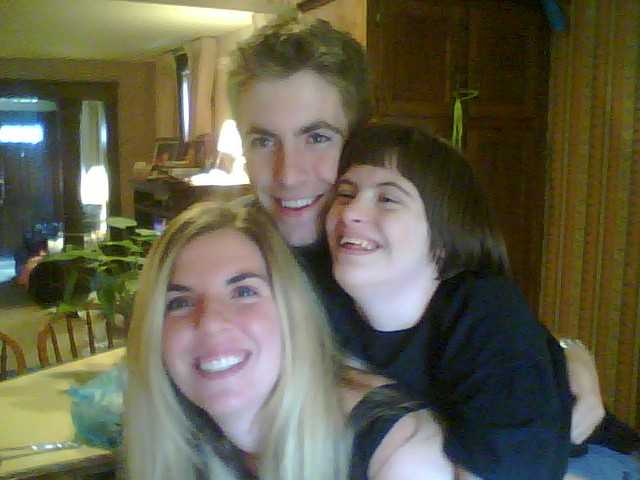
 Luckily, when our daughter, Jodi, was born with Down syndrome, she arrived as part of a rare package deal. She had a twin brother, Joe. She also had a two-year old sister, Jaime, who immediately considered the twins HER babies.
Together, as a family, we embarked on a journey into unfamiliar territory. We had a lot to learn about Down syndrome – the sooner, the better!
Admittedly, with three children under three, we were in survival mode most of the time. But we experienced an important lesson during those early years. Simply put – we could do this.
Through the combined efforts of therapists and educators, physicians and caseworkers, Jodi made progress. But we never lost sight of the fact that she had a secret weapon at home. She had a twin brother…and an older sister.
 As one therapist pointed out, Joe would become Jodi’s best teacher. When Jodi couldn’t roll over or stand, Joe would do it first. If she took too long to copy him, Jaime would push her over or lift her up…and I would hold my breath!
Eventually, Jodi got the idea. There was always someone there for her to watch and imitate. She also had a cheer leader and coach just 2 years older.
Never was that more evident than when the kids were watching Sesame Street one morning. Jodi was still non-verbal at this point and the “word” of the day was not particularly easy. But Joe kept repeating it for her. When she didn’t reply, he jumped up, took her cheeks in his hands and firmly said, “Jodi say IDEA.” And she did…as clear as day…IDEA! No Mama or Dada, her first spoken word was IDEA!

Joe helps Jodi say her first word.
Joe had stumbled into that teachable moment. I sat there in tears and Jaime jumped into Mommy mode – making them repeat it, over and over, until Daddy came home!
Despite the detours and challenges of parenthood, we discovered that those unexpected triumphs can ultimately direct a child’s path to success. They give us hope and determination, but it’s often the siblings who provide the inspiration.
We’re reminded of that every day when Joe and Jaime call from opposite sides of the country to check in on their sister. After 30 years, the love they share is priceless…the bond, unbreakable…and the journey, far less frightening.


 Scientists and researchers are constantly uncovering more information related to autism, offering insights into the origins, possible causes and even at times potential cures. I come across dozens of articles on a weekly basis, some of which seem more important than others. After the positive response I received when I posted Top Research Stories of2014, I thought I would share on a monthly basis stories that caught my eye.
 Next Wednesday is Unity Day, a chance for schools and communities around the country to come together to take a stand against bullying. I have shared some startling statistics on bullying in the past (see:





 Of course, parents are having similar experiences in many venues, church, the grocery store, amusement parks… the list is endless. I, too, have been the mom who felt pressured to quickly exit a room full of people who were staring at us, all because of Ryan’s perceived “disruptive” behavior.