#ChangeYourMind about Brain Injury


Did you know that brain injury is the leading cause of death and disability in children and young adults? I certainly did not, and was shocked to learn this.

BRAINSTEPS POST 7

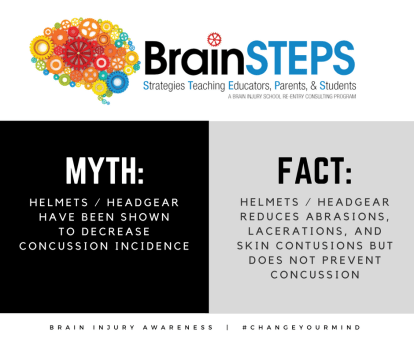
As part of Brain Injury Awareness month, a PA organization called BrainSTEPS has shared a number of statistics, myth v. fact comparisons, and helpful resources for parents, caregivers and school support staff.


BrainSTEPS was founded in 2007 by the PA Department of Health to address the cognitive, physical, socio-emotional and behavioral impairments that can impact a student’s performance following an acquired brain injury (ABI). Just last year, the CDC recognized BrainSTEPS as a national model for educational consultation supporting students and school teams.


  • Every 9 seconds, someone in the United States sustains a brain injury.
  • Approximately 22,000 children and adolescents ages 0-21 years sustain concussions each year.
  • More than 3.5 million children and adults sustain an ABI annually.
  • One of the least common symptoms of concussions is loss of consciousness.
  • One of every 60 people in the United States lives with a brain-injury related disability.

BNI staff person Cindy Priester, OT/R, MS, serves as a member of the local BrainSTEPS team.

For more information about traumatic brain injury and resources to help a child return to school following injury, visit Getschooledonconcussions.com.

Posted in Uncategorized | Leave a comment

How to talk to your child about Parkland

safeIn the aftermath of the tragic Parkland, FL incident, it seems that whenever you turn on your TV the news is always covering some aspect of the incident; whether it is asking “Could this have been prevented?” to how to make schools safe. No matter how much we try to censor, our children are hearing this conversation daily. They are coming to us and expressing their worries about safety while attending school. What can we as parents do to help our children through these frightening times? Below are some tips to help you talk to your child:

Pay Attention, not just to what your child is saying but also what they do. Some children may come to you and ask to talk about it. Others may engage in drawing, or imaginative play, to share their feelings. So much depends upon the individual child and how he expresses himself. For example, if your child shy and timid, his anxiety may be expressed in seemingly unrelated ways.

Reiterate their safety. It is essential to reinforce the idea that regardless of where your child may be during the day, school or at home, there are always adults present who have a plan to keep them safe. Talk to them about many, many steps that are taken to ensure that they are safe at school.

Let their questions be your guide. Encourage open conversation and allow them to speak freely about their worries. Be prepared to answer all kinds of questions, and try to think through your responses prior to talking to them. Depending on your child’s age, your answers will vary greatly.

Take a break from the media… as best as you can. While it is wise to censor it at home, your child probably is seeing and hearing about the tragedy through social media. Still, you can and should encourage your child to take a break from the ongoing deluge of information surrounding the incident.

These tips are applicable for all children, regardless of age or ability. In our home, in the wake of the tragedy I have simply turned off the TV. We listen to the Weather Channel, but that’s it. The unfolding of the Parkland tragedy caused such anxiety and worry for Ryan that he didn’t feel safe leaving the house. We have had many conversations, with him asking many questions about what happened and why it happened and will it happen in Erie. We have revisited the plan of what he should do if he feels unsafe, which helps a great deal in making Ryan feel safe and in control. I can only pray that it will be a long time before we need to address this again!

Posted in Uncategorized | Leave a comment

Book Review: Maria Shriver’s “I’ve Been Thinking”

I am an avid follower of Maria Shriver’s Sunday newsletter, so I was thrilled to hear that she was writing a book, “I’ve Been Thinking: Reflections, Prayers and Mediations on a Meaningful Life.”  I learned that she was going to make available to some of her followers an early edition of the book so that we might read, share our thoughts and comment on social media. I answered some questions, submitted my application with little assurance that I might be selected…but to my great surprise, I was!

IBT.jpeg

This book has challenged and inspired me to truly consider what a meaningful life is for me, and given me the building blocks to work towards one.  I now find myself choosing to live in the present, not regretting the past nor worrying about the future. Without her inspirational and motivational words, I am not sure if I would have begun this journey.

I am also beginning to see the role faith plays in a meaningful life; as the root of fortitude, it brings calmness and stability to an often unpredictable and even at times chaotic life.


One of the chapters that was most inspiring to me was “The Power of Gratitude.” I learned that making a daily, conscious effort to be grateful makes you happier and more hopeful. Gratitude reduces the output of stress hormones, primarily cortisol, during challenges and crises. Gratitude also strengthens social bonds and fosters feelings of love. For some, gratitude comes naturally, but for others, a daily gratitude practice is needed.

When I wake up in the morning, one of my first thoughts is: “What am I grateful for?” Each day is different, but it usually centers around health, family, faith, and the work I do. I am finding this a great positive way to begin my day.

So, I thought to myself: Ryan needs to have a daily gratitude practice. For him, waking up would not be the best time, so we decided to have our gratitude practice during breakfast. I initially explained to him why this was going to be one of our daily habits and that, instead of giving up something for Lent, we would be doing this. It was a little rough from the start but as he began to see how much he had to be thankful for, I could see that he enjoyed it more.

Our plan is to continue beyond Lent and have this as one of our morning routines. I think that a gratitude practice is an invaluable tool for both children and adults. Try it out and see what you think!


Posted in Uncategorized | Leave a comment

Celebrating Digital Fluency: Digital Learning Day!

Tomorrow is Digital Learning Day, an event that we have been celebrating at the Barber National Institute for the past five years. One of the main reasons we so look forward to this day is that it offers us a chance to show the community the many ways that we integrate technology into the culture of our school. By incorporating it in the therapies and lessons our students regularly engage in, students use technology to achieve their IEP goals as well as to enhance communication with their peers, staff, and families.TRE_0749.jpg

We have made great strides over the last decade to become a fully technologically integrated school. At the start of each school year, teachers and therapists meet to discuss each student’s technology needs. As we always have an eye towards the future, we also conduct periodic needs assessments for the school as a whole to determine what latest tech we might wish to bring on. Digital fluency is much more than simply knowing how to use a particular app or device. It’s a general mindset that technology can open doors for our students that were formerly closed.

So what does this actually look like in the classroom? Here are some of the ways that we infuse tech into our classroom culture.

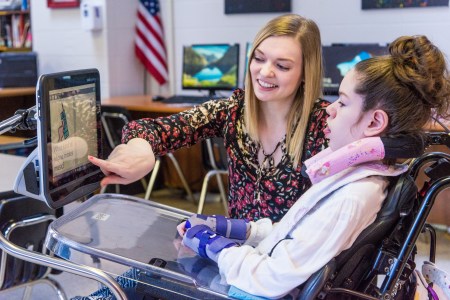
Take advantage of the wide variety of augmentative and alternative communication (AAC) devices. Our students use many forms of AAC, ranging from low-tech to high-tech systems. These devices have provided our students and families communication opportunities and interactions that no one knew were possible!

Incorporate devices into your lesson planning. Using devices such as the iPad can enhance many aspects of instruction and offer some flexibility for the teacher to circulate and give one-on-one support or create small groups.

Consider exploring online-only curriculums. It is no longer a world of simply textbooks – we utilize many online curriculums, such as News2You.

Start texting. No, seriously! Our school is implementing an opt-in texting system between teachers and parents that allows classrooms to share bits of news ranging from a theme of the week to helpful reminders. The feedback on this has been nothing but positive and really helps to keep parents engaged.

rr-digital-learning-day-495-resIf you would like to learn more about technology at the Barber National Institute, I encourage you to join us tomorrow, Thursday February 22, from 11 AM to 1 PM. Held in the gym, we will have a variety of stations set up to encourage fun interactive learning experiences. Plus, you will have the chance to win some free tech goodies! Reservations are not required, just stop by!

Posted in Uncategorized | Leave a comment

Stand Up to Stigmas

stigmaDr. Joseph Barber, MD., recently wrote a letter to the editor in the Erie Times News about the unfortunate fact that being overweight is a stigma in an increasing number of children. Obesity rates for children with disabilities are nearly 40% higher than for children without disabilities. The rates for adults are frightening: approximately 60% higher than for adults without disabilities. Reasons for this can vary; they include:

  • A lack of healthy food choices and/or dietary restrictions
  • Medications that can contribute to weight gain
  • Physical limitations that reduce a person’s ability to exercise
  • Lack of accessible environments that enable exercise

With obesity comes other health problems, including asthma and migraine headaches. In children with ASD who were obese, other health issues that were associated include anxiety, depression, and sleep problems. As Dr. Barber points out, obese children often miss more school and underachieve academically compared to average weight peers.

Peers, parents, and family members can contribute to stigmatization; for example, teachers may establish lower expectations for obese children. Of course, in today’s social media-saturated world, many negative associations can further increase feelings of depression, negative self-esteem, binge eating and social isolation.

What can we do? We must be positive supports in the lives of anyone, with or without disabilities, who struggles with obesity and encourage others to do so as well.angelou

Posted in Uncategorized | Leave a comment

How Will You Celebrate?

Did you know that todaywra is World Read Aloud day? It is a day that is dedicated to celebrating literacy as a fundamental human right. On this day, people around the globe celebrate by coming together to read aloud and share stories, whether that is in the home, the classroom, or out in the community.

I started reading aloud to Ryan when he was a newborn. Goodnight, Moon, How Much Do I Love You?, and Is Your Mama A Llama? were just some of our favorites. This practice continued through his preschool years… until he began reading aloud to me!

Here are some reasons why reading aloud is so beneficial and important:

  • Reading aloud to children every day puts them almost a year ahead of children who are not read to
  • 750 million adults around the world lack basic reading and writing skills
  • Nearly 85% of the juveniles who face trial in the juvenile court system are functionally illiterate, illustrating the close relationship between illiteracy and crime. More than 60% of all inmates are functionally illiterate.
  • Low literacy rates cost $74 million annually in direct health care costs
  • 1 in 4 children in America grow up without learning how to read

read

Literacy is a skill that you can acquire at any age. One of our students in our Adult Basic Education program is 75 years old  – and he just learned to read!

At the Elizabeth Lee Black School, we are celebrating World Read Aloud day in a number of ways, including having parents join their Early Education students to collectively read a story in the gym; having our adult students read to some of our middle schoolers; and our high school aged students reading to individuals at our Senior Center.

How will you “Read Aloud” today?

Posted in Uncategorized | Leave a comment

How Did Special Education Hold Up in Court?

fape5042017 was a significant year for special education law. The two most important legal developments were rulings on the meaning of Free Appropriate Education (FAPE) and the scope of the IDEA exhaustion requirement (the first two listed below, respectively).

I anticipate that we may see more challenges to school districts based upon the Endrew decision, in particular. I very briefly summarized ten of the most significant legal findings of the year below.


  • Progress, IEP must be “appropriate” in light of child’s circumstances

Rather than adapting a rule for determining the substantive adequacy of any given IEP, the Supreme Court ruled that the program must be “appropriately ambitious,” meaning that programs must sufficiently challenge a student regardless of disability.

ENDREW  V. DOUGLAS

  • Exhaustion not necessary for claims unrelated to provision of FAPE

supreme-court-2018.jpg

The Supreme Court unanimously held that IDEA’s exhaustion of administrative remedies requirement only applies when the substance of a parent complaint is a denial of FAPE. Parents cannot bypass the IDEA’s administrative procedures by simply omitting certain terminology from their complaints.

FRY V. NAPOLEON

  • District has no obligation to address child’s religious or cultural needs

IDEA


does not require an IEP to address the religious and cultural needs of a child with a disability, even when those needs go to the core of his identity. A district fulfills its duty to provide FAPE if it develops an IEP that meets the child’s secular educational needs.

M.L. V. SMITH

  • Reference to methodology in PWN doesn’t modify terms of student’s IEP

PWN (Prior Written Notice) is a proposal for program implementation that is not binding on the school district, meaning districts can make recommendations without the court interpreting them as being part of the IEP.

M V. FALMOUTH

  • IDEA’s statute of limitations only applies to the filing of a complaint


ideaParents can seek relief for IDEA violations that occurred more than two years before the filing date, provided they file a complaint within two years of discovering the district’s alleged wrongdoing.

AVILA V. SPOKANE

  • “Clear consensus” of evaluative data undercuts offer of 6:1 placement

This ruling does not require IEP teams to adopt all recommendations by outside evaluators; rather, it shows that an IEP team cannot disregard a “clear consensus” of evaluative materials showing that a child needs a particular service, methodology, or placement to receive FAPE.

A.M. V. NYC DEPT OF EDU

  • Unilateral IEP amendment impedes CA mom’ ability to monitor services


A parent’s right to meaningful participation does not end when the IEP document is signed; she/he also has a right to monitor and enforce the provision of special education services.

M.C. V. ANTELOPE VALLEY

  • Reimbursement award can’t predate district’s obligation to provide FAPE

A court may not award reimbursement for private services a student with a disability received before the district had a duty to provide the student FAPE. Once the district violates that duty, though, it may have to pay for any private services for the student afterward.

DALLAS INDEP V. WOODY

  • Stay-put reimbursement order turns parents into prevailing parties

gavelIf parents have to sue a district to compel the provision of stay-put services, the district will likely have to pay any legal expenses related to that enforcement action.

M.R. & J.R. V. RIDLEY

  • Child’s IEP must address transition between private, public school settings

Nothing in the IDEA expressly requires an IEP to include a plan for transitioning a child with a disability from one type of environment to another; however, an IEP team would be well-advised to consider whether a child requires such services to make progress towards his/her annual goals.

R.E.B. V. HI DEPT OF EDU


Posted in Uncategorized | Leave a comment

Top Autism Research Stories in 2017

I always enjoy looking back at the research developments of the year. I thought I would share with you what I found to be some of the significant findings throughout 2017… What a year it’s been!

~ Maureen


Link between parental age and autism, explained

  • Study of 5,000 people suggests that parents in their mid-40s are 5-10% more likely to have a child with autism than are 20-year-old parents
  • Why? Older men and women pass along a greater number of spontaneous DNA mutations

CDC says developmental disabilities are on the rise

  • Least common among Hispanic as compared to other ethnic groups
  • Lower than some earlier funding as LD, ADHD not included
  • More restrictive definition of developmental disabilities
  • Between 2014 and 2016, the prevalence of developmental disabilities among kids ages 3 to 17 increased from 5.76% to 6.99%
  • Prevalence was “significantly higher” among boys than girls
  • Rise stems from an uptick in children diagnosed w/DD and not autism or ID


Picture1

Rapid brain growth in infancy may signal autism

  • Surface area measurements (blue) of 6-month-old babies can distinguish children with autism from those without the condition
  • Increase in brain surface volume before 12 months
  • Largest brain growth = most severe symptoms


Depression, not treatment, is to blame for increased risk in autism

  • Children exposed to antidepressants were twice as likely as the other children to be diagnosed with autism
  • Association disappeared when the researchers controlled for other characteristics, including mother’s education level, mental health diagnosis, and age at delivery
  • During a child’s second year of life, overall brain size increased at the same time as their behavioral symptoms, which lead researchers to correlate the largest brain growth with the most severe symptoms of autism
  • Autism occurs at a higher rate in families that are affected by depression, anxiety, or OCD

Heightened stress reaction linked to autism-related GI problems

  • Cortisol is released by the adrenal glands during physical or emotional stress
  • Relationship between increased cortisol response to stress and GI issues
  • Children with autism and chronic GI symptoms had significantly greater spikes of cortisol

Benefits of parent participation in early interventionPicture2

  • Randomized longitudinal follow up from 2-18 years
  • Teaching parents how to interact and respond to cues from babies at high risk of autism can decrease the severity of autism features at age 3
  • The new study suggests these gains persist for months to years

Cerebellum’s role in autism homes in on social region

  • Researchers stimulated brain activity in the RCrus1 (transcranial direct current stimulation)
  • Cerebellum has to do with motor planning, social skills, and language
  • Findings indicate that a region of the cerebellum called right crus 1(red/orange) is disrupted in children with autism
  • Area plays role in processing social information; can cause social problems and repetitive behaviors
  • Artificial stimulation of the region in adults reverses social problems

Autism rate appears to have stabilized

  • National Health Interview surveys polls American households about a variety of conditions
  • Prevalence of autism in US has reached a plateau
  • 41% of US kids/teens are on the spectrum
  • 34% of these are boys; 1.22% girls
Posted in Uncategorized | Leave a comment

Funding Autism Research like Venture Capital?

Word Cloud "Venture Capital"I recently read an interesting article that made the case for treating autism research like a venture capitalist endeavor. Although I’m familiar with the concept of venture capitalism, I went in search of its definition. Venture capital is a form of financing that is provided by larger firms to small, emerging firms that are deemed to have high growth potential.

This article argues that because autism research is funded by only three organizations, research is currently focused primarily on autism as a genetic disorder of brain wiring. While this is certainly a worth endeavor, more investors with varying interests could lead to more diversified research topics. I certainly believe a case could be made, since we have seen the rate of autism rise exponentially from 1 in 150 to 1 in 42 children in less than two decades.

research-stratplan

This makes a lot of sense to me… I wonder why we aren’t doing this. Would we see a breakthrough in autism research if the opportunity to conduct research was made available to more scientists? Imagine the impact if a new treatment were discovered that would enable the individual to require less support and gain more independence. This would have a trickle-down effect on the families from an emotional and financial standpoint, as well as the nation, which currently spends between 300-500 million dollars annually for autism services.

I am all too familiar with the challenges of applying for a research grant and the many, many steps of review that are required before a grant is approved. We applied for an NIH grant to provide a training program for educators and paraprofessionals on best practices in teaching children with autism in the early 2000s, and months went by before we heard that we were approved – for the first stage. There was still an additional supplementary application required. I can only imagine the process to begin a scientific research study!

Certainly, the rigid procedure is well-intentioned but perhaps if we considered streamlining this process we would see a surge in new interest and activity… and who knows where that may take us?

research-header


Posted in Uncategorized | 1 Comment

A Little “Thank You” Goes A Long Way

Danke, grazie, merci, gracias, spasibo, 谢谢, cảm ơn bạn, thank you!

January is National “Thank You” Month.Thank you card

Growing up, my siblings and I quickly learned that thank you was an essential word in our vocabularies.   Of course, mothers are always right.  Studies have shown that being thankful improves sleep patterns, mental and physical well-being, relationships and anxiety — not just for the giver, but the recipient, too.  Research found that by saying thank you, people felt valued, appreciated and were more likely to provide additional assistance.

From the age of 2, I always encouraged Ryan to say thank you.  Today, he may be the most polite person ever, and I think his thankfulness to others has had a positive impact not only on him, but on those who provide him with support.

There are many ways to celebrate National Thank You month.  This article suggests many that I myself practice.

  • Keep a gratitude journal
  • Random acts of kindness
  • Write a note of gratitude (teacher, child, parent, spouse, friend)
  • Take the time to visit a friend or relative who is confined to their home

As I walked down the hall today, one of our high school students was talking with faculty member Maria Hopkins.  I overheard the student say “You’re a gift from God, Maria Hopkins. Thank you Jesus Christ.”

thankful4I often ask myself as I drive myself to work what am I thankful for?  It’s a great way to start the day off with a positive attitude.

I’d encourage you to post on the blog what makes you thankful this January.

“When you arise in the morning, give thanks for the morning light, for our life and strength.  Give thanks for your food, and the joy of living.  If you see no reason for giving thanks, the fault lies with yourself.” ~ Tecumseh, Shawnee Chief

Posted in Uncategorized | Leave a comment