The Jay and Mona Kang Art Show Moved to Virtual Platform for 2023 

As you may have seen and heard in the news recently, the 2023 Jay and Mona Kang Art Show, which was to take place both in-person and online, is being offered exclusively through our virtual platform located at https://2023.barberartshow.org.  

You may ask, “Why was this change made?” Last week, the Barber National Institute was faced with a credible threat from a member of the community. For the safety and security of our employees, children, adults and families we serve along with a wide range of stakeholders from the community, we chose to offer the experience online.  

While it may be disappointing to not be able to see so much beautiful artwork in person, we are committed to keeping everyone as safe as possible. We are working with local agencies to ensure that the highest levels of security are followed.  

The Art Show continues to be a great way to support the work of local artists, and it also serves to support the mission of the Barber National Institute. Our patrons are supporting the show as well as our mission to provide the highest quality of services to children and adults with disabilities. We are hopeful that next year’s event will have an in-person component.  

You still have time to browse this year’s online gallery. Don’t delay or your favorite piece of art may be sold! 

Posted in Uncategorized | Leave a comment

A Hybrid Experience: Jay & Mona Kang Art Show Has In-Person, Online Options for 2023

The annual Art Show has been a Barber National Institute tradition since 2006. Initially, we wanted to have an event that would celebrate “April is Autism month”. As we discussed ideas, we felt that it was important to recognize both children and adults with autism and other disabilities as well professional and amateur artists who support people with disabilities. And so began the first Art Show.

We were assisted by the Erie Art Museum who loaned us their panels for the exhibit. There was an overwhelming response the first year. People wanted to participate, and the public responded with their interest in attending the show.

The show grew over the years until 2019 when we were forced by the pandemic to move to a virtual platform.  Yet the show continued to grow as persons across the country could participate since it was virtual.

This year, we have nearly 300 paintings, photography, and scriptures from youth, adult, adult amateur and adult professional artists.

The in-person galleries will be available for viewing at the main campus of the Barber National Institute from April 15-April 17, 2023. This will be the first in-person art show since the start of the COVID-19 pandemic.

Online galleries will also be available from April 14-April 27, 2023 for those who want to conveniently browse a wide range of artwork from anywhere.

The Jay & Mona Kang Art Show is one of the region’s largest and most diverse art exhibits, featuring creative works of youth and adult artists across a variety of media.

For more information, please visit http://www.barberinstitute.org/events/art-show.

The Art Show is a great way to support the work of local artists, and it also serves to support the mission of the Barber National Institute. Our patrons are supporting the show as well as our mission to provide the highest quality of services to children and adults with disabilities.

Don’t delay or your favorite piece of art may be sold.

Posted in Uncategorized | Leave a comment

Creating Greater Inclusivity and Continuity of Care for People with Autism Spectrum Disorder

As we begin the Autism Acceptance month of April, I thought that I would review some of the basic facts about Autism. 

  •  Autism is a neurological disorder that impacts social skills, communication skills and may result in repetitive behaviors and restricted interests.  
  • In 2023, the CDC reported that approximately 1 in 36 children in the U.S. is diagnosed with autism spectrum disorder (ASD), according to 2020 data. 
  • Boys are four times more likely to be diagnosed with autism than girls. 
  • Most children were still being diagnosed after age 4, though autism can be reliably diagnosed as early as age 2. 
  • It is a spectrum disorder.  31% of children with ASD have an intellectual disability (intelligence quotient [IQ] <70), 25% are in the borderline range (IQ 71–85), and 44% have IQ scores in the average to above average range (i.e., IQ >85). 
  • Autism affects all ethnic and socioeconomic groups. 
  • Early intervention/Education affords the best opportunity to support healthy development and deliver benefits across the lifespan. 
  • There is no medical detection for autism. 
  • There is no one cause for autism, but it is believed to be a genetic disorder with many genes involved. 

As I looked back on the Autism month blogs that I have written these past 10 years, I am struck by the fact that the incidence of Autism has increased so dramatically.  I would guess that is in part due to the exponential increase in awareness among parents, physicians, educators and the general public.   No longer, I hope, is there a stigma attached to having a child with a disability.  If 1:44 children have autism, then many if not most people would know a child or adult with Autism.  

So, in 2023, what should our focus be moving forward?  I believe it should be on supporting, including and engaging adults with Autism in all aspects of our lives.  For children with Autism, Early intervention and educational programs are provided from infancy to 18 or 21 years of age.  But the mandate for services ends.  There are programs for adults, but the availability can be based on where you live.  And, of course, as it is a spectrum disorder, some adults are pursuing higher education while others may be looking for vocational training, day programs, supported employment.  

We, as individuals, and as a society need to continue to explore how adults with Autism can find meaningful engagement.  What works for one person may not work for another. 

On a personal note…. My son, Ryan, would tell you that he has 3 jobs. He is employed at Bello’s grocery store and does maintenance work.  His 2 other jobs are “helping the kids at the Barber Center by cleaning their classrooms and reading to the kids every Tuesday.”  He is very proud of his work, which offers him dignity, confidence, and drive.  Vacation is not a word in his vocabulary. He plans to continue working forever as he does not want to ever retire.  Then, when he is 90, he will go to heaven and do the same work there. Of course, we will be going together…. 

Posted in Uncategorized | Leave a comment

Reflecting on Rising Autism Rates

Due to the important announcement from the Centers for Disease Control and Prevention last week regarding an increase in autism spectrum disorder (ASD) rates, I posted a blog on Friday, March 24.

In case you missed it, please visit my blog post on Rising Autism Rates: Factors Impacting Diagnosis, Treatment, and Intervention.

What are your thoughts on the factors leading to increased diagnosis in the U.S.? Undoubtedly, this will be a discussion point for years to come as children with ASD move into adulthood and require continuation of care.

Posted in Uncategorized | Leave a comment

Rising Autism Rates: Factors Impacting Diagnosis, Treatment, and Intervention

The Centers for Disease Control and Prevention (CDC) released 2 reports yesterday looking at the rate of children diagnosed with ASD. These findings are based on surveillance data from 11 communities that participate in the CDC’s Autism and Developmental Disabilities Monitoring Network. The data are not nationally representative and vary widely by location – from a prevalence of 1 in 22 children in California to about half as many in Maryland. The CDC says more research is needed to understand this variation.

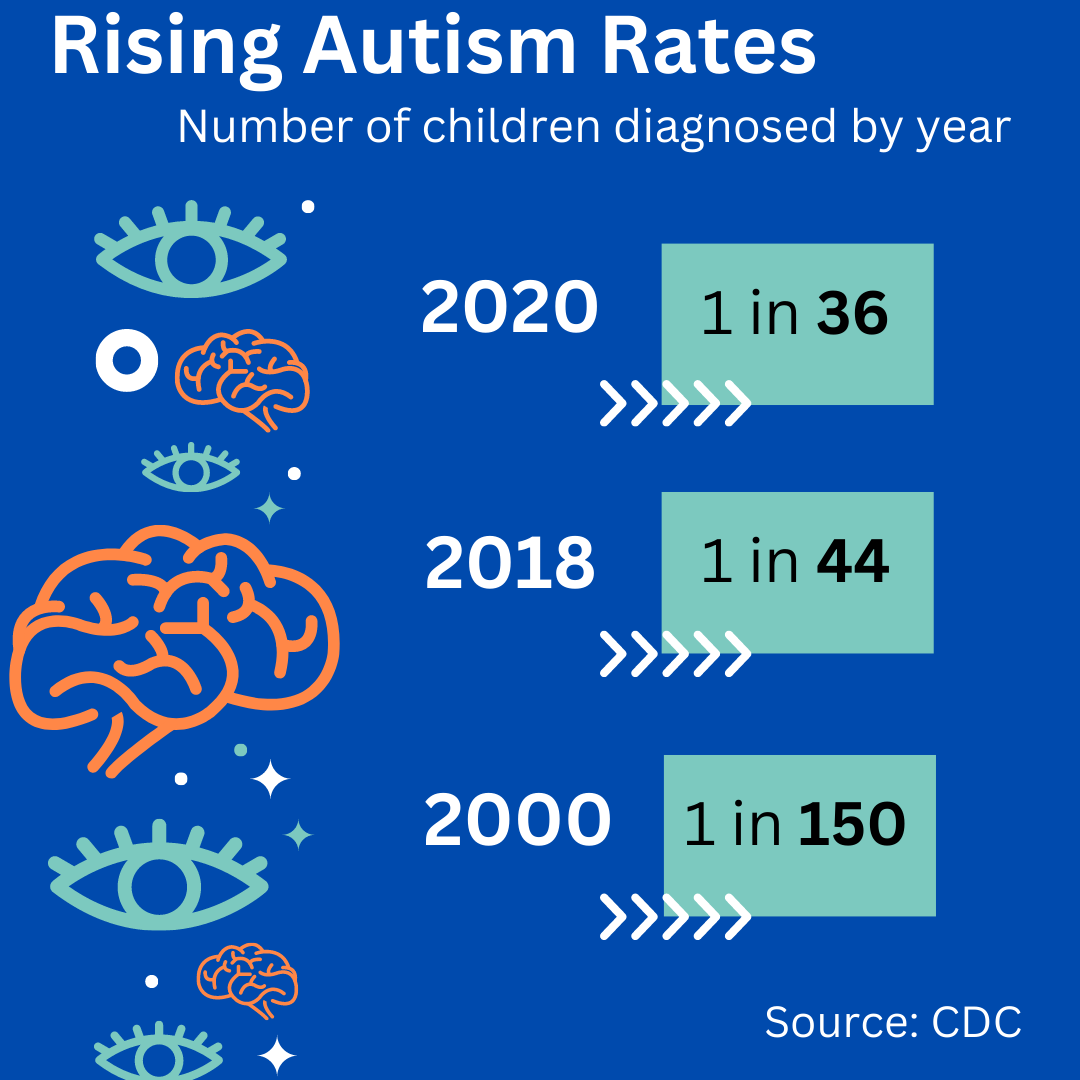
In 2020, about 1 in 36 children had been diagnosed with autism by age 8, according to the CDC – about 2.8%. That’s up from a prevalence of 1 in 44 children in 2018 and 1 in 150 children in 2000.

Some important findings:

For the first time, diagnosis was more common among Asian, Black and Hispanic children than it was among Caucasian children. The CDC researchers note that this shift “may reflect improved screening, awareness, and access to services among historically underserved groups.” In fact, between 2018 and 2020, autism prevalence rose more than twice as fast among Asian, Black and Hispanic children than it did among Caucasian children.

Still, some trends have stayed consistent.

Autism prevalence is significantly higher among boys than girls – in 2020, there was about a four-fold difference. But it was the first year that more than 1% of 8-year-old girls had been diagnosed with autism.

In recent years, good progress had been made in early detection of autism – an earlier CDC report found that children born in 2014 were 50% more likely to receive an autism diagnosis or special education by age 4 than those born in 2010.

I was very interested to read what if any impact did COVID have on diagnosis. CDC found that there were “sustained lower levels” of evaluations and identification of autism across most of the surveillance network.

In first six months of the pandemic, there were 217 fewer evaluations for every 1,000 children at age 4 than there were four years earlier. There were also nearly three fewer identifications for every 10,000 children, according to the CDC report.

Since we know the impact of Early Intervention, my concern would be that many children did not receive evaluations, did not get a diagnosis and so were unable to start services until a later age…which could have long term impact.

Looking back to 1995 when Ryan was diagnosed by my brother, Dr. Joe Barber, an Erie pediatrician and child neurologist, we have come so far.  My question always is where will we go from here?????

Posted in Uncategorized | Leave a comment

World Down Syndrome Day: A Spotlight on Awareness and Advocacy  

Many if not most people are familiar with Down syndrome. However, for those who are not, a few facts: 

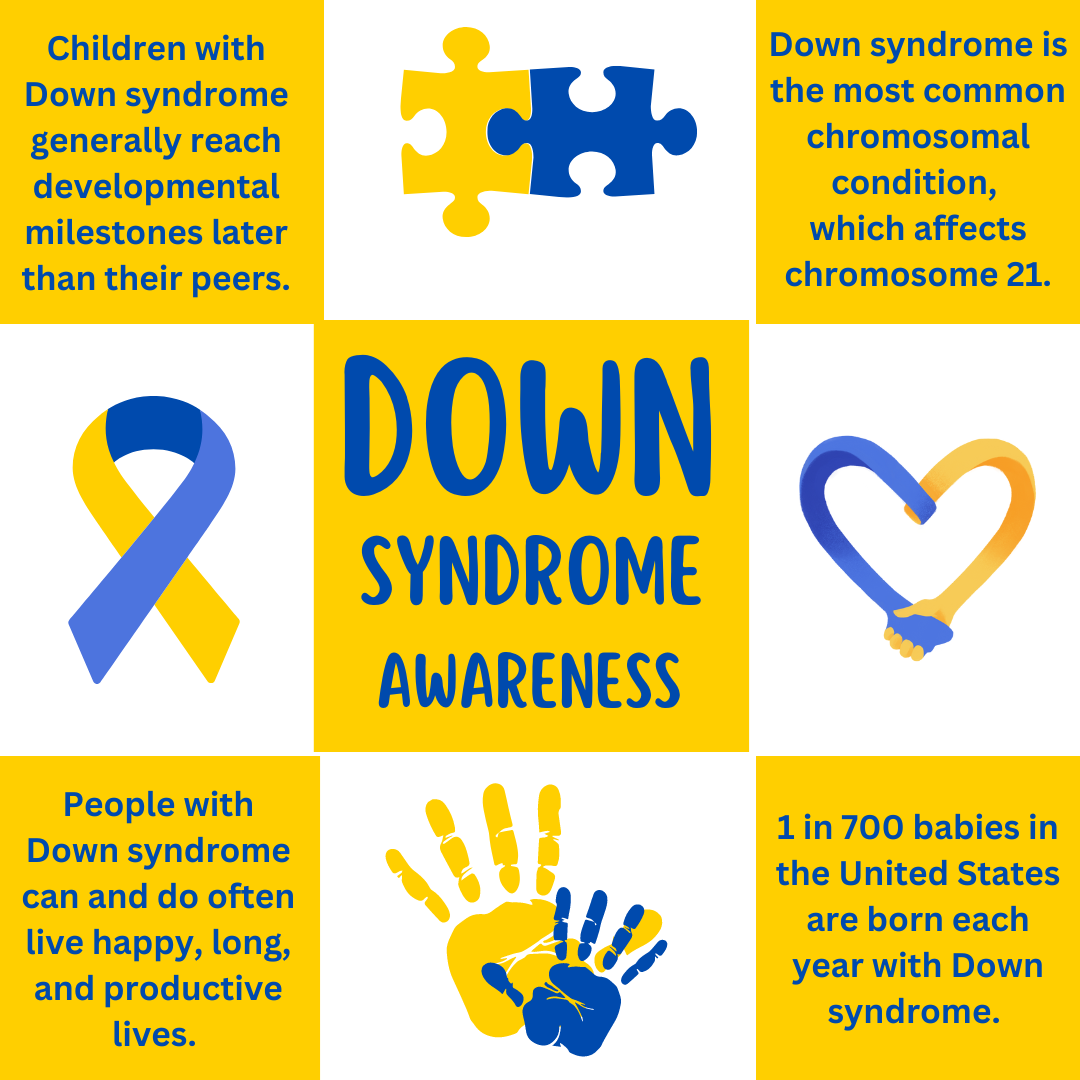
World Down Syndrome Day (WDSD) is celebrated annually on March 21 to bring global awareness about Down syndrome, a condition in which a child is born with an extra 21st chromosome. 

The 21st day of March, which has been observed by the UN since 2012, was selected to signify the uniqueness of the triplication (trisomy) of the 21st chromosome which causes Down syndrome. The medical term for having an extra copy of a chromosome is “trisomy” so Down syndrome is also known as Trisomy 21. 

Each year, 1 in 700 babies are born with Down syndrome in the U.S., which is about 6,000 babies annually.  

The theme for World Down Syndrome Day 2023 is “With Us Not For Us.” The Down syndrome international network (DSi) seeks to establish a human rights-based approach to disability. They are campaigning for the right to legal capacity, supported decision-making and easy-to-understand communication. 

We celebrate World Down Syndrome Day at the Elizabeth Lee Black School with the ROCK THE SOCKS DAY, as the karyotype for Down syndrome looks like mismatched socks. So, when you are walking through our halls and you see our staff and students with mismatched socks, you will know that we are celebrating a very special day.  

Posted in Uncategorized | Leave a comment

The Shamrock: An Enduring Symbol of Faith, Hope, Love, and Community 

With Saint Patrick’s Day quickly approaching, I wanted to focus on the legacy of the shamrock. More specifically, I wanted to share some history about the Barber National Institute shamrock. 

We all know that the shamrock is the familiar emblem of Irish culture. Often, I have been asked, “Do you have a shamrock for your emblem because the Barber Family is Irish?” While we do come from an Irish heritage, the shamrock truly has a meaning that extends beyond just our lineage.  

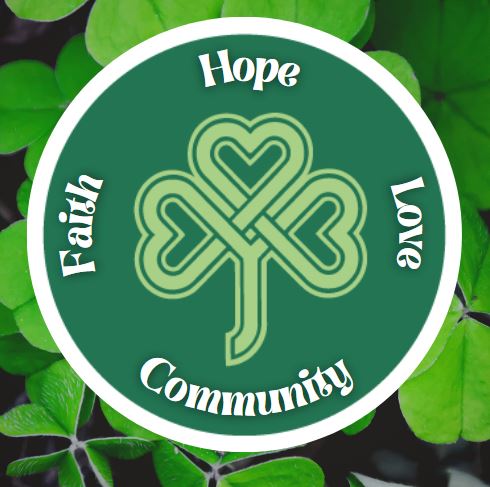
I recall sitting with Dr. Barber as she explained her concept of the shamrock to artist Frank Fecko. Each of the three leaves has significance: faith, hope, and love.  

Through faith, hope, and love, we can reimagine the opportunities available to people with disabilities and their families. We can build bridges and break down barriers. We can help create a brighter future for those who want to be seen, heard, and respected for their valuable contributions.  

Dr. Barber’s dream for better lives for children and adults with disabilities could have remained a dream, but in fact became a reality because of the continued support of our staff, the Erie Community, and an ever-expanding group of stakeholders. This is where the shamrock’s stem comes in. It represents our community of supporters, our children and adults, families, staff, and friends. Frank used Dr. Barber’s guidance to design our shamrock, an emblem we have used every day since! 

Today, the shamrock endures as our promise to future generations that the Barber National Institute will continue our commitment to serving children and adults with disabilities and their families. It’s comforting to think that we will continue to see this “lucky” green symbol for decades to come! 

Posted in Uncategorized | Leave a comment

Starting Strong: It’s Never Too Early to Focus on Literacy   

Early literacy: is it ever too early to start? 

My response would be a definite “No.” A baby’s brain begins forming connections very quickly after birth, and these are the connections that will build the foundation for life-long learning. It’s estimated that around 90 percent of a children’s brain development occurs by the age of 5, which makes learning experiences so critical early in life.  

I remember reading to Ryan as an infant.   One of my favorites was “How much do I love you.”  Reading was an activity we did every night.  By the time he was a toddler, he was pointing at the figures on the page and helping me turn the pages.  Why read stories to your child?  When you read to your child, they are hearing new words beyond those they hear at home as the family goes about its daily business of getting ready for school, eating, bedtime, and shopping. Through reading, children hear more complex and sophisticated language, which becomes the building blocks of their literacy and language development. 

 There is some interesting but rather startling data as to the amount of reading parents did pre pandemic and during the pandemic. There was a dramatic decline in the amount of reading done during the pandemic in the homes of families struggling with poverty. Children did not attend school, parents lost jobs, how would parents find the time to read?  So, children, especially the early learners, returned to school and are now struggling to meet the reading benchmarks.   Research indicates that struggling readers in first grade are 88% more likely to be struggling readers in 4th grade.  That is why there is so much attention on 3rd grade reading scores because if our children are not on track by the end of third grade their chances for success decrease substantially.  

So, if you are a mom or dad, grandma or grandpa, pull out your books and start reading… I am. 

Posted in Uncategorized | Leave a comment

The Teen Mental Health Crisis:  How the Barber National Institute Can Help

For this week’s blog, I have invited Cecelia Hollands, the Director of Clinical Programming for Barber Behavioral Health, to discuss the teen mental health crisis and what services the Barber National Institute can provide in helping address mental health needs of teens and their families.

Cecelia is a licensed professional counselor who has worked in mental health in the Erie area for ten years in various roles, including as a psychiatric rehabilitation specialist, mobile therapist, and outpatient therapist.  In addition to her work at the Barber National Institute, Cecelia also serves on the Board of the White Pine Center for Healing. 

I want to thank Cecelia for offering her perspectives and wealth of expertise, which I am certain will help teens and their families locate accessible and effective mental health services.

___________________________________________________________________________________

In her most recent blog post from February 23rd, 2023, Dr. Maureen Barber-Carey wrote about a recent report released by the Centers for Disease Control (CDC) pertaining to teen mental health; Sadly, the statistics are both shocking and sobering.  As the Director of Clinical Programming for the behavioral health programs at the Barber National Institute, I am all too aware of the barriers facing adolescents in today’s world, especially if one considers the complicating factors of being an adolescent girl or identifying as LGBQ+.

While it should be noted that the data shows that all teens’ mental health has declined within the last decade, certain subsets of youth have far different experiences than some of their peers.  The CDC report, which looked at the ten-year period between 2011-2021, found that the number of teen girls who feel persistently sad and/or hopeless has grown by a staggering 60% since 2011.  Nearly 25% had made a suicide plan.  Additionally, almost 25% of female students experienced sexual violence within the past year and 14% reported having been physically forced to have sex.  Teens who identify as part of the LGBQ+ population are more vulnerable to all forms of violence than their peers.  According to the report, nearly 70% of LGBQ+ students had experienced persistent feelings of sadness or hopelessness during the past year, and almost 25% had attempted suicide.  

It should be no surprise that exposure to violence and/or the experience of sexual trauma is deeply intertwined with teen mental health and substance abuse.  It follows that nearly 30% of female students reported having used alcohol within the past 30 days.  Furthermore, students who identify as LGBQ+ were more likely than their peers to engage in use or misuse of all substances, including illicit drugs, alcohol, marijuana, and vapes.

There are numerous factors which have contributed to the state of teen mental health as it stands today (more than I can get into here), however, these factors are deserving of attention, reflection, and examination, which is why I would recommend reviewing the full CDC report.  Of equal importance is to examine what type of preventative measures can be taken, and what services exist to treat teens who are experiencing a mental health crisis.  At the Barber National Institute, we offer an array of services targeted for children and teens who are experiencing a mental health concern.  Our clinicians all receive annual training in suicide prevention and working with the LGBQ+ population and take a trauma-informed approach to caring for their clients.

Housed within our Intensive Behavioral Health Service (IBHS) line, we have master’s level mobile therapists (MTs) who can meet with their clients in a variety of settings, including the home, school, and community.  Our MTs all receive training and certification in Trauma-Focused Cognitive Behavioral Therapy (TF-CBT).  An MT will work with you and your teen to identify mutually agreed upon treatment goals.  While much of their work will be working one on one with your teen, the MT will also work closely with the parent or caregiver throughout treatment so that parents are aware of how to best support their teen outside of the context of therapy.  

Slightly more intensive than mobile therapy in terms of the frequency of services and the types of services offered is our Family-Based Mental Health (FBMH) program.  This program is designed to treat the behavioral health needs of children and teens whose mental health is severe to the degree that they are at risk of some type of out of home placement (such as foster care, inpatient psychiatric care, or long-term residential treatment).  All our FBMH therapists receive monthly training in Eco-Systemic Family Therapy through the Western Psychiatric Institute and Clinic.  FBMH therapists work in a team of two and handle the therapy needs, case management needs, and crisis needs of the client and his/her/their family within the home, school, and community settings.  While your teen might be the “identified patient,” practically speaking, FBMH therapists work with the entire family system to assist with stabilization, establishing appropriate roles and rules within the home, and helping parents/caregivers best support the needs of their child or children.

Last, our Acute Partial Program is a short-term, 15-day program that is meant to provide immediate stabilization for children and teens whose behavioral health needs are causing severe disruption to their everyday functioning.  Programming is offered Monday-Friday (roughly equivalent to school hours) and encompasses psychiatric care, group therapy, individual therapy, and family therapy.  While in the acute program, clients participate in intensive group therapy and receive regular individual therapy so that they can learn tools to provide a healthy, safe means of coping with their particular challenges.  Additionally, clients and their families have an opportunity to meet with our psychiatrist several times within a treatment stay to explore whether medications might be appropriate.  

For more information on these programs, you can visit our website at barberinstitute.org or contact me at Ceceliahollands@barberni.org

Cecelia Hollands, MA, LPC

Posted in Uncategorized | Leave a comment

Widening of the Gender Gap: Persistent Sadness Among Teen Girls a Major Concern 

In my last two blogs, I discussed some of the latest research in ASD. Today, I am following up with a look at the mental health challenges during the teenage years. These years can be challenging for anyone, but recent data released by the Centers for Disease Control and Prevention shed light on a troubling trend that is impacting teen girls especially hard.  

Research has shown that teen girls faired significantly worse than their male counterparts when it comes to mental health challenges, thoughts of suicide, exposure to violence, and persistent sadness and hopelessness.  

The Youth Risk Behavior Survey (YRBS) Data Summery & Trends Report, a publication of the CDC’s Division of Adolescent and School Health (DASH), highlights data collected among a nationally representative sample of U.S. high school students. The survey considers several issues facing teens: sexual behavior, experience with violence, substance abuse, and mental health and suicidality.  

According the YRBS Data Summary & Trends Report: 2011-2021, 42% of high school students felt so sad or hopeless that they stopped doing usual activities. However, 57% of female respondents were impacted by persistent feelings of sadness as compared to 29% of male respondents.   

Access the full YRBS Data Summary & Trends Report: 2011-2021.  

What is the root cause of this startling trend of increased persistent sadness at a much higher rate among females? There are several factors, including increased isolation brought on by the COVID-19 pandemic, bullying in schools, influences of social media and 24/7 news outlets, stress combined with a lack of coping strategies, and untreated mental health conditions such as anxiety and depression, that are helping fuel this national issue.  So, the question is, what are we as educators and providers going to do to support high school students???? Your thoughts? 

Posted in Uncategorized | Leave a comment