Video Games – Good, Bad or Both?

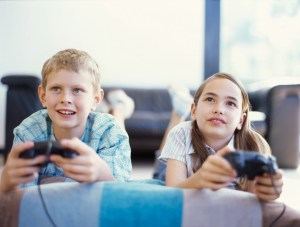
boy and a girl playing video gameToday I hope to summarize some of the good and bad effects of video games according to the latest in research.

Yes, video games can be highly rewarding, stimulating and motivating activities.  We know that video games change our brains in the same way that learning to read or ride a bicycle does.  Similar to exercise, gaming releases the mood regulating chemicals dopamine and glutamate in the brain.  A concern is that over time this release will require an increased amount of gaming in order for the child to receive the same rewarding effects.  It is for these reasons that the American Medical Association has speculated that 15% of teens and adults may be addicted to video gaming.

Video GamesIn a recent study of game usage of 141 boys between the ages 8 – 18, (56 boys with autism, 44 with ADHD, 41 typically developing) researchers found that boys with autism played video games about twice as long as their typical peers (2.1 vs 1.2 hours/day).   In addition, the study found that problems with inattention were strongly associated with problematic game use in children with ASD and ADHD.

An additional study of 160 boys with ASD between the ages of 8 – 18 found that access to a video game system was associated with greater oppositional behavior in homes where parents reported no rules on the child’s video game use.

I was also very concerned to read that there is considerable evidence that violent video games cause increases in aggression when the gamer has a predisposition to volatile behavior while others are seemingly unaffected.

There certainly are positive effects of video games.  These include:family-playing-video-game-console

  • Problem Solving and Logic
  • Executive Functioning Skills (planning, doing and evaluating)
  • Developing reading and math skills
  • Teamwork
  • Simulation, real world skills
  • Increase in self confidence and self-esteem as he / she masters games.

Some suggestions to help your child play responsibly can include:

  • Give your child a variety of entertaining things to do (books, sports, social events)
  • Limit the amount of time your child plays video games
  • Monitor how the video games affect your child

How to choose the right video game for your child:

  • Check the Ratings of the game before allowing your child to play it
  • Recognize your child’s maturity level and then determine which game is suitable for him/her
  • Choose a game that requires strategy and decision making skills
  • Look for games involving multiple players to encourage group play / social skills

When played responsibly video games can support children with ASD.  We simply need to monitor their use and maximize the benefits as we minimize the potential risks.

Posted in Uncategorized | Tagged , , , , , , , , , , , , , | 4 Comments

child tired and cryingWhat can I do to help my child go to sleep at night?  How can I help my child sleep through the night?

These are two questions I’ve asked on numerous occasions and are two of the most common questions of parents with children on the autism spectrum.  Sleep problems are reported to be as high as 80% in children with ASD.   We know that sleep related disturbances are an important issue for children with ASD because they can increase and worsen repetitive and stereotypic behaviors, inattention and hyperactivity, and can interfere with learning.  It’s also challenging for mom or dad to be up throughout the night and still have to go to work the next day.

Looking back, I remember too well the period when I slept outside Ryan’s bedroom on the floor because he was waking up numerous times during the night and walking through the house.  Fortunately for me, that challenge eventually passed and today he sleeps through the night.

I recently read some new research looking at the role of in-bedroom video game usage and losingits potential in contributing to sleep disorders.  A study of 141 boys between the ages of 8 – 18 looked at children’s video game usage.  The researchers found that boys with autism played video games about twice as long as boys with typical development (2.1 vs 1.2 hours respectively).

In another study looking at media use and sleep among boys with ASD, boys with in-room access to video games (i.e. access to a computer or dedicated game system) spent less time sleeping per night than boys without an in-room system.  Additionally, the amount of time spent playing video games per day was negatively associated with the number of hours sleeping per night.  Since we know that children with ASD have more difficulty disengaging from screen based media, it could be that the media is contributing to bed time resistance and delayed sleep onset.  It’s also been suggested that the brightly lit screen might disrupt melatonin production, which could affect sleep quality with children with ASD because they are already at risk for low melatonin concentrations.

sleep-photoSo, what should we as parents do? I would suggest that we limit the amount of time that our children have to play video games during the evening.  Take some data and look at sleep patterns based upon the amount of time your child has access to video games.  Talk to your physician if you’re finding that your child is sleeping less and you cannot determine why.

There are a number of resources available in helping you establish positive sleep patterns for your child.  Two I found especially helpful are: Establishing Positive Sleep Patterns For Children On The Autism Spectrum and Sleep from Autism Speaks.

If you have any special tips to share with our readers, I would love to hear them.  Please share below.

On Thursday, I am going to discuss video game use and problematic behaviors in boys on the autism spectrum.  Tune in then.

Posted on by all about autism | 9 Comments

child_learn“Education is the most powerful weapon which you can use to change the world” ~ Nelson Mandela.
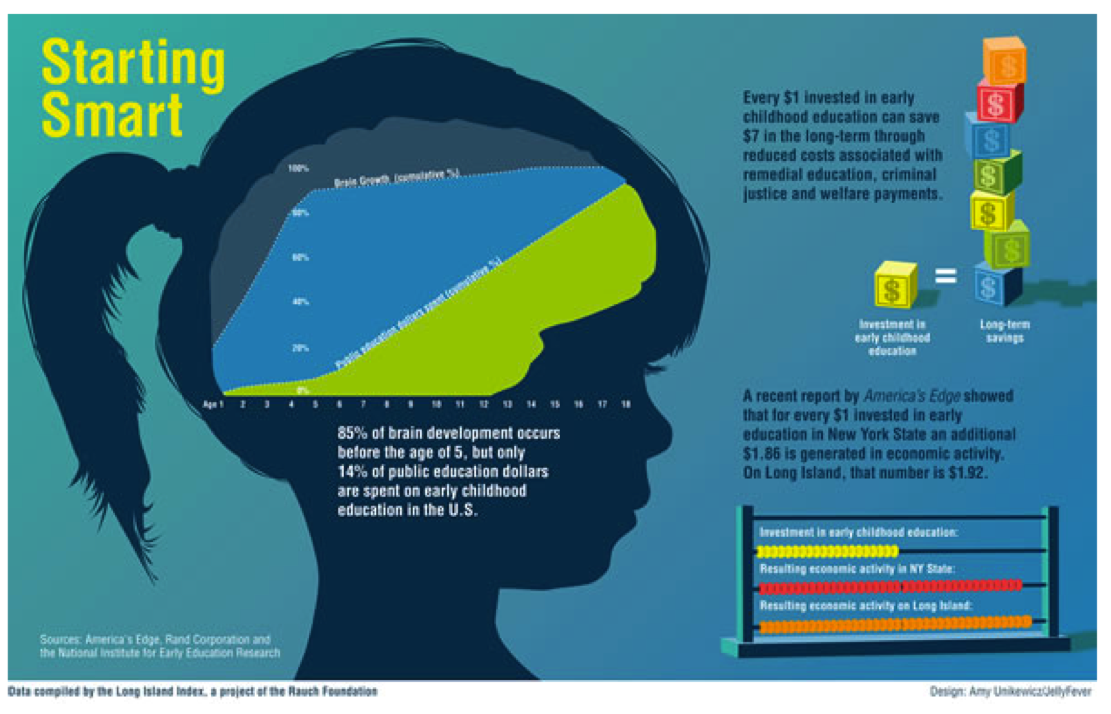
Did you know that at risk children who don’t receive a quality early education are:

  • 25% more likely to drop out of school
  • 40% more likely to become a teen parent
  • 50% more likely to be placed in special education
  • 60% less likely to go to college
  • 70% more likely to be arrested for a violent crime

So what are we doing about this?  Municipalities are increasingly seizing the momentum on early education.  In many cases, cities around the country are offering programs that are available to more students than state funding would allow.

The latest initiative is New York Mayor Bill de Blasio’s plan to create a universal preschool program for the city’s four-year-olds through a tax on the city’s highest earners.  The next step would be whether Albany lawmakers grant the Mayor the authority to increase taxes on the approximately 40,000 city residents who earn more than $500,000 a year.

Early-EdCertainly most cities would not have the tax base to allow this; however, research has demonstrated that quality early learning programs have positive effects that extend beyond the first years of school, well into adulthood, and benefit society as a whole.  For every $1 spent on early childhood programs for at risk children, society sees a savings of $7.

I encourage each of you to contact your legislators and tell them about the importance of early childhood education programs to our community, state and society.   It’s not too late to start paying it forward for the young children in our communities.   Below are some additional links on how communities and businesses are advocating for early education programming.

PNC Grow Up Great
Sesame Street
HighScope Perry Preschool

Posted on by all about autism | 5 Comments
Ryan skiiing 1.2014

Ryan Skiing (2014)

Have you been walking your way to health?  This week is Healthy Weight Week.   Unfortunately, obesity is more prevalent in people with disabilities than people without disabilities.  Obesity rates for children with disabilities are approximately 38% higher than children without disabilities.   Certainly there are behavioral, environmental and genetic factors that can affect if a person is overweight or obese.

It can be difficult for people with challenges to eat healthy, control their weight and be physically active.  This might be due to:

  • A lack of healthy food choices
  • Medications that can contribute to weight gain
  • Physical limitations that can reduce a person’s ability to exercise
  • Lack of accessible environments that enable exercise
  • Lack of resources (for example, money, transportation, social support)
TRR_0245

Adaptive Bike Program at ELBS

We do know, though, that regular physical activity provides important health benefits for people with disabilities.  These benefits include improved cardiovascular health, improved mental health and better ability to do everyday tasks.  Engaging in physical activities with typical peers enable friendships and increase their social circle, thus decreasing the social isolation experienced by many children with disabilities.

bbb4

Barber Beast on the Bay Adaptive Course (2013)

Research has also demonstrated that increased aerobic exercise can significantly decrease the frequency of negative, self-stimulating behaviors that are common among individuals with autism, while not decreasing other positive behaviors.

Ryan Kayaking

Ryan kayaking at Lake Erie

Exercise has always been a big part Ryan’s and my life.  From participating in the kids marathon through skiing, 10k’s, bowling, kayaking, racquetball, golf, a part of our day is always set aside for exercise.  I encourage all parents to start exercise early and together as a family.  It’s Tuesday at 5, we’ve both completed our workday and we are off to the local health club, LECOM, to exercise.

What are you doing to promote Healthy Weight Week?

Posted on by all about autism | Leave a comment

How Will You Celebrate Martin Luther King, Jr. Day?

mlk

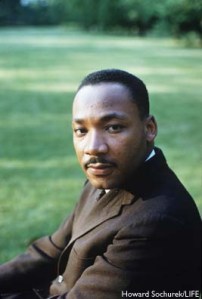
Martin Luther King, Jr.

As we look to celebrate Martin Luther King, Jr. day on Monday, I see how far we have come since the first school where children with disabilities was established in 1817.  Our accomplishments have been many, yet we continue to struggle with barriers for equality of persons with disabilities.

Did you know that …

  • 10% of the world’s population, or 650 million people, live with a disability.  They are the world’s largest minority.
  • 20% of the world’s poorest people are disabled.
  • Women with disabilities are recognized to be multiply disadvantaged, experiencing exclusion on account of their gender and disability.
  • 90% of children with disabilities in developing countries do not attend school
  • 386 million of the world’s working age people are disabled.
  • People with physical and mental disabilities continued to be underrepresented in the U.S. workplace.

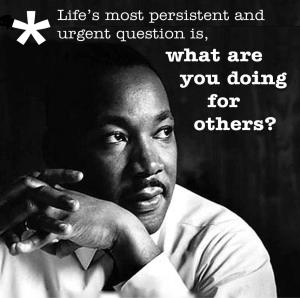
The following quote by Martin Luther King, Jr. both encourages and inspires me to continue the fight for equality for all people:

martin-luther-king-jr-day-L-xGOagM1

Martin Luther King, Jr.

“Whatever career you may choose for yourself – doctor, lawyer, teacher – let me propose an avocation to be pursued along with it.   Become a dedicated fighter for civil rights.  Make it a central part of your life.  It will make you a better doctor, a better lawyer, a better teacher.  It will enrich your spirit as nothing else possibly can. It will give you the rare sense of nobility that can only spring from love and selflessly helping your fellow man.  Make a career of humanity.  Commit yourself to the noble struggle for human rights.  You will make a great person of yourself, a great nation of your country and a finer world to live in.” 

How do you plan to honor Dr. King’s dream?

Posted in Uncategorized | Tagged , , , , , , , , , , , , | 2 Comments
Families attend an autism-friendly performance on April 29, 2012 in this photo released by the Theatre Development Fund.

With an increasing number of children being diagnosed with autism spectrum disorder, more organizations are acknowledging the need to offer an adaptive program for children with special needs.

Three years ago, we initiated an autism/disability friendly Santa at the Millcreek Mall.  As our numbers continue to grow, I became a vocal advocate for the inclusion of children and adults with disabilities in cultural events.

Erie Playhouse AladdinThe Erie Playhouse responded with an autism/disability friendly performance of Disney’s Aladdin, Jr. on January 18th.   Tickets are available for purchase now.

What makes this performance special?  Students attending the performance can read a social story on Aladdin.  Written by BNI faculty and artist Jude Shingle, the social story prepares students so they know what to expect when attending the play, appropriate behavior at the theatre and what to do if they need a break.  Lights and sounds will be at a safe and comfortable level and a sensory break area will be provided in the lower lobby.  All the members of the cast attended a seminar on autism to help them better understand the challenges experienced by some children on the autism spectrum.

In addition, BNI partnered with ArtsErie and Very Special Arts of PA to provide a workshop for local cultural organizations and artists interested in learning how to prepare an environment for children and adults on the autism spectrum.

I’m thankful for the Erie Playhouse for this initial production and I’m hopeful that this will become a new trend that we see in all local productions.

Posted on by all about autism | Leave a comment

Creativity (student & Krista Amon)Did you know that January is International Creativity Month?   Walking through the BNI halls you see expressions of creativity all around – artwork on the walls, students creating angels made of clay, technology everywhere.

I am thankful for our faculty whose imagination has led us to develop new and original ideas.  They have introduced our students to various technologies, like creating animated videos and interactive electronic books.  We have explored the art of photography through adaptive cameras and iPads, allowing the students to showcase their own creativity.

Patricia Czulewicz and David Chergi

Patricia Czulewicz and David Chergi

Our young people with significant physical challenges are able to create their own masterpieces through Artistic Realization Technologies (A.R.T.).  Check out David Chergi’s story (cousin of Andy Warhol) whose dream of being an artist came to true through the A.R.T. program.

Science, math and reading come alive when you are creative.  Not only are our students motivated, but creativity sustains their attention, encourages engagement in the activities, and fosters social interactions with their peers.  On snowy, no school days like Tuesday, I’ve included some fun activities to do with your child at home.

“Imagination is the beginning of creation.  You imagine what you desire, you will what you imagine and at last you create what you will.” ~ George Bernard Shaw

I am always looking for new and creative ideas.  Share yours with me and I will reference them in a future blog.  Stay creative!

Posted on by all about autism | Leave a comment

Don’t Forget To Say Thank You

Danke, grazie, merci, gracias, spasibo, 谢谢, cảm ơn bạn, thank you!

January is National “Thank You” Month.Thank you card

Growing up, my siblings and I quickly learned that thank you was an essential word in our vocabularies.   Of course, mothers are always right.  Studies have shown that being thankful improves sleep patterns, mental and physical well-being, relationships and anxiety — not just for the giver, but the recipient, too.  Research found that by saying thank you, people felt valued, appreciated and were more likely to provide additional assistance.

From the age of 2, I always encouraged Ryan to say thank you.  Today, he may be the most polite person ever, and I think his thankfulness to others has had a positive impact not only on him, but on those who provide him with support.

There are many ways to celebrate National Thank You month.  This article suggests many that I myself practice.

  • Keep a gratitude journal
  • Random acts of kindness
  • Write a note of gratitude (teacher, child, parent, spouse, friend)
  • Take the time to visit a friend or relative who is confined to their home

As I walked down the hall today, one of our high school students was talking with faculty member Maria Hopkins.  I overheard the student say “You’re a gift from God, Maria Hopkins. Thank you Jesus Christ.”

thankful4I often ask myself as I drive myself to work what am I thankful for?  It’s a great way to start the day off with a positive attitude.
I’d encourage you to post on the blog what makes you thankful this January.

“When you arise in the morning, give thanks for the morning light, for our life and strength.  Give thanks for your food, and the joy of living.  If you see no reason for giving thanks, the fault lies with yourself.” ~ Tecumseh, Shawnee Chief

Posted in Uncategorized | Tagged , , , , , , , , , , , , , , , , , | Leave a comment

As I look to the start of another year, I find that it is not the end nor a beginning but an opportunity to continue to expand the knowledge and experience that we have gained over the last 365 days.

1383072192_photosTAP---BNI

Tap-it Technology

  • Technology burst onto the scene at the ELBS and across the world. Classrooms equipped with iPads, touch screens and Tap-its enable faculty to truly individualize students programs.  A conference room equipped with an interactive white board, state of the art printer, computer and conference speaker phones allows us to fully engage our parents in the IEP process.
  • Adaptive equipment for children with mobility challenges is enabling students who came to us wheelchair bound to walk with assistive devices in the halls.
    Dr. Mary Beth Pinto and Jessie, therapy dog
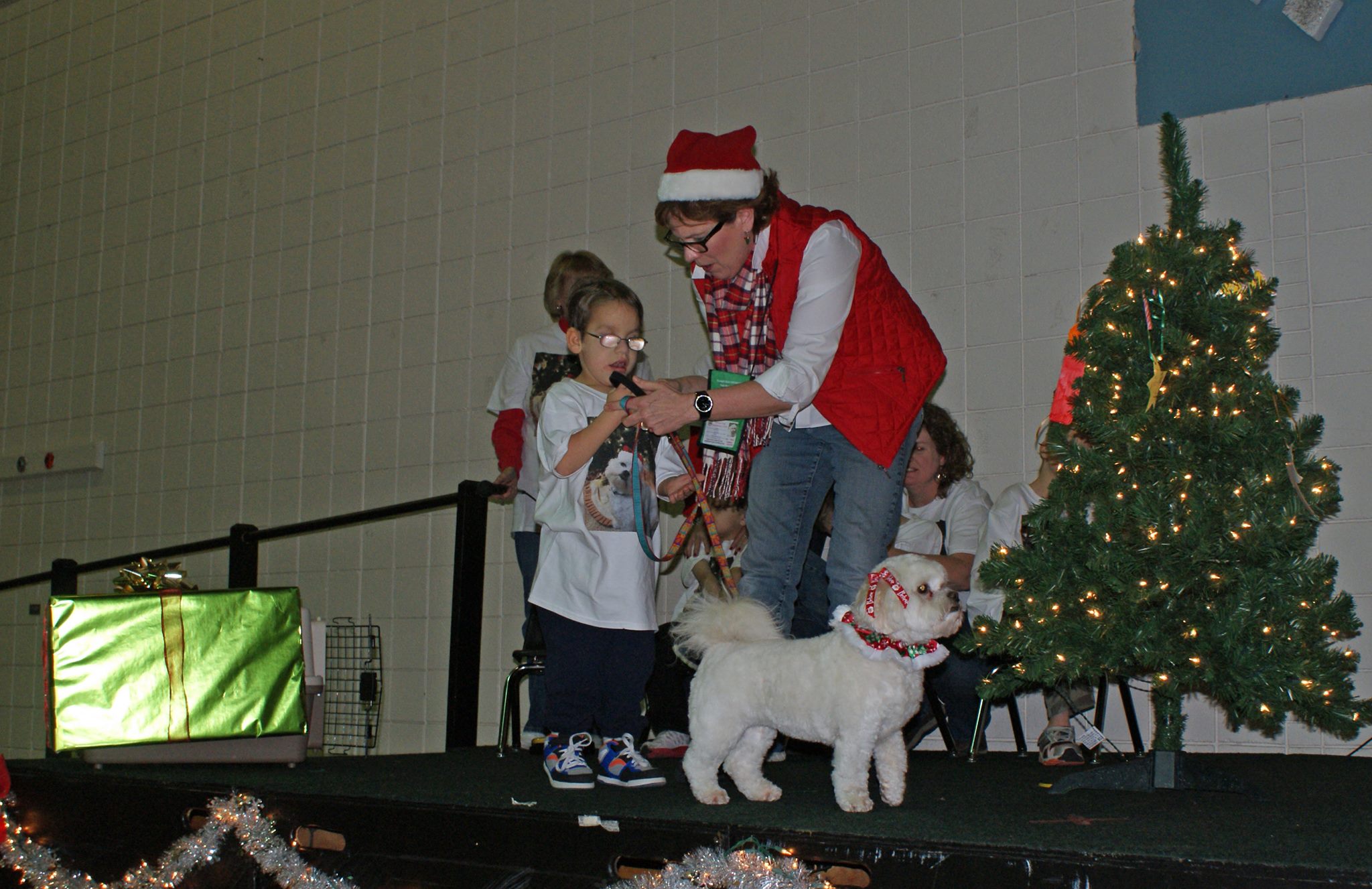
    Dr. Mary Beth Pinto and Jessie, therapy dog
  • Dog therapy has been integrated into our curriculum and was showcased during our Christmas play.
  • Under the direction of Jude Shingle, artist in residence, students are creating their own iBooks with the use of digital technology.
  • Research continues to tell us the most effective treatments for students with autism and other challenges.
  • Our Beast on the Bay, an extreme obstacle course challenge and adaptive course brought many new friends to Erie and the BNI.  Mark your calendars for next year’s Beast on the Bay on September 6, 2014.
    barber-beast-on-the-bay-trial-run_212
    Beast on the Bay
  • Every student has an individually designed adaptive bicycle program thanks to Chris Gross, PT.  Sharing her expertise with others across the country, Chris has written an iBook on adaptive bicycling which can be purchased at the iTunes store.
  • Our students and faculty reached out to the community with a penny drive for the John Kanzius Foundation and raised over $1,000.
  • Working with University of Notre Dame on our robot project allowed us to be on the cutting edge of using robotics in teaching children with ASD.
  • My blog has had over 10,000 visits. What began as a desire to share what I have learned with others is helping many internationally from Saudi Arabia to Mexico to China.
  • Music is heard daily through our halls as we expanded our collaborations to include not only the YPC of Erie but also the Erie Chamber Orchestra.

2013 was a year of many accomplishments.  We have achieved much through the efforts of our dedicated staff who inspired our children and adults.  With the support of our community we will continue to make dreams come true in 2014.

“The future belongs to those who believe in the beauty of their dreams”  Eleanor Roosevelt

Posted on by all about autism | Leave a comment

Stories from Christmas Past

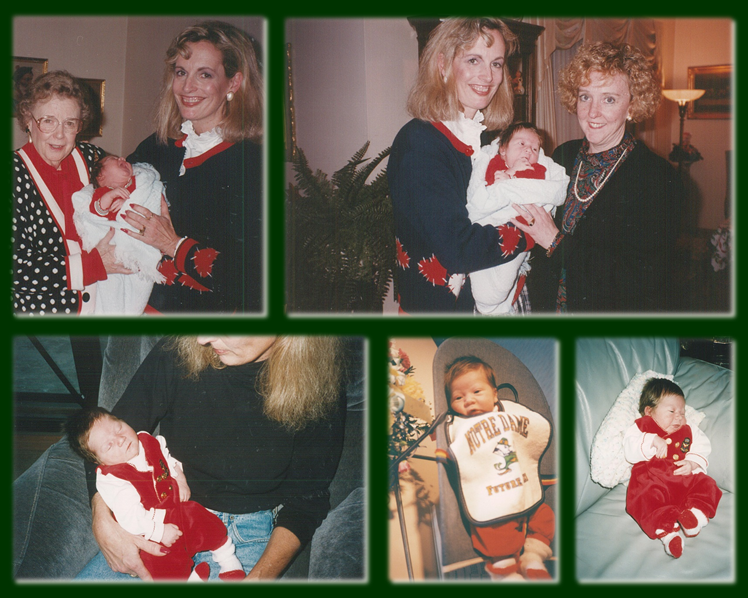
Newborn Collage
Clockwise from Top Left: Dr. Gertrude Barber, Ryan and Dr. Maureen Barber-Carey; Dr. Maureen Barber-Carey, Ryan and Jeanne Baker; Ryan in his Christmas outfit; Ryan in his Notre Dame bib; Ryan and Dr. Maureen Barber-Carey
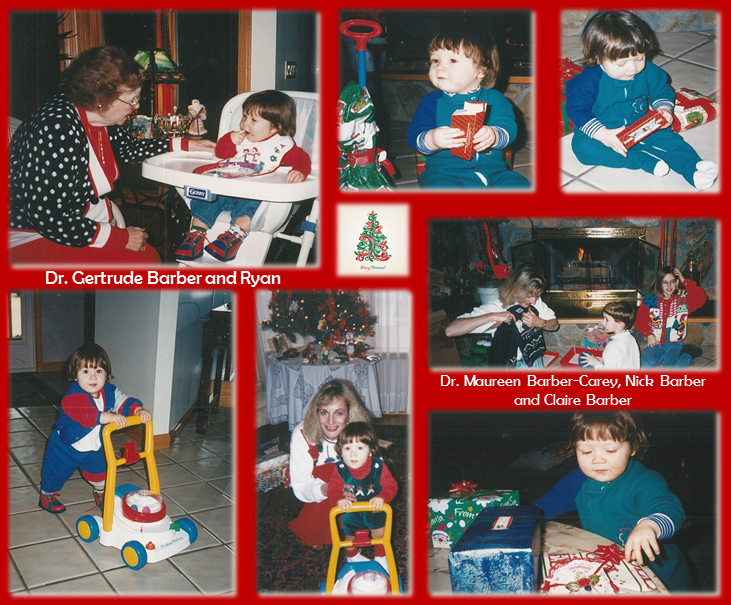
Ryan's 1st Christmas Collage

Ryan’s First Christmas

As I look forward to Christmas tomorrow, I’m thinking of the many memories of Christmas past.  Ryan was only 23 days old when he celebrated his first Christmas.  Yes, he had a red Christmas outfit and was already a Notre Dame fan. Unfortunately, our annual Christmas birthday dinner with Uncle Joe and his family did not happen, as it took us 1 hour for a 20 minute drive due to the raging snow storm.  We turned back as we knew we would never make it out to North East and Uncle Joe’s.  That first Christmas, Ryan slept most of the day but holding him in my arms was a dream come true.

Ripping wrapping paper from the gifts was the highlight of Ryan’s second Christmas.  I was so disappointed that he was more interested in the paper than what was in the boxes.  His favorite gift that year was a lawn mower that he pushed anywhere and everywhere.   When Claire and Nick visited us, Ryan had no interest in their gifts and continued to roam with his lawn mower.

Ryan's 1st Christmas Play & Santa Collage
Ryan’s 1st Christmas Play and Visit with Santa

His second Christmas, at 1 year old, was also a year of firsts – his first visit with Santa and his first Barber Center Christmas play.  His first visit to Santa was uneventful; he didn’t cry, but he didn’t smile, either.  His first Barber Center Christmas play overwhelmed him with the crowds, music and the general noisy atmosphere.

Ryan's 2nd Christmas Play Collage
Clockwise from Left: Dr. Gertrude Barber with Adrian Pinto, Ryan Carey and Patrick Barber; Ryan with Happy Hearts at his 2nd Christmas Play

As a 2 year old, Ryan was again up on stage for the Christmas play with his classmates from Happy Hearts.   It warmed my heart to see him playing his tambourine.

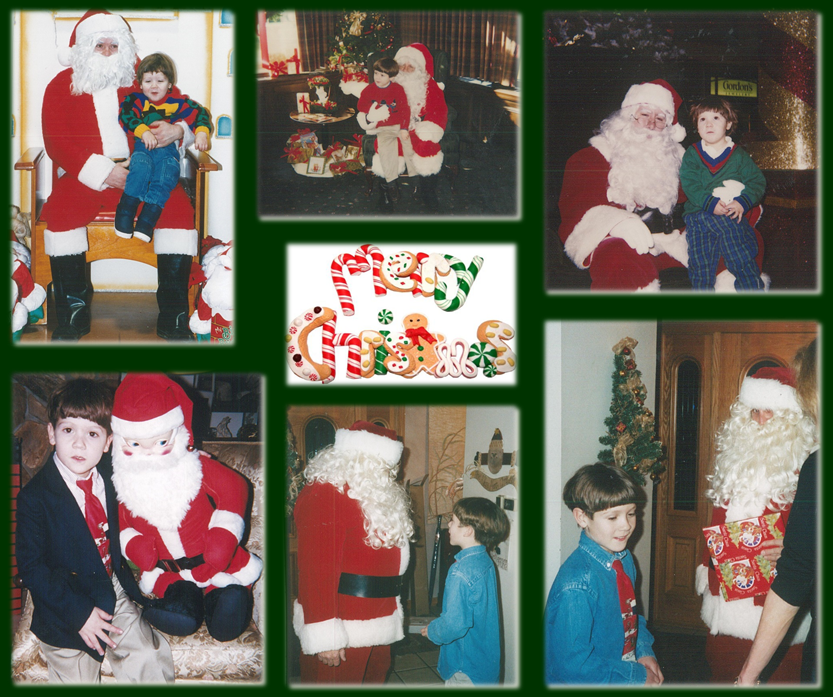
Ryan and Santa collage
Ryan and Santa over the years

Visits with Santa when Ryan was a preschooler were challenging.  Ryan, was typically overwhelmed with meeting Santa even though we attempted to go when crowds were small and noise levels were bearable.  That is why I was so pleased to bring Autism Friendly Santa to the Millcreek Mall.  One year we arranged for Santa to visit our home, which was a huge success.   When Ryan went to answer the door and found Santa, he was as excited as anyone would be when their dream came true.   If Ryan had his way, Santa would never have left.

Ryan was a believer in the magical tale of Santa until 12.  I knew his classmates would laugh if he talked about Santa so I thought it best to break the news to him myself.  I explained that Santa was for little kids and that as he was getting older mom and dad would become his Santa.  His biggest concern, after the Santa talk, was would he continue to get presents.

From the start I encouraged Ryan to think about baby Jesus and the story of the first Christmas.  As the wise men brought Jesus three gifts, Ryan would receive three gifts on Christmas.  We’ve continued this through the years.  Just yesterday Ryan wondered out loud what his three gifts would be this year.

This year his gifts will be a Peek’n Peak season ski pass, skis and cold weather attire, but it’s a surprise so don’t tell him!  I have encouraged many to use the story of the three gifts of the magi for their children.

Christmas 2013 begins for us this evening with a 5 p.m. mass at St. Patrick’s.  On Christmas day we will be in North East celebrating Uncle Joe’s birthday with family, which for me is the best Christmas gift of all.

Merry Christmas to all!

Posted in Uncategorized | Tagged , , , , , , , , , , , , | Leave a comment