
Recently, a favorite organization of mine, Autism Speaks, posted an article that reviewed 2014’s “Top Ten” stories in autism research.  These stories are so encouraging that I think it is important to share with my community as well, and to take a moment to remember that we are making progress in many ways, every day.
#10 Autism and GI Disorders: Largest-Ever Analysis Confirms Strong Link
The first meta-analysis of all peer-reviewed research on autism and gastrointestinal conditions showed that children with autism have four times the rate of GI problems as do other children. At the forefront of this research, Autism Speaks launched an unprecedented initiative funding major investigations into autism’s gut-brain connection.
#9 Autism ‘Baby Sibs’ Study Identifies Another Early Red Flag
Researchers with the Autism Speaks Baby Sibling Research Consortium used eye-tracking technology to discover that babies who begin showing decreased interest in facial expressions at 8 months go on to develop more-severe autism symptoms by age 3. The authors expressed hope that this early red flag signaled an important window of opportunity for early intervention that improves outcomes.
#8 Autism’s Subtle Early Signs: More Findings from Infant Eye Tracking
Another Autism Speaks “Baby Sibs” study found that even earlier differences in social attention – this time at 6 months – flag high risk for autism. The researchers called for the development and testing of very early interventions that engage at-risk babies in enjoyable activities that involve shared attention.
#7 Study Links Specific Gene to Autism Subtype
Researchers linked a specific gene mutation to a newly identified subtype of autism. Experts hailed the finding as a crucial step toward using genomic testing to develop individualized treatments for autism spectrum disorder.
#6 Brain Study Suggests that Autism Involves Too Many Synapses
Researchers analyzing donated postmortem tissue from children affected by autism found that their brains had a significant surplus of connections between brain cells. These excess synapses appeared to result from a slowdown in the normal pruning process that occurs during brain development. The investigators then used a mouse model of autism to show that they could restore normal synaptic pruning and reduce autism-like behaviors with an experimental medication. They called for further research that might advance to a clinical trial involving people with autism.
#5 Studies Implicate Early Injury to Cerebellum as Major Cause of Autism
In a review of published studies, Princeton researchers said they found strong evidence that injury to the cerebellum during pregnancy or birth may be the leading nongenetic cause of autism. A small but crucial brain region, the cerebellum sits near the base of the skull and is best known for coordinating movement. During brain development, it plays a crucial role in directing cross wiring to other brain regions.
#4 Broccoli-Sprout Extract Shows Promise for Easing Autism Symptoms
In a small placebo-controlled trial, sulforaphane supplements eased autism symptoms in nearly half of 29 participants affected by autism. Experts called the results “promising” but cautioned that larger studies were needed to determine effectiveness and safety.
#3 MSSNG: Changing the Future of Autism with Open Science
This historic collaboration between Autism Speaks and Google is queueing up 10,000 anonymous autism genomes and making the data freely available for research anywhere, anytime. “We don’t know enough about autism. MSSNG is the search for the missing answers.”
#2 Physical Evidence that Autism Starts During Prenatal Development
Researchers found a common pattern of disruption in the prenatal brain development of children who had autism. Their study, supported in part by Autism Speaks, analyzed the donated post-mortem brain tissue of 11 children with autism and of 11 unaffected children. In 10 out of the 11 ASD cases, they found recurring patches of abnormal development in layers of the cerebral cortex that form during prenatal development. By contrast, they found these patches in just 1 of the 11 children unaffected by autism. The researchers propose that early intervention may help the brain “rewire” around these disturbed areas.
#1 New Meta-analysis Affirms No Association Between Vaccines and Autism
A meta-analysis of ten studies involving more than 1.2 million children affirmed that vaccines don’t cause autism. The analysis found that immunization with the measles-mumps-rubella (MMR) vaccine was associated with a slight decrease in risk.
All Autism Speaks research news and expert advice columns are available at http://www.autismspeaks.org/research.
 I felt this is what happens to many families who have children with disabilities and it made me sad. But after watching the movie several times, I saw a different parallel to the lives of people with disabilities-there are ups and downs in our lives and sometimes we just want to run away; we should try to accept and help people who are different from us, even if those differences can be a little scary; there are battles that we must fight; and true love is what helps us rise above it all and live!
  Let it go, let it go

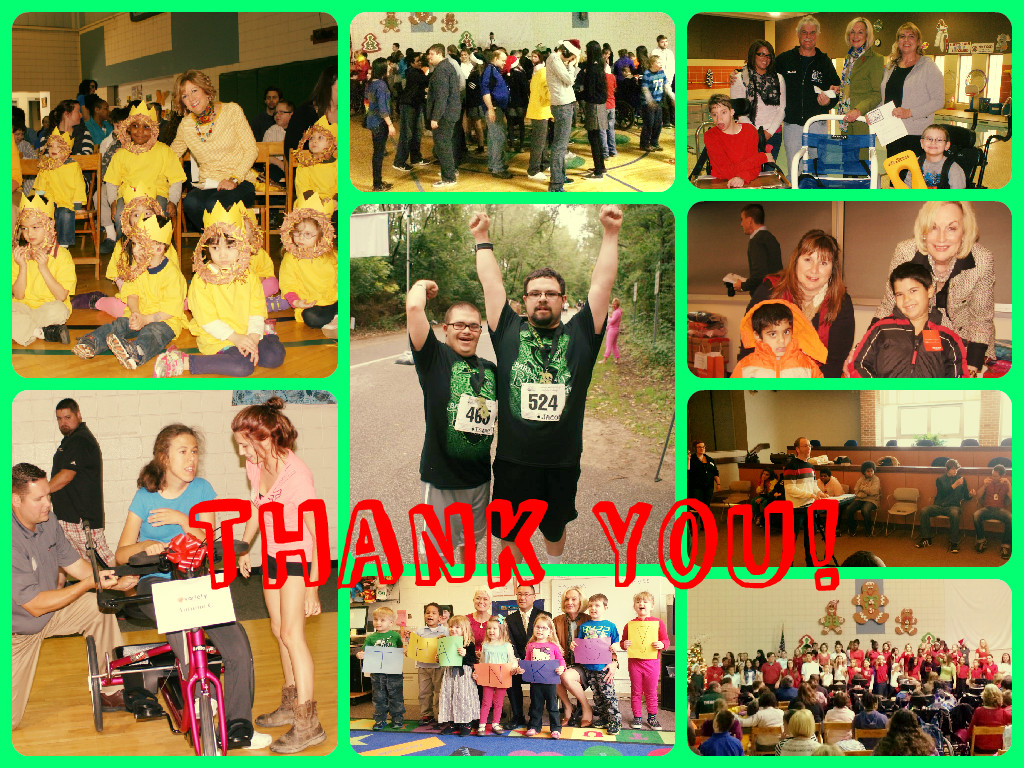
 This morning, students from 21 classrooms ranging from preschool through high-school age participated in an event that has been a holiday tradition for more than two decades. Many of the faculty and students work for weeks to practice routines, and prepare costumes, scenery and props for their performance.
 I had the privilege of attending the funeral service for Paul W. Layden, Sr., M.D. this past Saturday. Dr. Layden was a volunteer at the Barber National Institute for 51 years. When Dr. Layden began, physicians were truly not interested in providing services to children and adults with intellectual challenges. Not Dr. Layden. He gave all the time he could, both personally and professionally.
 The Barber National Institute was founded on the belief that the right to work is a fundamental human right. Unfortunately, too often persons with disabilities are not considered for employment because of negative perceptions or the incorrect assumption that accommodating persons with disabilities will be cost prohibitive. On IDPD, we drew attention to the available technologies and measures that can create work environments that are open, inclusive, and accessible.
 We at
We at 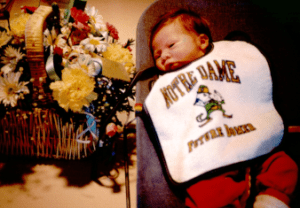 Is it possible? Ryan is turning 21 today! This is one of those special days where I love to take a moment to reflect on my journey with Ryan. I enjoy looking at his pictures that remind me of some of our “momentous” occasions, and I thought I’d share a few with you as well.
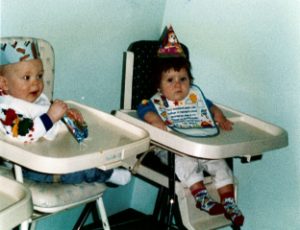 Hearts.
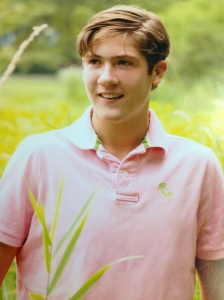 As I look back on the past 21 years of this journey, with its peaks and valleys, I’m very proud of who Ryan is, how he has grown and matured, and his numerous successes along the way. Today, his days are busy, divided between work at Bello’s Market and BNI. Before and after work, you’ll find him on the track or swimming at LECOM, or doing any of his favorite sports, including golf, tennis, skiing, and bowling.
 Wouldn’t it be great to avoid the rush of traffic and rising early and instead shop from home, while supporting children and adults with special needs?



 All About Autism