 2017 was a significant year for special education law. The two most important legal developments were rulings on the meaning of Free Appropriate Education (FAPE) and the scope of the IDEA exhaustion requirement (the first two listed below, respectively).
I anticipate that we may see more challenges to school districts based upon the Endrew decision, in particular. I very briefly summarized ten of the most significant legal findings of the year below.
- Progress, IEP must be “appropriate” in light of child’s circumstances
Rather than adapting a rule for determining the substantive adequacy of any given IEP, the Supreme Court ruled that the program must be “appropriately ambitious,” meaning that programs must sufficiently challenge a student regardless of disability.
ENDREW V. DOUGLAS
- Exhaustion not necessary for claims unrelated to provision of FAPE

The Supreme Court unanimously held that IDEA’s exhaustion of administrative remedies requirement only applies when the substance of a parent complaint is a denial of FAPE. Parents cannot bypass the IDEA’s administrative procedures by simply omitting certain terminology from their complaints.
FRY V. NAPOLEON
- District has no obligation to address child’s religious or cultural needs
IDEA
does not require an IEP to address the religious and cultural needs of a child with a disability, even when those needs go to the core of his identity. A district fulfills its duty to provide FAPE if it develops an IEP that meets the child’s secular educational needs.
M.L. V. SMITH
- Reference to methodology in PWN doesn’t modify terms of student’s IEP
PWN (Prior Written Notice) is a proposal for program implementation that is not binding on the school district, meaning districts can make recommendations without the court interpreting them as being part of the IEP.
M V. FALMOUTH
- IDEA’s statute of limitations only applies to the filing of a complaint
 Parents can seek relief for IDEA violations that occurred more than two years before the filing date, provided they file a complaint within two years of discovering the district’s alleged wrongdoing.
AVILA V. SPOKANE
- “Clear consensus” of evaluative data undercuts offer of 6:1 placement
This ruling does not require IEP teams to adopt all recommendations by outside evaluators; rather, it shows that an IEP team cannot disregard a “clear consensus” of evaluative materials showing that a child needs a particular service, methodology, or placement to receive FAPE.
A.M. V. NYC DEPT OF EDU
- Unilateral IEP amendment impedes CA mom’ ability to monitor services
A parent’s right to meaningful participation does not end when the IEP document is signed; she/he also has a right to monitor and enforce the provision of special education services.
M.C. V. ANTELOPE VALLEY
- Reimbursement award can’t predate district’s obligation to provide FAPE
A court may not award reimbursement for private services a student with a disability received before the district had a duty to provide the student FAPE. Once the district violates that duty, though, it may have to pay for any private services for the student afterward.
DALLAS INDEP V. WOODY
- Stay-put reimbursement order turns parents into prevailing parties
 If parents have to sue a district to compel the provision of stay-put services, the district will likely have to pay any legal expenses related to that enforcement action.
M.R. & J.R. V. RIDLEY
- Child’s IEP must address transition between private, public school settings
Nothing in the IDEA expressly requires an IEP to include a plan for transitioning a child with a disability from one type of environment to another; however, an IEP team would be well-advised to consider whether a child requires such services to make progress towards his/her annual goals.
R.E.B. V. HI DEPT OF EDU

 Dr. Joseph Barber, MD., recently wrote a letter to the editor in the Erie Times News about the unfortunate fact that being overweight is a stigma in an increasing number of children. Obesity rates for children with disabilities are nearly 40% higher than for children without disabilities. The rates for adults are frightening: approximately 60% higher than for adults without disabilities. Reasons for this can vary; they include:
 is
is 
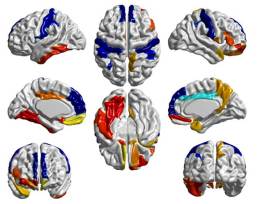

 I recently read an interesting article that made the case for treating autism research like a venture capitalist endeavor. Although I’m familiar with the concept of venture capitalism, I went in search of its definition. Venture capital is a form of financing that is provided by larger firms to small, emerging firms that are deemed to have high growth potential.


 I often ask myself as I drive myself to work what am I thankful for? It’s a great way to start the day off with a positive attitude.


 As we approach Christmas, I began thinking about Christmases past. Ryan’s first Christmas was quite eventful. Erie was in the midst of the Blizzard of ‘93, and we were picking up my mother and driving to Uncle Joe’s house for Christmas dinner. Typically, it takes 45 minutes to get to his home – on this evening, it took one hour just to get to my mother’s home! There was no visibility, but we forged ahead in hopes that the weather would get better. By the time arrived, there were “No Travel” advisories on every TV station. Rather than risk driving off the road with a newborn baby, we turned around and drove home.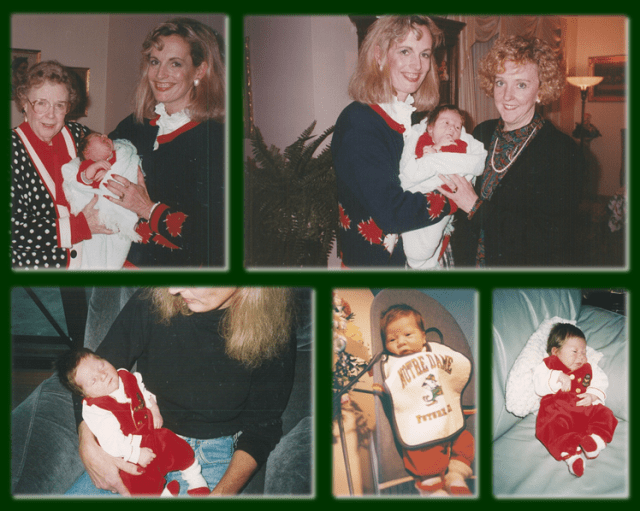
 Scientists and researchers are constantly uncovering more information related to autism, offering insights into the origins, possible causes and even at times potential cures. I come across dozens of articles on a weekly basis, some of which seem more important than others. I thought I would share on a monthly basis stories that caught my eye.


 All About Autism