Starting the School Year Strong: Tips for a Successful Transition 

I recently heard a Back-to-School ad on the TV and immediately thought, “Can it be time for this already?” Ryan graduated many years ago, but I can still recall how I felt as July turned into August, and we began the back-to-school countdown. Ryan was always very anxious (and I was, too) so I learned over the years how I could help the both of us control our worry. Perhaps some of my ideas might help you and your child. 

  • If your child is entering a new school, it is helpful to set up times prior to the start of school for your child to walk through the school building and locate his or her classroom. When Ryan was transitioning to middle school, we walked through the school and located his classroom, locker, restrooms, etc. to allay his anxiety about being in a new school. We even had an album of photos of the staff with whom he would interact. 
  • Schedule an appointment with the principal – support of the administrative team is critical for a successful school year. 
  • Similarly, request a team meeting prior to the start of school. I asked that all the teachers who would interact with Ryan attend as it is important that not only the classroom teacher, but the ancillary staff become acquainted with his strengths and challenges. 
  • Each year I created a handout describing what teaching methods and behavioral strategies were most successful with Ryan. I made sure that the team understood the importance of setting the bar high by including a sample of his best work as well as his efforts when he lacked interest in the work he was doing. 
  • Count down the days to the start of school so that your child is prepared for the transition from summer fun to school days. Bedtime and morning routines often change in the summer, so begin readjusting 2 weeks ahead of time so that your child gets used to getting up early and starting the day in a structured way. 
  • Remain positive and calm about the new school year. Ryan could always sense my anxiety, which in turn made him become more anxious. 

Ryan was very fortunate to have many GREAT teachers from Mrs. C. in kindergarten through elementary, middle and high school teachers. His success can certainly be attributed to all of them! 

Posted in Uncategorized | Leave a comment

Second Edition of Effective Instruction for Children with Autism Provides Timely Guidance, Critical Resources for Parents and Professionals Alike

With an unprecedented increase in the number of children being diagnosed with autism, we find ourselves in a time when it is especially important to understand best practices for treating children with autism spectrum disorders while helping to support parents, caregivers, and teachers working with these children.

 Effective Instruction for Children with Autism was first published by the Barber National Institute in 2007 to provide strategies on how to address the unique challenges faced by children with autism, including restricted communication, trouble interacting with others, delayed cognitive development, and irregular behavior.

The field of Applied Behavior Analysis (ABA) is constantly evolving, with newer techniques and more advances in the field every day. The goal of this revised manual is to provide the most recent and valid information on effective instruction for children with autism to parents, professionals, and students to help children with autism achieve their greatest potential.

Dr. Jennifer Musolff, Behavior Analysis at the Barber National Institute, provides her expertise on step-by-step programming when implementing a curriculum to teach children with autism language and social skills.  This guide is designed to help parents and professionals meet the child at his or her current skill level and build a foundation of skills for future growth and development.

Effective Instruction for Children with Autism is available for order through this Barber National Institute webpage. It’s reassuring to know that we can face autism together – get your copy of Effective Instruction for Children with Autism today!

Posted in Uncategorized | Leave a comment

Pathway to Engagement: An Immersive Sensory Experience

Sensory experiences are essential for brain development in all children. For students with autism spectrum disorder (ASD) or other sensory disorders, sensory experiences can be uncomfortable and counterproductive. Some children may be sensitive to loud noises, movement, and textures. While there are several significant benefits to sensory play for children regardless of age or developmental ability, some benefits include the enhancement of cognitive, fine, and gross motor skill development along with greater independence and sharpening of language and social skills.

For occupational therapists at the Elizabeth Lee Black School, creating a state-of-the-art sensory-based play space so that more students can learn and develop critical skills while feeling safe has been a vision. That vision is now becoming a reality.  Thanks to a grant from Erie Insurance, the Elizabeth Lee Black School will open a new sensory play space in the fall. The play space is equipped with a fitness trail along with various visual, auditory, and kinesthetic components so that learning is more enjoyable and accessible to a broader group of students we serve.

I asked the occupational therapists about their perspectives on the potential the sensory play space has for our students.  “The occupational therapy department is especially excited about the new sensory play space, and not just because we designed it! We created this space knowing the unique needs of our students as well as the desire to create outdoor sensory and play opportunities that were not previously available. We wanted our students to experience this new outdoor space using as many senses as possible, so we incorporated a bird feeder, wind chimes and spinners, bubble tubes, outdoor play kitchen and utensils, steppingstones, and many more items.”

Each classroom will also have their own raised garden bed and the ability to plant, water, and cultivate a flower, vegetable, or herb of their choosing. Our goal with this project was also ensuring accessibility so that all our students can use this space to their fullest potential. We hope that our students and staff are as excited to start interacting in this sensory space soon!

Last summer, Helen Tullio, an Erie artist with exceptional talents, donated her time to decorate the pathway for the fitness trail, which opened last summer. Helen drew the artwork for twelve activity stops along the trail, as well as a brightly colored ribbon rainbow and clouds that surround a butterfly garden enjoyed by students, adults and staff.

This week, I’m so excited to share that the Elizabeth Lee Black School will host a ribbon cutting ceremony to celebrate the milestone of completing the sensory play space. I would like to thank Brian Wilking, Senior Community Outreach Specialist at Erie Insurance, and his team for considering us for a grant as well as our occupational therapists Amanda Richardson, Amanda Schleicher, Julie Baer, Katie Dillen, and Danielle Herman.

Posted in Uncategorized | Leave a comment

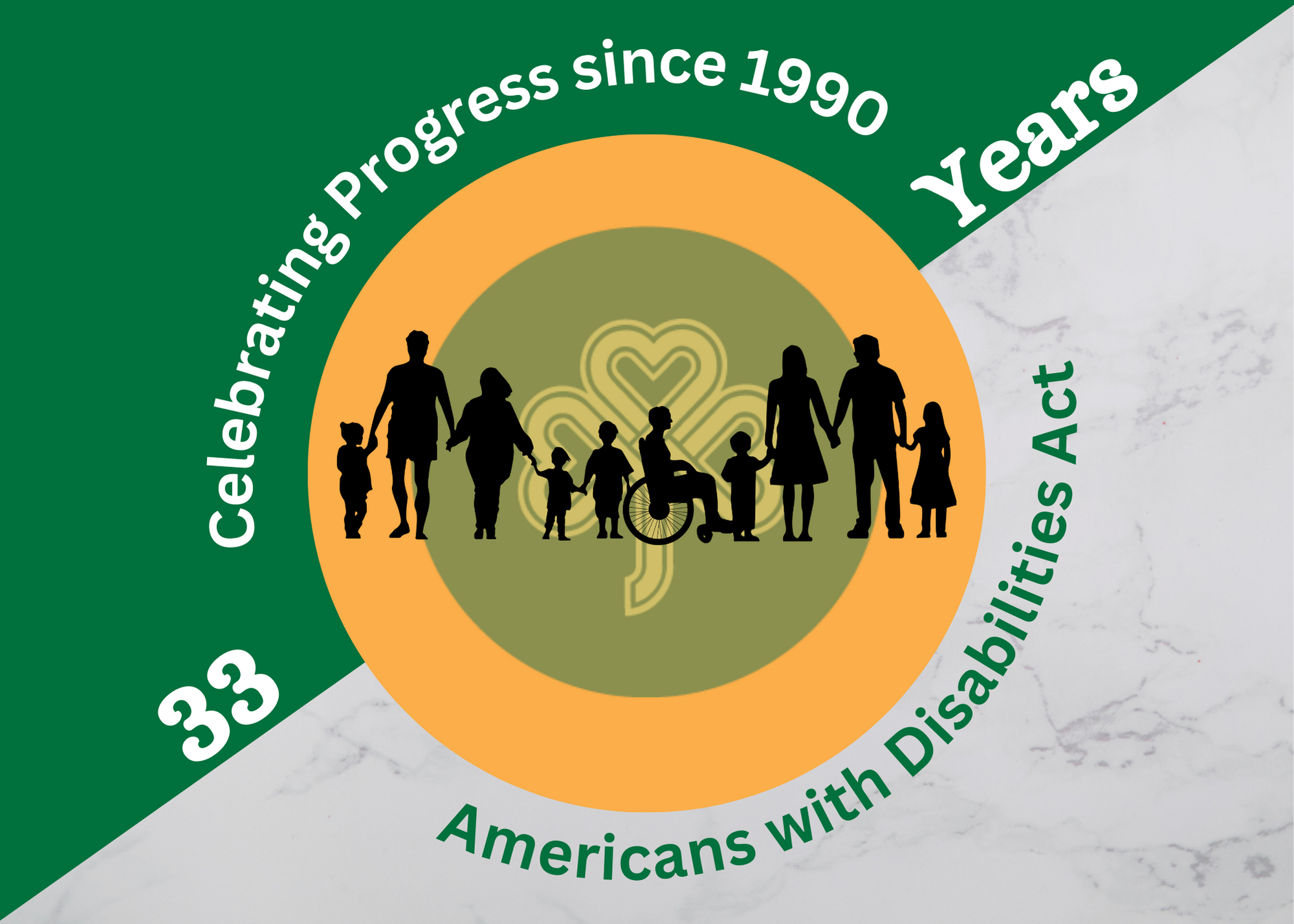
Celebrating 33 Years of Progress Since Signing of Americans with Disabilities Act 

Today we celebrate a second independence day in July. Yes, less known, but just as important! On July 26th, 1990, President George H.W. Bush signed the historic Americans with Disabilities Act (ADA), a civil rights law that prohibits discrimination against all individuals with disabilities in all areas of public life, including jobs, schools, transportation, and all public and private places that are open to the community at large. 

The ADA has helped millions of people with disabilities, their families, their friends, and society overall. We have seen many wonderful achievements since the passing of the ADA including, but not limited to: 

  • Employers are required to give all qualified individuals equal opportunity in the workforce, regardless of any disability they may have. This is perhaps the greatest impact of the ADA. 
  • Many physical accommodations have been implemented, such as the construction of curb cuts, ramps, automatic doors, public buses with wheelchair lifts, and countless forms of assistive technology. 
  • There has been incredible growth in the overall community’s attitude and mindset regarding people with disabilities. No longer are persons with intellectual disabilities hidden away at institutions; rather, we hear more and more success stories every day about what people with disabilities are accomplishing. You will see some of those stories on our webpage, www.barberinstitute.org

These achievements were made possible because of the perseverance and persistence of the visionary advocates who were not satisfied with the status quo. Dr. Gertrude Barber shattered numerous “glass ceilings” in her lifetime, but July 26th was the pinnacle of her efforts. As a member of President Kennedy’s Commission on Mental Retardation in the 60’s, she was involved in crafting initial legislation for the inclusion of persons with disabilities. She was invited to the White House by President George Bush to see this landmark legislation signed into law. She was so proud to be in attendance!  

Today we celebrate, remember, and thank those who fought for equal rights for persons with disabilities and honor them by living full lives in the community and maximizing every opportunity the ADA has made possible. The importance and need for advocacy in education, employment and community life can never be forgotten.  

Posted in Uncategorized | Leave a comment

Technology Makes a Real Difference for Our Students  

It’s hard to imagine our current world without technology. As modern technology becomes more innovative, we can use it to meet the needs of so many different learning styles.  

The Elizabeth Lee Black School is very fortunate to have received several grants that make it possible to expand the diversity of technology we can offer our students and staff to make their experiences as productive as possible.  

Here are some of the technology purchases we have made during the last school year:  

Samsung Smart TVs offer the best viewing experience for the user. These TVs are the best way to introduce our students to technology. The teachers will be engaging the students in video and audio learning by using educational videos, interactive games, and even using them as a whiteboard. The TVs are sturdy enough to withstand heavy use by the teachers and the students. And they all come with adjustable height mounts, so they are accessible to almost all students. In addition, the Smart TVs have a private broadcasting feature that allows teachers to stream what is displayed on the screen to students who are unable to attend in person and can join the classroom virtually. The Smart TVs are essential in our classrooms. 

iPads, which are made by Apple, are powerhouse PCs in the size of a tablet. They are an integral part of our tech ecosystem, and they provide an incredible service for the students and our staff. 

The Elizabeth Lee Black School has expanded the number of iPads in the classrooms by 35. With the remaining 15 new iPads, we are targeting students who may have an iPad at home, but because it’s their primary device, the family is reluctant to send it to school. The remaining will be used to replace outdated devices.  The iPad Pros will be assigned to Teachers and Support staff for use in case of remote learning. It also provides a standardized experience for all staff when joining virtual meetings. 

The Apple Studio will be used for video editing, mobile device management of the school’s iPad and iPad Pro devices & production of school media. 

The Lü Interactive Playground transforms any space into an active and immersive educational environment where children are engaged physically, intellectually, and socially-emotionally. 

The Elizabeth Lee Black School collaborated with the intermediate unit that serves our region to best identify vendors that install The Lü Interactive Playground. This spring, we were able to obtain our very own Lü Interactive Playground, which is on full display in the gym. 

A 30 Bay UV Clean & Charge Cart conveniently charges and cleans up to 30 devices at once. This unit is ideal for charging larger devices such as laptops, Chromebooks, and MacBooks. The simple One-Touch control system makes it easy to control the charging and UV-C disinfection cycles with the touch of a button. 

SMART interactive displays are boards interactive boards that allow for so much more beyond simply viewing materials.  They are a fun way to engage the students with learning. 

With these advancements in technology, a new world of opportunity has opened for our students! 

Posted in Uncategorized | Leave a comment

Extended School Year: An Opportunity for Enrichment, Growth, Learning, and Fun  

Yes, the school bells are ringing for students at the Elizabeth Lee Black School. 

We offer an Extended School Year (ESY) program and have, since 1979, when the federal court decision in Armstrong v Kline established this mandate in Pennsylvania. Here is some information on ESY:  

  • The Court found that the Commonwealth’s 180-day rule violated the classes and named plaintiffs’ right to a free appropriate public education under the Act.  
  • Not all students with IEPs are eligible for ESY.  The services the child receives include specialized instruction or related services that are part of the child’s IEP.   
  • There is no cost to the parent as the child is provided the services based on free appropriate public education (FAPE).  
  •  The Individuals with Disabilities in Education Act allows each school district or state to set its own rules for eligibility.   
  • The main criteria considered   are regression (losing skills) and/or recoupment (time needed to relearn skills). 

We have 120 children attending ESY. This might sound as if it’s just more schoolwork, but it isn’t. The students do fun activities both inside and outside that maintain the skills reflected on the IEP.  Our goal being that we do not want the students to regress during the summer so that it takes months to recoup the skills.   

I do think that we are fortunate to have this requirement in Pennsylvania.  Three months of vacation does not do justice for children with special needs. 

Posted in Uncategorized | Leave a comment

See You in July!

Our seniors have graduated. Our preschool children have moved on to kindergarten, and our staff are on vacation until July 3.  So, I have decided to take a hiatus from the blog.  I will be back again with the blog on July 3 with the start of Extended School Year.  I will see you then!  Enjoy the beginning of summer! 

Maureen 

Posted in Uncategorized | Leave a comment

Celebrating Our 2023 Graduates 

Monday was one of the highlights of our school year: Graduation! We have two ceremonies, one for our PreK Counts and Happy Hearts graduates (28 students) and one for our High School students (8 seniors).  Our Early Childhood graduation, held in the afternoon, had a gym packed with parents, siblings, extended families and lots of balloons.  The children sang and danced as a Thank You to their families. It was TOO CUTE! We were the first school experience for many of these children and now they are headed for kindergarten. Our High School graduation in the evening is more solemn as the students prepare to leave us for employment and/or various Adult Day programs.  

Graduation is both happy and sad for us.  We are happy that our students are moving on, but we are sad to say goodbye to these children and families who we have come to know throughout the years and have had the good fortune to work with as part of our team. Many of our high school graduates began as preschool children, and they are leaving here today as adults. This is a major step in the journey of their lives, and their family’s lives one that should be recognized for its significance. It is an act not only of personal commitment, but also of pride. They and their families have worked hard to get to this day. 

My challenge to each of our graduates is to continue to strive to achieve your full potential. The future is truly in your hands. You will always be a part of the Barber National Institute family. We are here for you as a resource, today, tomorrow and the years to come. 

When Dr. Barber established the Barber National Institute 70 years ago, it was to ensure that all children and adults had every opportunity to go to school, get jobs, and become active participants in the community. Each of our graduates and their families have met their goals through hard work, diligence, and dedication. We are proud of what our students have accomplished and are inspired by each of them. 

Congratulations to the Classes of 2023! 

Posted in Uncategorized | Leave a comment

How PNC Grow Up Great Is Promoting the Foundation for Future Success Among Young Children  

I had the opportunity to participate in the PNC Grow Up Great Advisory Board meeting last week. It is always a wealth of information, so I thought that I would share some of the key points with you. 

PNC celebrated its 19th annual Great Month, which occurs every April.  A host of in-person and virtual activities occurred across the PNC footprint.  Some included a Donors Choose flash fund with 1.9 million in teacher requests filled, 10,000 Can Do Cans were assembled by volunteers, 218 trikes and 218 wagons were built, school supply drives were conducted across all markets, to name but a few of the programs.  

Sesame Workshop announced a multiyear focus on children’s emotional wellbeing with research-based resources and Sesame content. Their strategies support all families from celebrating joyful, everyday moments to teaching children the skills they need to understand and manage their feelings. They also are addressing how to help caring adults recognize the signs of more serious mental health challenges. 

Steve Barnett summarized a National Institute for Early Education Research (NIEER) Fall 2022 survey.  The survey asked 1,000 parents of children ages 3-5 about their children’s experiences with preschool, and childcare with results compared to pre-pandemic data. Some of the findings were: 

  • Preschool enrollment has come back but not in the lower income groups (under 25,000K). 82% of families identified costs, and the absence of childcare. 
  • Concern remains regarding the continued drop in parents reading to children and the potential impact on early literacy.  85% read to the child pre-pandemic and 73% in Fall of 2022.   White families dropped from 91% pre pandemic to 78% Fall 2022. Hispanic families read 77% of the time whereas in Fall 2022 53% 
  • Educational level appears to impact reading as 47% with less than high school read to children vs 85% with a BA or higher read.  
  • 50% of children do not play outside every day. Why? Perhaps, Dangerous neighborhoods? 
  • How states set priorities for ECE can depend on the wealth of the state. 
  • Equity and justice in the community: Your neighborhood should not determine your success. 

PNC voluntarism continues to grow exponentially.  Great Month 2023 saw a 95% increase in employee voluntarism compared to Great Month 2022.  The impact on employees and participating organizations is significant. 

The collegiality of the meeting always leaves me with more food for thought…… 

Posted in Uncategorized | Leave a comment

The Role of Technology in the Mental Health of Children and Youth

For this week’s blog, I have invited Cecelia Hollands, the Director of Clinical Programming for Barber Behavioral Health, to discuss the role of technology in mental health, especially as it relates to children and youth. This is an especially timely topic considering May in Mental Health Awareness Month. Although technology does present challenges, it also, under the right circumstance, has the potential to connect people.

Cecelia is a licensed professional counselor who has worked in mental health in the Erie area for ten years in various roles, including as a psychiatric rehabilitation specialist, mobile therapist, and outpatient therapist.  In addition to her work at the Barber National Institute, Cecelia also serves on the Board of the White Pine Center for Healing. 

I want to thank Cecelia for offering her perspectives and wealth of expertise on this topic.

___________________________________________________________________________________

Several weeks ago, I presented at a mental health fair to a group of parents on the topic of the role of technology as it pertains to mental health in children and youth.  As I was preparing for the presentation, I began thinking about my own experiences parenting my two-and-a-half-year-old.  I was reminded of an incident that occurred about a month ago, when I had momentarily left my daughter in the living room so that I could retrieve something to drink for her.  As I was filling her sippy cup, I became aware that the theme song from Blippi was playing somewhere in the background.  When I returned to the living room, my daughter was relaxing comfortably on the couch, remote in hand, watching her program.  In the minute or two it had taken me to get her a drink, she had picked up the remote, turned the television on, and selected Blippi from the Netflix menu.  I was stunned!  Though I was amused more than anything else, I was also mildly concerned that, at just two-and-a-half, she had the wherewithal to use the TV independently.  In that moment, I was reminded of just how ubiquitous technology is and how my daughter will never know a time when tablets and smartphones are not part of everyday life.  Research is clear that the question is not whether technology impacts the development of children and adolescents, but how.

            The most current research suggests that children and adolescents who spend more than one hour per day on a mobile device are at increased risk for developing depression and anxiety.  According to the Pew Research Center, 95% of U.S. teens use a smartphone and 45% of those users report that they are online “almost constantly.”  In fact, a study by Common Sense Media found that the average American teenager spends an average of nine hours per day using technology; the average for eight to 12-year-olds was six hours.  Essentially, “the vast majority of American children and adolescents are spending six to nine times more time with technology than is required to begin experiencing negative mental health symptoms” (Common Sense Media).

            In addition to putting children and youth at greater risk of developing depression and anxiety, excessive technology use can also contribute to distractibility, poor emotion regulation, difficulty completing tasks, and difficulty making friends.  Technology use affects us on a neurological level as well and is associated with both transient changes in arousal and mood and long-term changes in behavior and brain function.

            It’s difficult to discuss technology use amongst children and teens without addressing the impact of social media.  Research by the Child Mind Institute supports the hypothesis that social media use can be detrimental to self-esteem.  Excess time spent on social media can lead children and youth to judge their value based on “likes” and increases the likelihood of weight dissatisfaction and self-objectification.  A 2015 poll found that the average 16 to 25-year-old woman will spend over five hours per week taking “selfies.”  Disturbingly, a 2018 poll from the American Academy of Facial Plastic and Reconstructive found that 42% of surgeons were asked by their patients to perform procedures that would improve one’s appearance in selfies.  In fact, there is now a term for children and youth who fixate on their appearance due to social media:  selfie dysmorphia (sometimes called Snapchat dysmorphia).  Fixation on one’s appearance can lead to more serious issues, such as body dysmorphic disorder, anxiety, and depression.

            Social media has also created another pathway for children and teens to bully one another.  Cyberbullying is linked to an increased risk of depression, and frequently, victims suffer in silence, so parents and caregivers may be completely unaware that it is even occurring.  Some studies have shown that the effects of bullying can be as bad as or worse than childhood abuse.  According to research by the Pew Research Center, 46% of youth report having been bullied online.  A similar poll from the Cyberbullying Research Center found that 13% of youth reported having bene perpetrators of cyberbullying.  Interestingly, “bully-victims,” or those who both are targeted and target others, are most at risk for developing depressive symptoms.

            All this is not to say that technology is without merit.  Throughout the pandemic, it was the ability to provide telehealth sessions that enabled clients to continue their mental health treatment without risk of exposure to COVID-19, not to mention the innumerable apps that have been developed to give users instant access to mindfulness exercises, meditation exercises, and psychoeducation on their diagnosis.  Social media can be used as a tool to connect to others via online support groups and for therapists to connect to each other to help clients obtain care with providers who specialize in treating certain diagnoses.  The key is for parents and caregivers to teach children and adolescents how to use technology safely and responsibly.  To establish safe guidelines for technology use:

  • Don’t overreact.  Technology isn’t going anywhere, so we need to teach healthy habits early.
  • Teach children about responsible online activity, especially in the areas of safety/privacy.  Make sure they know that they can speak to an adult if someone online is engaging them in scary or hurtful information.
  • Use your judgment.  Establish tech-free zones and determine what counts as screen time (for example, does doing homework count?  Video chatting with a friend?)
  • Protect bedtime.  Limit technology use for 30 minutes before your child or children go to sleep.
  • Pay attention.  Discuss with your child what types of sites are off-limits and don’t allow them to have their phone or tablet in their room.
  • Teach (and model) good online behavior.  Discuss cyberbullying, what to do if they witness cyberbullying, and over-sharing online.
  • Foster real-life friendships.  Help your child develop social skills and “real-life” relationships.

For better or worse, technology is here to stay.  To protect children and youth from technology’s potential deleterious effects on their mental health, parents and caregivers must not only help children learn about safe, balanced, and healthy habits, but also to model those habits on a daily basis.

Cecelia Hollands, MA, LPC

Posted in Uncategorized | Leave a comment